

-

不懈追求切割:从石器时代开始
十万年前,我们的祖先用雕刻石头制成的“打制石器”屠宰猎物。其中尤为值得注意的是一种被称为“手斧”的工具,它被认为是现代刀具的直接祖先。即使在日本,直到弥生时代中期,石器也作为食物加工的主要工具,持续了长达十万年之久。
想象一下,我们的远古祖先手持石头,一遍又一遍地雕刻,试图打造出理想的刀刃。他们纯粹的“更高效地切割”的渴望,成为了人类技术创新的驱动力。
-

失落传奇之谜:“大马士革钢”
世界刀具史上最神秘、最迷人的存在莫过于“大马士革钢”。它的根源在于印度的“乌兹钢”,乌兹钢因重量轻、坚韧、防锈、拥有压倒性切削力而被称为“传奇钢材”。
然而,我们今天面临着一个令人震惊的事实:这项非凡技术的制造方法已经完全失传,如今看来,完整复制也已困难重重。中世纪工匠们掌握的知识和技术为何会失传?这个谜团至今仍是现代技术专家面临的最大挑战之一。
-

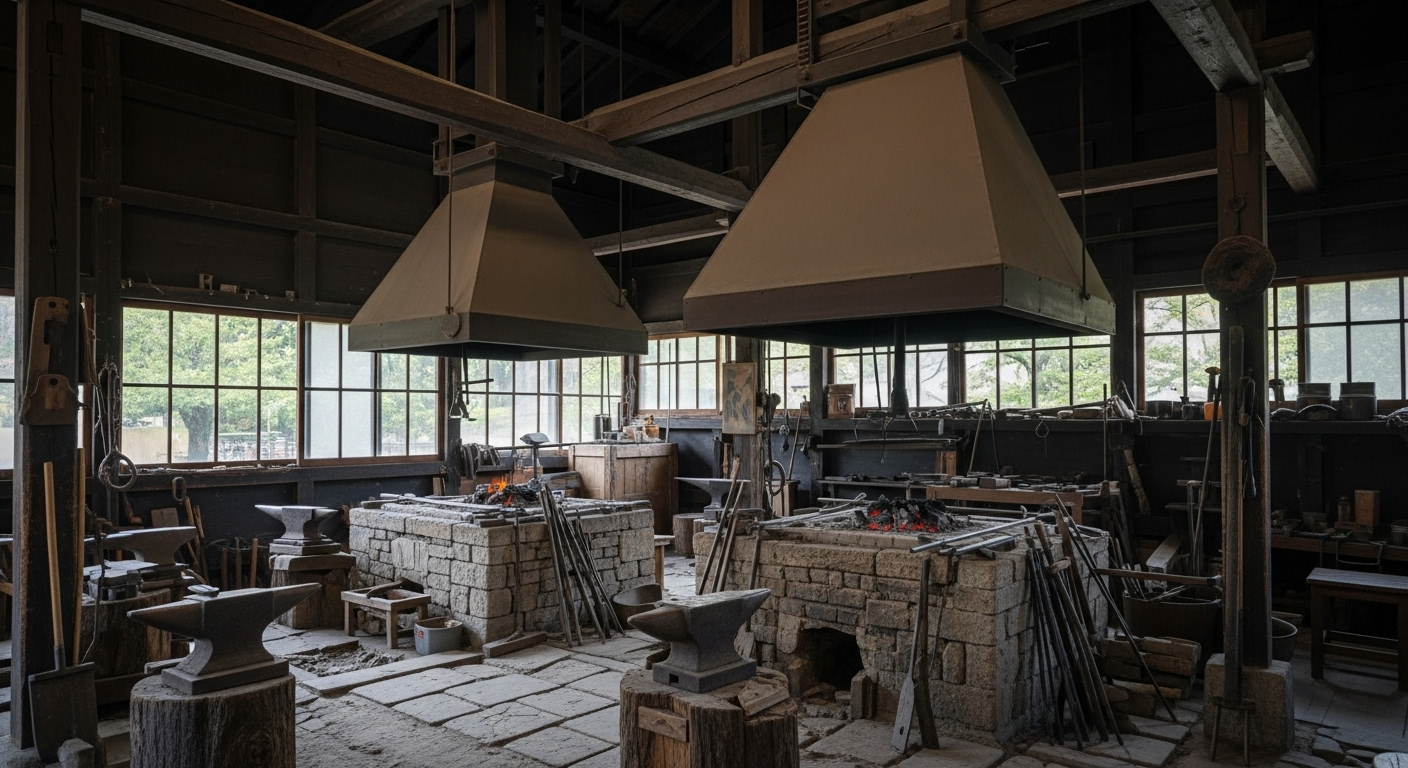
改变刀片世界的工业革命
1856年,贝塞麦炼钢法的发明,使钢铁生产成本从每吨40英镑大幅降低到6-7英镑,这项技术革新也给刀片行业带来了革命,开启了大规模生产的新纪元。
然而,这里却引发了一场有趣的争论。虽然机器化的大规模生产确实带来了质量的提升和广泛的应用,但也有人批评工匠手工技艺所蕴含的“光环”正在消失。效率与传统价值观之间的平衡——这是我们今天面临的普遍挑战。
-

未来之刃:科技与文化的和谐
刀具的历史是一面镜子,映射着人类的技术创新和文化多样性。从石器到最新的复合材料,我们不断追求更优质的工具,并不断发展。然而,与此同时,效率的阴影下,也有一些事物逐渐消逝,例如失传的乌兹钢制造工艺和工匠的“气质”。
今天,你们手中的这把刀,是人类十万年智慧与热情的结晶。刀刃上蕴含着我们对美好生活的不懈追求,以及对文化的深挚热爱。明天早晨,当你准备早餐时,请记住这段伟大的故事。你们也是这段悠久历史的一部分。


2.6 Million Years of the Same Idea
-

What Has and Has Not Changed
Consider what is different about a modern Japanese knife compared to a Paleolithic stone blade. The steel is hardened to precise specifications and contains carefully controlled proportions of carbon, chromium, and tungsten. The handle is shaped ergonomically, from wood selected for weight and grip. The edge is ground to an angle measured in fractions of a degree, refined on whetstones of increasing fineness, capable of separating individual cells without rupturing them.
The sophistication is real, and it is the product of millennia of accumulated understanding.
Now consider what is the same. There is still a blade. There is still a handle. A human hand still wraps around it. And the act it performs is still, at its core, the act of cutting — of separating one thing from another with controlled, directed force.
The 2.6-million-year gap between the first stone flake and the yanagiba on a sushi chef's bench is filled with human ingenuity. But the shape of the solution — the shape that every generation of makers arrived at independently, across every culture that developed tools — is the same shape. Blade. Handle. Hand.
There is something profound in the persistence of a form across that span of time. It suggests that the solution was correct from the beginning — that the human body, and the human need to cut, defined the answer, and that every civilization that has tried to answer that question differently has eventually come back to the same place.
-

The Knife That Connects Us to Everyone Who Came Before
There is a particular quality of emotion that some objects produce — objects that have been used by many people across many generations, that carry in their form the accumulated decisions of all those who came before. An old cathedral. A well-worn path across a mountain. A piece of music that has been performed for three hundred years.
A knife is this kind of object.
When a Japanese chef picks up a yanagiba in Osaka today, they are performing a gesture that a cook performed in that same city during the Edo period, and in China during the Tang dynasty, and in ancient Rome, and in the kitchens of the first agricultural settlements in the Fertile Crescent. The specific knife is different. The steel is different. The form of the handle is different. But the gesture — the grip, the pull, the separation of flesh from bone — is the same gesture, made by human hands, across thousands of years.
There is a word in Japanese — mono no aware — that describes a particular kind of bittersweet awareness of the transience of things, and the beauty that this transience contains. Something of that feeling attaches to the knife. This specific knife, in this specific hand, today — but also a chain of knives, and a chain of hands, stretching back further than any family memory or historical record can follow.
The knife is not a relic of this chain. It is a living link in it. Every time a hand wraps around a handle and a blade moves through an ingredient, the chain extends by one more gesture.
-

Why the Simplest Things Last
The history of technology is full of solutions that were superseded — tools that were made obsolete by a better idea, a better material, a better method. The wheel was not abandoned when the axle was invented; it was combined with the axle, and the new form superseded the old. The bow and arrow gave way to the firearm. The scroll gave way to the codex, and the codex to the printed book, and the printed book to the screen.
The knife did not give way. It was combined with better materials and more refined methods, and it became better. But its fundamental form was never superseded, because the fundamental form was already the correct answer.
This is what distinguishes tools that endure from tools that are replaced. A tool that endures does so because it answers a need that does not change. The need to cut — to separate, to shape, to prepare — is as fundamental to human life as it has ever been. As long as there are ingredients to be prepared and hands to prepare them, there will be a need for a blade, a handle, and the gesture that connects them.
The knife answers this need with a directness and completeness that no subsequent technology has improved upon. A blender chops. A food processor slices. A laser can cut steel to tolerances that no human hand can match. But none of these things are a knife, and none of them do what a knife does — the direct, tactile, responsive act of a skilled hand moving a blade through an ingredient with intention and control.
This is why, in the most advanced kitchens in the world, alongside every piece of modern equipment, there is always a knife rack. The 2.6-million-year-old idea has not been surpassed.
-

The Romance in Your Hand
The word "romance" is often used carelessly, to mean a vague feeling of sentiment attached to old things. That is not what the knife's romance is.
The romance of the knife is something more specific: it is the awareness that an ordinary object — this blade, this handle, this edge — participates in something that extends far beyond the meal being prepared, far beyond the kitchen you are standing in, far beyond your own lifetime.
When you pick up a knife, you are holding a form that your most distant ancestors would recognize. You are performing a gesture they performed. You are participating in the oldest practical skill that human beings have — the skill of using a blade to shape the world.
The knife is the oldest companion of human beings in the work of living. Not the most dramatic tool, not the most powerful, not the most sophisticated. But the most persistent, the most universal, and in a quiet way, the most human. Every culture that has ever existed has made knives. Every cook who has ever worked has relied on one. Every meal that has ever been prepared has been touched by the edge of a blade.
This continuity is not accidental. It is the shape of a relationship — between human beings and the need to cut, sustained across more time than the mind can easily hold.
-

What It Means to Hold a Japanese Knife
Within this long history, the Japanese knife tradition represents something specific: the most sustained, the most deliberate, and the most refined pursuit of what a knife can be.
The craftsmen who forged knives in Sakai during the Edo period were not simply making tools. They were refining an answer — pushing the fundamental form toward the limit of what the available materials and methods allowed. The single bevel. The urasuki. The pulling cut. The KIREAJI that measures sharpness not in the hand but on the tongue. These are not features of a tool. They are the results of centuries of people asking, with extraordinary seriousness, how well the oldest human idea can be executed.
When you hold a Japanese knife — when you feel the weight of it, the specific balance, the edge that was ground to a standard measured in the flavor of the food it cuts — you are holding the current answer to a question that has been asked for 2.6 million years.
It is not the final answer. There will be craftsmen in the future who know things that no craftsman alive knows today, who will push the form further than it has been pushed before. The conversation between humans and the blade is not over.
But this knife, in this hand, today, is a moment in that conversation. And that moment — ordinary and extraordinary at the same time, a Tuesday afternoon in a kitchen and 2.6 million years of human ingenuity simultaneously — is what the romance of the knife actually is.
You are not just cooking. You are holding the oldest tool in the world, and continuing the longest story ever told by human hands.


世界上最古老的刀是什么刀?
已知最古老的工具于 1960 年在非洲坦桑尼亚发现,距今约 180 万年。这是已确认的最古老的工具,可视为现代刀具的原型。对此的研究仍在继续发展。
为什么要发明刀?
据信,古代人类使用由凿石制成的“石器”来狩猎、剥皮和切肉。这些工具对于采集和准备食物都是必不可少的,可以看作是刀具的起源。
刀尖为什么是尖的?
为了提高锋利度,必须将力集中在锋利的尖角上,以打破材料的键。一旦开始切割,刀片的楔形形状可使切割过程顺利进行。您可能见过寿司厨师用长生鱼片刀切鱼,以一个流畅的动作将刀片拉向鱼。
Q4. 刀具是什么时候开始专门用于烹饪的?
刀具最初是万能的生存工具,但随着人类社会的发展,烹饪逐渐演变成一种文化实践。在埃及、希腊和中国等古代文明中,刀具的改良逐渐用于食物准备,而非狩猎或战斗。在日本,这种专业化在江户时代(1603-1868)达到顶峰,当时日本料理的多样性激发了人们创造出用于烹饪鱼类、蔬菜和肉类的独特刀具。这种演变反映了刀具不仅成为生存工具,也成为烹饪艺术的工具。


KIREAJI 对您的三个承诺
-

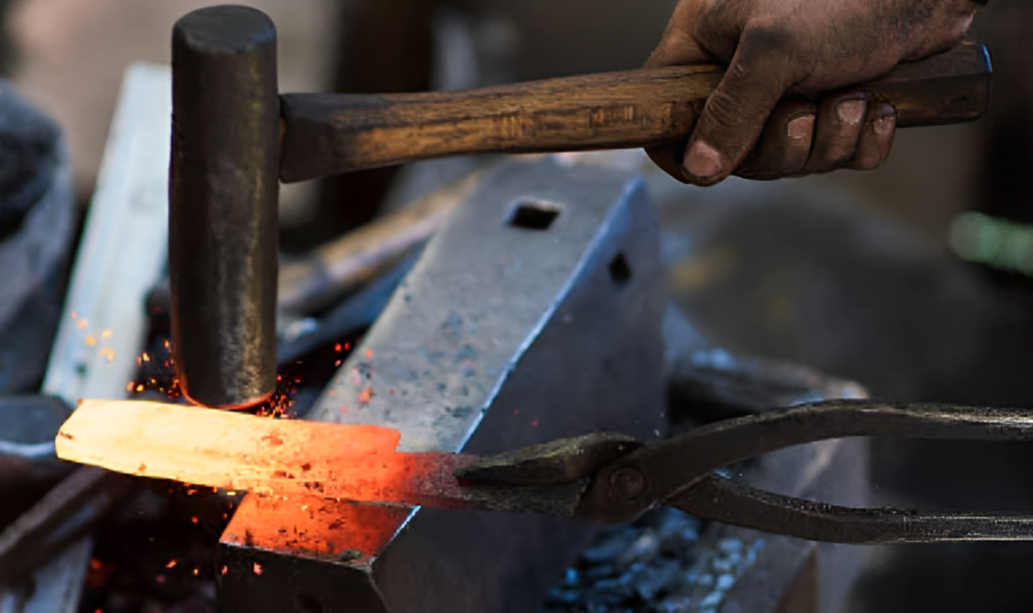
1. 秉承堺的遗志
堺市——日本著名的专业厨刀发源地——每一把刀都由拥有超过六个世纪传统的工匠精心打造。完美平衡、持久锋利、精湛工艺,每一次切割都蕴含着真正的工艺精髓。
-

2. 贴心呵护,呵护您的日常使用
每把刀都配有手工镶嵌的木兰刀鞘,方便安全存放。我们可根据您的要求提供免费的“本刃付”手工磨刀服务,让您从第一天起就能拥有精准的刀刃。
-

3. 终生的伙伴关系
KIREAJI 刀不仅仅是一件工具,更是您一生的伴侣。我们提供定制的付费售后服务,以维护其锋利和美观,确保它始终如初,精准可靠,如同初次接触您的手。


