

Caring for Your Knife — and Your Culinary Journey
-

Repairs by Shiroyama Knife Workshop
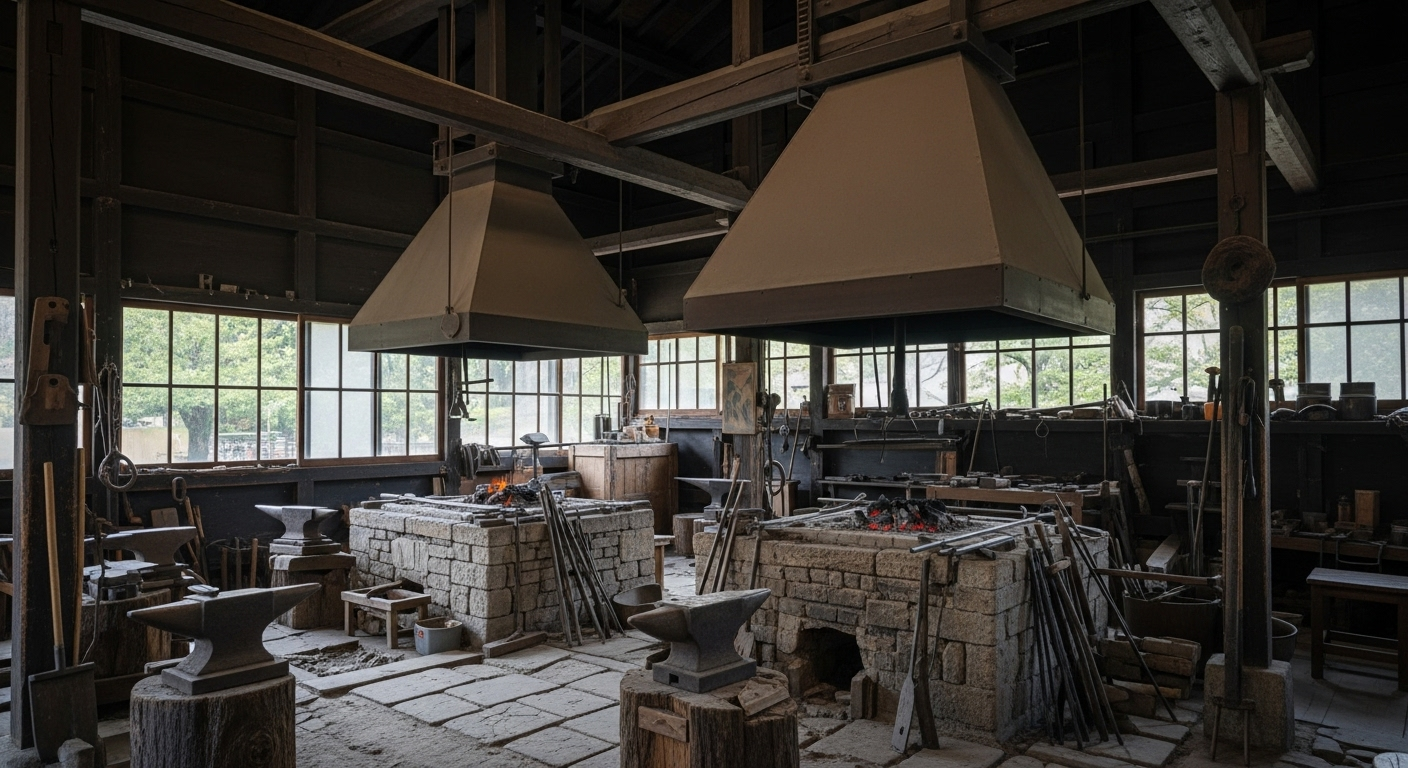
All services are carried out by the Shiroyama Knife Workshop — the very workshop that produces KIREAJI knives.
Every repair is performed by skilled craftsmen,
with the same precision, care, and respect
as when the knife was first made.

Repair Process
-

STEP 1
Please submit the details of your repair or maintenance request through our inquiry form.
-

STEP 2
Our team will consult directly with the Shiroyama Knife Workshop
to confirm whether the repair is possible.
We will then provide a detailed cost estimate by email. -

STEP 3
Once you agree with the estimate,
we will kindly ask you to proceed with payment via PayPal. -

STEP 4
Please send your knife to the Shiroyama Knife Workshop.
Kindly note that shipping costs are the responsibility of the customer. -

STEP 5
Your knife will be carefully repaired by skilled craftsmen,
with the same precision and respect as when it was first made. -

STEP 6
After completion, we will securely ship your knife back
to the address you provided,
taking every precaution to ensure safe delivery.


For Repair Inquiries
KIREAJI Artisan Repair: A Service That Preserves Your Knife for Life
-

Your KIREAJI knife is supported by a repair service performed by the same Sakai artisans who forged it.
Submit your request, approve the estimate, and send in your knife.
Our craftsmen restore it with its original precision and respect, ensuring your knife remains a lifelong culinary partner.


Before Using a Japanese Knife
A knife is more than a tool—it’s the heart of cooking. Learning how to use it properly helps protect its quality, durability, and safety, so you can enjoy it for years while elevating every meal.

Japanese Knife Care
With the right daily care, your knife will stay sharp and reliable for a long time. Here, we share the key points to keep it in peak condition and extend its lifespan.

The Knife That Outlasts Everything Else in Your Kitchen
-

The World We Live In, and What It Has Cost Us
We live in an era of designed obsolescence. The things we use are made to be replaced. The phone that was excellent three years ago is now inadequate. The appliance that seemed like a permanent acquisition has a lifespan counted in years, not decades. The expectation, built into the design of almost everything we buy, is that it will eventually stop working and be discarded.
This is efficient, in a narrow economic sense. It keeps factories running and markets moving. But it has cost us something that is harder to name — the experience of genuine ownership. The experience of having something that becomes more yours over time, rather than less relevant. The experience of a relationship with an object that deepens with use rather than degrading with it.
A Japanese knife made in the traditional way is a direct refusal of this logic. It does not become obsolete. It does not have a lifespan in the conventional sense. It wears — very slowly, in ways that are the natural consequence of honest use — but it does not degrade. A knife that has been sharpened a thousand times is thinner than the knife that left the workshop, but it is not diminished. It is, in the understanding of Japanese craft culture, more fully itself. The sharpening has revealed the steel. The use has personalized the geometry. The history of its owner lives in its shape.
-

What a Japanese Knife Actually Requires of You
To own a Japanese knife well is to accept a relationship — not a transaction. And a relationship, unlike a transaction, involves ongoing commitment.
The commitment is not onerous. It is, in fact, quite simple: care for the knife, and the knife will care for your cooking.
Wipe the blade after each use. Dry it completely before putting it away. Do not leave it in water, and do not put it through a dishwasher. These are not the maintenance demands of a fragile object — they are the respectful habits of someone who understands what they are working with. Carbon steel that is dried immediately after use develops a patina rather than rust. The grey-brown surface that a well-maintained carbon steel knife gradually acquires is not deterioration. It is the visible record of the knife's working life, and in Japanese craft culture it is considered beautiful — the beauty of something that has been genuinely used.
Sharpen it regularly. Not because sharpening is a chore to be endured, but because the relationship between a cook and a well-maintained knife — the knowledge of how this specific steel responds to this specific stone, the understanding that accumulates over years of sharpening this particular blade — is one of the most direct expressions of craft ownership that cooking offers. The cook who sharpens their own knife knows their knife. They know where it is thicker, where it responds more readily, what angle produces the best result for the work they do. This knowledge is not transferable. It belongs to the relationship between one person and one knife, and it deepens over time.
Use a wooden cutting board. The fine edge of a Japanese knife is not designed for glass or hard plastic — those surfaces accelerate edge degradation in ways that compound over time. A wooden board yields slightly to the blade, absorbing the end of each stroke rather than deflecting it. This small accommodation is the correct environment for a fine edge, and it costs nothing to provide.
Store it with care. A knife block, a magnetic strip that holds the blade away from the faces of other knives, or a wooden sheath — any of these is correct. A drawer where the blade contacts other metal is not. The edge that was refined through careful sharpening should not be undone by careless storage.
-

The Knife That Was Made for Your Grandchildren
Here is a thought that is worth sitting with: the knife you are holding was made to outlast you.
Not in a melancholy sense. In the most generous sense — the sense that the craftsman who made it brought to their work not just the intention that it should function today, but the intention that it should still be functioning in fifty years, in a hundred years, in hands that have not yet been born. The steel chosen, the heat treatment applied, the geometry established — all of these decisions were made with that timeframe in mind.
In Japan, it is not unusual for a knife to pass from parent to child, from grandparent to grandchild. The knife that a chef used for thirty years is not, at the end of those thirty years, a tired object approaching obsolescence. It is a knife at the height of what it can be — shaped by decades of use and sharpening to fit one specific pair of hands, carrying in its geometry the accumulated decisions of someone who knew it completely. When it passes to the next person, it brings with it everything that was put into it: the craftsman's skill, and the previous owner's thirty years of relationship with it.
This is the inheritance that a Japanese knife makes possible. Not the sentimental inheritance of an object kept in a drawer because it is too precious to use. The living inheritance of a tool that is passed on still sharp, still capable, still offering what it offered on the day it was made — and offering, in addition, the visible history of everything it has been through.
-

The Repair That Extends Everything
One of the specific ways that a Japanese knife differs from most kitchen equipment is that it is fully repairable — not as an engineering achievement, but as a practical reality of daily kitchen life.
A chipped edge can be restored. A handle that has worn can be replaced. A blade that has been sharpened for twenty years to an angle that no longer quite fits the cook's current technique can be re-profiled. None of these represent the end of the knife's useful life. They represent moments of renewal — opportunities to bring the knife back to full capability, or to adjust it to what the cook has become rather than what they were when they first acquired it.
The handle, in particular, is worth noting. The wooden handle of a Japanese knife is not merely decorative. It is functional, and it is personal — the shape and material that the cook chooses when they replace a handle is a choice about how the knife will feel in their hand for the next decade. This is a form of customization that factory-produced knives cannot offer, and that most Western knives do not invite.
A knife that can be endlessly repaired and adjusted is a knife that has no natural end point. Its useful life is not determined by the rate at which it degrades. It is determined by the attention given to it and the skill of the craftsmen available to maintain it.
-

What We Hope For
When a knife made by the craftsmen of Sakai leaves the workshop and enters a kitchen — in Tokyo, in London, in Melbourne, in Toronto — what we hope is simple.
We hope that it cuts well on the day it arrives. We hope that it is sharpened, and that the sharpening teaches the cook something about the steel. We hope that it is used for the work it was made for, and that in that use it earns the care that it needs. We hope that it is passed on, eventually — to a child, to a student, to someone who will value what it represents.
And we hope that somewhere, many years from now, someone will pick it up and feel what we hoped they would feel: that this knife was made by a person who cared, for a person who would care, with the full expectation that it would still be doing what it was made to do, long after everyone who made it is gone.
That is what a traditional craft object is. That is what a Japanese knife is for.
Use it. Care for it. Pass it on.



KIREAJI's Three Promises to You
-

1. Forged in the Legacy of Sakai
From Sakai City—Japan’s renowned birthplace of professional kitchen knives—each blade is crafted by master artisans with over six centuries of tradition. Perfectly balanced, enduringly sharp, and exquisitely finished, every cut carries the soul of true craftsmanship.
-

2. Thoughtful Care for Everyday Use
Every knife includes a magnolia wood saya, carefully selected and prepared to help protect the blade during storage. Upon request, we also offer complimentary Honbazuke, an initial hand-sharpening intended to prepare the knife for practical use.
-

3. A Partnership for a Lifetime
A KIREAJI knife is more than a tool—it is a lifelong companion. With our bespoke paid aftercare services, we preserve its edge and beauty, ensuring it remains as precise and dependable as the day it first met your hand.


