

-

Why KIREAJI Exists
We believe one simple truth:
A culture survives only if there are people who use it, and people who speak about it.
Craftsmanship does not survive in museums.
It survives in hands, in kitchens, in daily life.
Outside Japan, however, the market is flooded with mass-produced “Japanese-style” knives
products that imitate the appearance, but lack lineage, human story, and depth.
As a result, true craftsmanship becomes invisible.
And when it becomes invisible, it disappears.
KIREAJI exists to prevent that from happening.
Our purpose is not simply to sell knives.
Our purpose is to preserve, transmit, and root authentic Japanese knife heritage in the world. -

Protecting Tradition by Letting It Live
Tradition is not something to preserve untouched.
It is something to keep alive.
In Sakai, centuries-old techniques still form the foundation of every blade.
But for this craft to endure, it must continue to be used, understood, and valued in the modern world.
Innovation does not replace tradition.
It protects it.
It keeps the spirit of craftsmanship relevant and capable of being passed on to the next generation. -

Carrying the Legacy Forward
What we protect at KIREAJI is not steel and sharpness alone.
Each knife is an enduring story
shaped by generations of skill, patience, and devotion.
When a knife leaves the hands of an artisan and enters a kitchen somewhere in the world,
the heritage continues.
That is why KIREAJI exists.
Not to sell tools.
But to keep a craft alive.


2. What We Do (What)
-

A Blade as a Cultural Ambassador
Each knife we send carries more than function.
It is a cultural ambassador, born in Sakai, refined by human hands,
and destined to live in kitchens around the world.In a global market flooded with “Japanese-style” knives,
appearance is easy to imitate.But heritage is not.
What makes a true Sakai knife different is not only how it cuts,
but where it comes from, who made it, and why it exists.That is what KIREAJI delivers.
-

More Than Tools. More Than Products.
We do not treat knives as disposable tools.
We present them as:
- Partners in cooking
- Vessels of craftsmanship
- And bridges between cultures and generations
When you choose a KIREAJI knife,
you are choosing to participate in a living tradition. -

Rooted in Sakai, Connected to the World
Source (98% data): Sakai Tourism BureauEverything we do begins in Sakai.
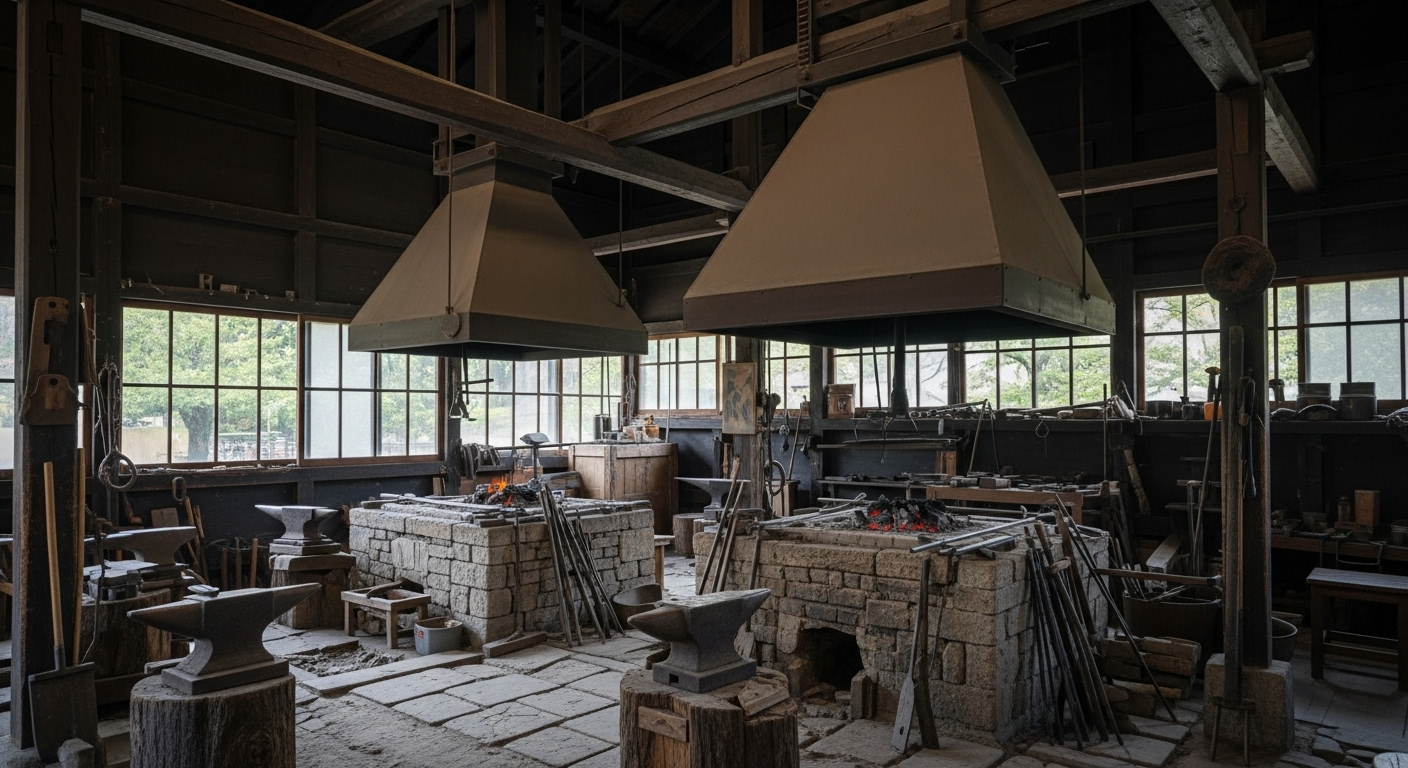
A city where knife-making has been refined for more than 600 years,
and where craftsmanship is still sustained by human hands, not machines.
Sakai knives are trusted by approximately 98% of professional chefs in Japan,
not because they are merely tools,
but because they represent a legacy of reliability, balance, and precision.


3. How We Do It (How)
-

(1) Direct Connection to Sakai
Global Delivery from SakaiEverything begins with people.
We work directly with Shiroyama Knife Workshop in Sakai,
one of the few workshops that still protects the true division-of-labor system.
For every knife, you will know:
- Who forged it
- Who sharpened it
- And why it is the way it is
This direct connection allows us to protect both quality and integrity. -

(2) The Hidden Process Behind Every Blade
Traditional Craftsmen CollectionA true Japanese knife is not born in a single moment.
From forging and heat treatment to grinding and sharpening,
each blade passes through more than 30 meticulous steps.
While mass production is built on shortcuts,
true craftsmanship is built on patience.
That is why we do not chase volume.
And that is why our knives cannot be rushed. -

(3) Education Comes First
Japanese Knife AcademyWe do not believe in “selling first, explaining later.”
Through:
- Japanese Knife Academy, covering topics from steel types to sharpening techniques
- Books, articles, and visual guides
- In-depth explanations of structure, history, and use
We build understanding before purchase.
Our philosophy is simple:
Know → Use → Share
A knife becomes heritage only when it is understood and spoken about.


-

(4) Fair and Honest Value
Our Thoughts on PricingWe believe great craftsmanship deserves honest value.
By working directly with workshops and eliminating two to three layers of traditional distribution,
we ensure artisans are fairly rewarded for their skills.
At the same time, we do not inflate prices through branding or speculation.
We do not discount.
We do not chase price competition.
We price our knives to reflect:
- The work behind them
- The people behind them
- And the craft they carry


Why We Exist
Why does KIREAJI exist?
Behind every knife is a reason for being—and a culture we are trying to protect.

How We Decide
The Four Principles of KIREAJI
Everything we do is guided by four clear principles. They define what we stand for—and what we will never compromise.

What Cannot Be Copied: The Meaning Behind Sakai Knives
Technology and design can be copied, but meaning cannot.
While many knives imitate the look of Japanese blades, authentic knives from Sakai, Japan carry over 600 years of craftsmanship and cultural heritage. Through KIREAJI, we share the meaning behind these knives and invite people around the world to Know, Use, and Share the spirit of Sakai.
KIREAJI: The Japanese Concept That Will Change How You Think About Your Knife
-

What KIREAJI Actually Means
Kire means to cut. Aji means taste, or flavor. Taken literally, KIREAJI is the flavor of the cut — the taste that the act of cutting leaves behind in the food.
In everyday Japanese, KIREAJI is used loosely to mean sharpness. But in professional culinary and knife-making circles, it carries a much more specific and demanding meaning: the state in which a blade has been refined to the point where the person eating the food notices a difference.
Not the person cutting. The person eating.
This distinction is everything. Most languages have words for a knife being sharp enough to feel good in the hand. No other culinary tradition has a word for a knife being sharp enough to make the food taste better. That word is KIREAJI — and its existence reveals something profound about how Japanese culinary culture understands the relationship between a tool and the food it produces.
-

Two Levels of Sharpness — Only One Is KIREAJI
Japanese culinary culture draws a clear line between two states that most other languages treat as the same thing.
The first is a knife that cuts well for the cook — efficient, responsive, moving through ingredients without resistance. This is a real and valid standard. Most sharpening stops here, and for many purposes, it should.
The second is KIREAJI — a knife that has been refined beyond functional sharpness into a state where the food it produces tastes different. Better. More itself.
Achieving KIREAJI requires a level of edge refinement that goes beyond efficiency. At a certain point, the edge becomes fine enough that cellular compression during cutting is genuinely minimized. The food that results is measurably different in flavor. And this is the standard that Japanese professionals apply when they evaluate a knife: not how it feels in the hand, but whether the food it cuts tastes the way the ingredient actually should.
-

A Word the World Needs
Japanese has given the culinary world several words that proved too useful to leave untranslated. Umami — the fifth taste — required a Japanese word because no Western language had named the concept. Dashi — the delicate stock that underlies Japanese cuisine — required its own word because nothing in European culinary vocabulary captured it precisely.
KIREAJI is in the same category. It names something real — a standard of sharpness measured not in the hand but on the tongue, a quality of the cut that shows up in the flavor of the food — for which no equivalent word exists in English, French, or any other culinary language.
Once you have the word, you cannot unknow it. You will taste the difference between food cut with KIREAJI and food cut without it. You will sharpen differently, choose your knives differently, and understand what Japanese knife culture has always understood: that how you cut is part of how you cook, and that a blade refined to true KIREAJI is not just a better tool.
It produces better food. And better food is the only measure that matters.


