Types of Knives: Modern & Versatile Knives
-
Everyday Versatility, Modern Adaptation
Japanese knives are not only about centuries-old tradition—they are also about evolution and versatility. As Japanese cuisine encountered Western influences, new blade types emerged to meet the needs of both professional chefs and home cooks. The Gyuto, Japan’s answer to the chef’s knife, and the Santoku, beloved in households for its all-purpose balance, embody this modern spirit. Alongside them, smaller companions like the Petty knife handle detail work with precision.
In this section, we will also explore how Japanese craftsmanship adapts to individuality, such as in the making of left-handed knives. These blades represent not only technical skill but also inclusivity and respect for each cook’s unique style. Whether you are preparing large cuts of meat, delicate garnishes, or seeking the right fit for your dominant hand, modern Japanese knives demonstrate how tradition and innovation continue to evolve side by side.
They are the tools of today, forged with the soul of yesterday—bridging heritage with the needs of modern kitchens.
-
Gyuto: The Japanese Evolution of the Chef’s Knife
-
Gyuto — A Cultural Bridge Between East and West
The Gyuto is Japan’s answer to the Western chef’s knife, born in the Meiji era when European cutlery entered Japanese kitchens. Its name literally means “beef sword,” reflecting its early role in slicing meat. Over time, Japanese craftsmanship refined the pattern into a thinner, lighter blade that favors precision and fluid control over brute force.
Versatile in everyday cooking, the Gyuto excels at slicing meat and chopping vegetables, and can handle basic sashimi prep at home. However, traditional sashimi work is best executed with single-bevel knives like the Yanagiba to maximize texture, gloss, and presentation.
Unlike heavy Western knives that rely on weight, the Gyuto moves with the cook’s hand—offering finesse, sharpness, and adaptability. With proper care and sharpening, it becomes a lifelong companion that evolves alongside its owner’s skills. In this way, the Gyuto is more than a tool; it is a cultural bridge that unites Western utility with Japanese artistry and elevates cooking into a craft of precision and expression.
-
Santoku: Japan’s Beloved All-Purpose Knife
-
Santoku — The Trusted Partner in Every Japanese Kitchen
The Santoku is the everyday hero of Japanese kitchens, named for its “three virtues”: meat, fish, and vegetables. Emerging in the 1940s as Japanese cuisine absorbed Western influences, it blends the precision of traditional Japanese knives with the adaptability of the Western chef’s knife.
Designed for practicality and comfort, the Santoku typically features a double-bevel edge that suits both right- and left-handed users and a compact, easy-to-control profile. Its broader blade aids scooping and board stability; food release, however, depends more on grind, surface finish, and technique than blade width alone. These qualities make the Santoku approachable for beginners and reliably efficient for seasoned home cooks.
More than a simple tool, the Santoku has become a cultural icon—an accessible, elegant companion that streamlines daily prep without sacrificing refinement, empowering anyone to cook with confidence and care.
-
Santoku vs. Gyuto: Choosing the Right Japanese Knife for Your Cooking Style
-
Two knives, two philosophies—discover which one matches your kitchen.
In the world of Japanese knives, the Santoku and the Gyuto are two of the most beloved and versatile choices. While both excel in everyday cooking, their design philosophies lead them in different directions. The Santoku, with its compact blade and balanced weight, is perfect for precise chopping and all-round tasks, making it approachable and reliable for daily use. The Gyuto, longer and more fluid, allows chefs to glide through larger ingredients with sweeping strokes, offering versatility and speed that elevate professional and home kitchens alike. Understanding these distinctions is the key to choosing the knife that complements your style—whether you value maneuverability and control, or adaptability and power. Both are not only tools, but expressions of Japanese craftsmanship that transform every cut into an art.
-
Petty Knife: The Small Knife with a Big Role
-
Petty Knife — Precision and Versatility in the Palm of Your Hand
At first glance, the Petty may seem modest, but in truth it is one of the most versatile knives in the kitchen. With its compact size and nimble handling, it excels in precise tasks that larger knives cannot perform with ease—peeling fruit, trimming meat, preparing garnishes, or cleaning small fish.
Often double-edged for universal use, the Petty embodies Japanese craftsmanship in every detail, from careful heat treatment to refined sharpening and elegant handle design. Its balance of control and comfort makes it approachable for both professionals and home cooks.
More than a “small knife,” the Petty is a trusted companion that brings precision, agility, and inspiration to daily cooking. Once experienced, it becomes an essential partner that no kitchen feels complete without.
-
Left-Handed Japanese Knives: Tradition, Craft, and the Perfect Fit
-
Knives Crafted for the Left Hand — Where Tradition Meets Sensitivity
Japanese single-edged knives are sharpened on only one side, with a concave urasuki on the other. This asymmetry means that right-handed knives cannot simply be used by left-handed chefs—they require a mirror image in design. In Sakai, master artisans adjust not only the bevel but also the geometry of the blade to ensure balance, safety, and precision for left-handed users.
Historically, left-handed apprentices were often trained to cut with their right hand, especially in sashimi preparation, where plating aesthetics dictated a left-to-right arrangement for diners’ ease. Yet in modern times, the philosophy has shifted toward respecting the chef’s natural handedness.
At KIREAJI, we embrace this evolution. Our left-handed knives are crafted with the same meticulous standards as our right-handed models, allowing every chef to experience the true performance of Japanese blades. This is not only about practicality—it is about honoring individuality, unlocking sensitivity, and enabling creativity in the kitchen.
-
Why Are Left-Handed Knives More Expensive?- Craftsmanship, Rarity, and Value
-
A rare blade for rare hands—discover why left-handed knives carry a higher price.
For the 10% of people in the world who are left-handed, finding the right Japanese knife is not simply about convenience—it is about achieving true precision, comfort, and joy in cooking. Yet left-handed knives often cost significantly more than their right-handed counterparts. The reason lies in the unique challenges of their creation. To forge one, artisans must reverse the entire blade geometry, a task that takes far longer and demands greater care than crafting a standard knife. With so few left-handed chefs, these blades are produced in small numbers, making them rare and exclusive. Each knife undergoes meticulous inspection to ensure flawless sharpness, balance, and performance, reflecting not only skill but respect for individuality. To own a left-handed Japanese knife is to hold a piece of craftsmanship that honors tradition while being made uniquely for you—a functional work of art that elevates every cut.
-
-
Epilogue: Knives for the Modern Table
The knives in this category—Gyuto, Santoku, Petty, and left-handed adaptations—show us that Japanese craftsmanship is never static. It listens, adapts, and responds to the evolving rhythm of kitchens around the world.
Where the Gyuto reflects Japanese refinement applied to Western ideas, the Santoku embodies practicality for everyday cooking. The Petty, though small, reminds us that precision is often in the details. And the existence of left-handed knives reveals a philosophy that values individuality and inclusivity, ensuring no cook is left behind.
Modern & Versatile knives prove that innovation does not mean abandoning tradition. Instead, it means carrying it forward—reshaped to serve the diverse, fast-paced, and creative world we live in today. In every cut, they tell the story of continuity: ancient skills reborn for modern hands.
-
Knowledge Quiz: Modern & Versatile Knives
Origins & History
From samurai swords to modern kitchens, discover how Japanese knives became cultural icons of sharpness, tradition, and identity.
Regions & Craftsmen
Explore Sakai, Sanjō, and Seki—the three great knife-making centers of Japan. And in Sakai, meet the master artisans whose hands preserve tradition and shape the future of Japanese blades.
Materials
Discover the steels that shape Japan’s finest knives—from the razor-sharp purity of White Steel to the balance of Blue Steel, the resilience of Ginsan, and the innovation of Super Steels like ZDP189. Each material is more than metal—it is a philosophy forged through centuries of refinement.
Structure & Features
Uncover the secrets of single-bevel geometry, urasuki hollows, and design features that make Japanese knives precise and unique.
Crafting Process
Follow the journey from raw steel to living blade—through forging, quenching, sharpening, and finishing guided by master hands.
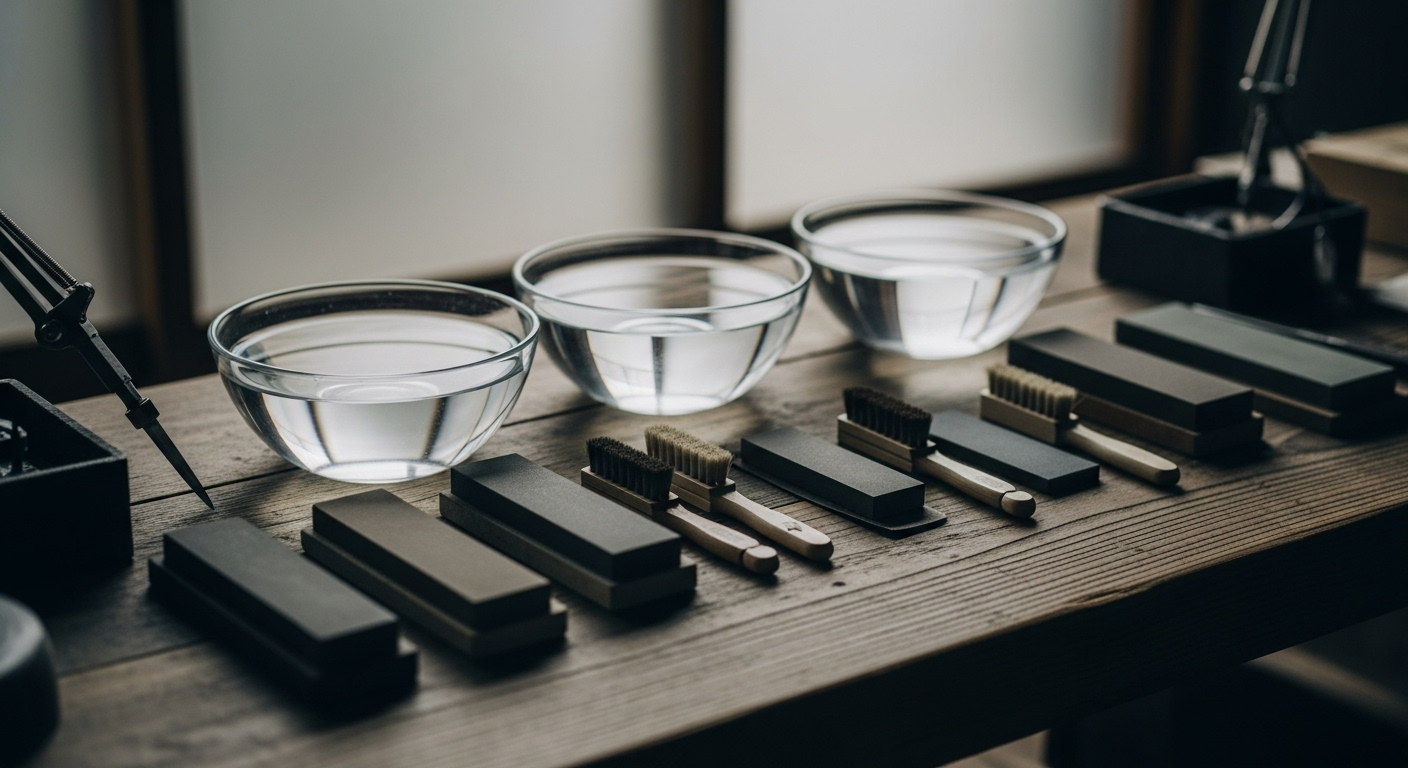
Blade Finishes
From the precision of Honbazuke sharpening to the elegance of mirror polish, the flowing patterns of Damascus, and the subtle refinement of kido finishing—each finish tells its own story of craftsmanship.
Usage & Care
Learn the daily practices—washing, drying, storing, sharpening—that preserve a knife’s sharpness, beauty, and spirit for decades.
Mindset & Philosophy
Discover The Chef’s Code—principles of character, skill, knowledge, devotion, and professionalism that connect chef and knife