Usage & Care: Knife Usage & Daily Care
-
Where Respect Meets Practice
A Japanese knife is not only defined by how it cuts, but by how it is treated before and after each use. Even the sharpest blade will falter if neglected, while the most ordinary steel can shine when cared for with respect.
In this section, we begin with the essentials every owner must know before using their knife, followed by the daily practices of washing, drying, and proper storage that keep rust at bay. We will explore how simple habits extend the lifespan of a blade, and why maintenance is inseparable from performance. Finally, we will look at the cultural dimension: Japan’s unique way of honoring tools at the Knife Memorial Service, a reminder that knives are not disposable objects but lifelong partners.
To learn care is to learn philosophy. Each act—whether preventing rust, maintaining sharpness, or respecting the end of a knife’s journey—reveals the deeper bond between craftsman, chef, and steel.
-
Before Using a Japanese Knife: What Every Owner Must Know
-
Before the First Cut — How to Protect the Life of Your Japanese Knife
A Japanese knife is unlike any other kitchen tool. Its razor-sharp edge, refined balance, and beauty demand a touch of respect before it even meets its first ingredient.
Used improperly, even the finest blade can lose its brilliance in seconds. Cutting frozen foods or bones, twisting or hammering the blade, or leaving it wet can cause chips, cracks, and rust that shorten its life dramatically.Understanding what not to do is as important as learning how to cut. Japanese knives are made for precision, not brute force — their strength lies in the glide of a smooth slice, not in prying or chopping. Just as important, washing and storing them with care ensures they retain their sharpness and elegance for decades.
To hold a Japanese knife is to enter into a quiet partnership. Treat it with respect from the very beginning, and it will reward you with a lifetime of faithful service and timeless beauty.
-
Japanese Knife Care: Three Habits That Protect
-
Wash, Dry, Store — The Simple Ritual That Preserves a Knife’s Soul
A Japanese knife’s brilliance is not only defined by how it cuts, but by how it is cared for afterward. Even the finest steel will rust or dull if neglected, making daily maintenance essential.
Three simple habits—wash, dry, and store—are the foundation of proper care. Gentle hand-washing with mild soap protects the blade from corrosion, immediate drying prevents rust, and thoughtful storage in a sheath or block safeguards sharpness and safety. For long-term storage, a light coat of oil adds further protection, continuing a tradition passed down by generations of craftsmen.
More than routine, these steps are a quiet ritual. In Japanese kitchens, the way a chef cares for their knives reflects discipline, respect, and even their philosophy toward cooking. To care for a knife is to honor the ingredient, the craft, and oneself.
-
Preventing Rust in Japanese Knives: Simple Habits to Protect Your Blade
-
Rust Prevention as Daily Ritual — Protecting Sharpness, Honoring Craft
Even the sharpest and most beautiful Japanese knife can lose its brilliance overnight if neglected. Rust is simply iron’s natural reaction to moisture and oxygen, but with care, it can be prevented.
Carbon steel knives, admired for their extraordinary sharpness, demand immediate drying after every use. Stainless steel offers greater resistance thanks to chromium, yet it too can rust without attention. The key lies in three habits: wash gently, dry thoroughly, and store safely. For long-term storage, applying a thin coat of camellia oil or wrapping the blade in newspaper helps protect it further.
If rust appears, light stains can be removed with a rust eraser or cork, while severe cases may require fine sharpening. Yet prevention is always easier than restoration.
In Japan, knife care is more than maintenance—it is a philosophy of respect. Each act of washing, drying, and storing is a gesture that honors the steel, the craftsman who shaped it, and the meals it helps create. Through this mindful routine, a Japanese knife can remain sharp, beautiful, and faithful for decades.
-
What Determines the Lifespan of a Knife?
-
A Knife’s True Lifespan Lies in Its Construction
The lifespan of a knife is not measured in years, but in how long it can continue to hold an edge. Once the steel is worn away and sharpening is no longer possible, the life of the knife comes to an end. And because not all knives are built the same way, their longevity can differ greatly.
In Japanese knife-making, there are two main construction styles that shape a knife’s durability and sharpening life. Zenkou, also known as all steel or honyaki, is forged entirely from steel and can be sharpened again and again as long as steel remains. In the case of honyaki, however, only the hardened section of the blade can be sharpened indefinitely, while the softer tempered portion cannot be reduced beyond a certain point. Kasumi construction, on the other hand, combines hard steel with layers of soft iron or stainless. Within kasumi, there are important differences: in three-layer kasumi, the steel core runs through the full height of the blade, allowing the knife to be sharpened for many years. In inserted steel kasumi, the core only extends partway down the blade, and once you sharpen past that layer, the edge disappears completely and the knife’s function is lost.
It is often said that a good knife will last forever if you keep sharpening it. In truth, the construction of the blade sets its limits. Many knives sold overseas are of the inserted steel kasumi type, which means they will one day reach a sudden end. The real question to ask is not simply how sharp a knife is today, but how much steel is inside the blade. By understanding this, you can choose a knife that will not only perform beautifully now, but also continue to serve you faithfully for many years to come. -
Knife Memorial Service
-
When a Blade’s Life Ends, Gratitude Begins
In Japan, even the most ordinary tool can be seen as carrying a spirit. A kitchen knife is more than steel—it holds the memory of countless meals and the care of its owner. When its life ends, it is not simply thrown away, but honored with respect.
This tradition is known as Hocho Kuyō, the knife memorial service. It reflects the belief that cherished objects acquire a soul over time. By giving thanks to a worn-out knife, people express gratitude for the craftsmanship that created it and the devotion with which it was used.
Every year on November 8, Knife Day is celebrated across Japan. The date comes from a playful word association: “11” for ii (good) and “8” for ha (blade). In Sakai, Seki, Sanjo, and other knife-making towns, people bring their old knives to shrines, where they are respectfully laid to rest—not as waste, but as honored companions.
The knife memorial service is more than a ritual. It is a cultural lesson in treasuring objects, respecting artisans, and pausing to value what we use. To honor a knife is to honor the spirit of craftsmanship itself, ensuring that respect and gratitude are passed on to future generations. -
-
Epilogue: Care as a Living Tradition
The true brilliance of a Japanese knife lies not only in its edge but in the discipline that sustains it. Proper use, daily care, and respect for its limits ensure that a blade will serve faithfully for years, perhaps even decades.
To clean and store a knife is to honor the ingredient it cuts. To prevent rust is to protect the spirit of the craftsman who forged it. To reflect at a knife memorial is to recognize the life of a tool that has shaped countless meals.
These are not burdens, but traditions—a quiet dialogue between hand and steel. When you maintain your knife, you are also maintaining trust, respect, and the unbroken chain of culture that turns cooking into more than work.
A cared-for knife becomes more than sharp. It becomes a mirror of the chef’s own discipline and devotion.
-
Knowledge Quiz: Knife Usage & Daily Care
Origins & History
From samurai swords to modern kitchens, discover how Japanese knives became cultural icons of sharpness, tradition, and identity.
Regions & Craftsmen
Explore Sakai, Sanjō, and Seki—the three great knife-making centers of Japan. And in Sakai, meet the master artisans whose hands preserve tradition and shape the future of Japanese blades.
Materials
Discover the steels that shape Japan’s finest knives—from the razor-sharp purity of White Steel to the balance of Blue Steel, the resilience of Ginsan, and the innovation of Super Steels like ZDP189. Each material is more than metal—it is a philosophy forged through centuries of refinement.
Structure & Features
Uncover the secrets of single-bevel geometry, urasuki hollows, and design features that make Japanese knives precise and unique.
Crafting Process
Follow the journey from raw steel to living blade—through forging, quenching, sharpening, and finishing guided by master hands.
Types of Knives
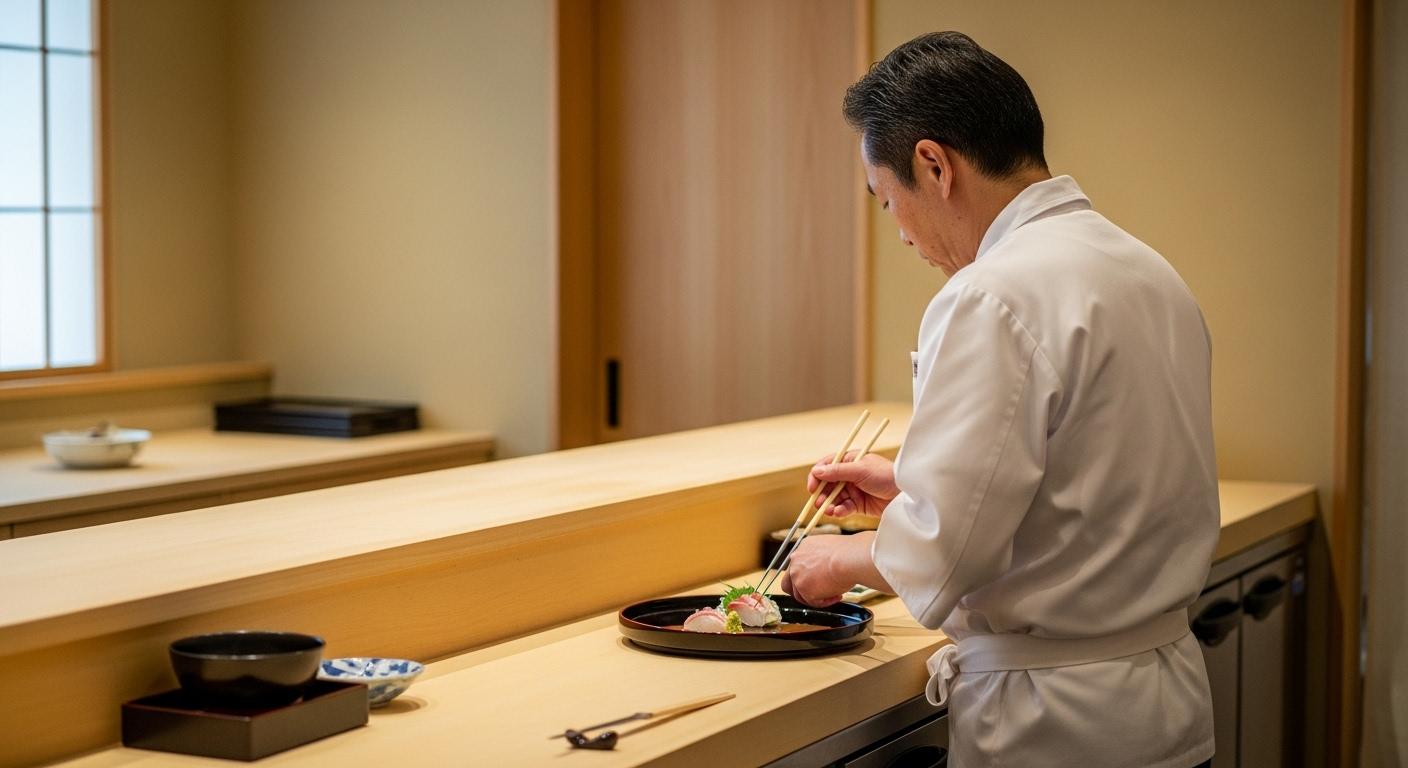
From Yanagiba to Deba to Usuba, learn why Japan developed so many specialized blades and how each reflects culinary culture.
Blade Finishes
From the precision of Honbazuke sharpening to the elegance of mirror polish, the flowing patterns of Damascus, and the subtle refinement of kido finishing—each finish tells its own story of craftsmanship.
Mindset & Philosophy
Discover The Chef’s Code—principles of character, skill, knowledge, devotion, and professionalism that connect chef and knife