• Steel is silent—until the craftsman gives it voice.

    The soul of a Japanese knife is not determined by steel alone, but by the sequence of processes that bring it to life. Each hammer strike, each moment in the flames, each pass on the whetstone carries centuries of knowledge and discipline.

    In this section, we explore the crafting process step by step—from forging that compresses and strengthens the steel, to heat treatment that hardens the edge, to sharpening that reveals the blade’s true character. Along the way, we will look at advanced innovations such as sub-zero treatment, as well as the cultural and practical differences between handcrafted and factory-produced knives.

    These are not just technical stages—they are living traditions, refined through generations of trial and mastery. By learning how knives are crafted, we begin to see why Japanese blades endure not only as reliable tools but also as works of cultural heritage, carrying both performance and spirit.

The Making of Japanese Knives: Steel, Fire, Spirit

  • A Tradition Forged in Steel and Spirit

    The story of Japanese knives is not one of machines or mass production—it is the living continuation of a tradition where steel is given soul through human hands.

    For more than 600 years, Sakai’s artisans have carried forward the techniques once used to forge samurai swords, transforming them into tools of extraordinary sharpness, beauty, and balance. Every step, from the heat of the forge to the cool precision of sharpening, is performed with discipline and devotion.

    Japanese knife-making is defined by four essential stages: forging (kaji), heat treatment (yaki), sharpening (togi), and handle mounting (e-tsuke). Each stage demands mastery, and together they create not just a blade but a companion for chefs around the world.

    To hold such a knife is to hold centuries of skill, spirit, and cultural pride—a reminder that true craftsmanship is more than technique. It is tradition made tangible, art made practical, and steel made alive.

Differences Between Handcrafted Knives and Mass-Produced Factory Knives

  • Handmade vs. Machine-Made: Why Craftsmanship Still Matters

    In Japanese knife-making, the contrast between handcrafted and mass-produced knives is more than a matter of process—it is a difference of philosophy and spirit.

    Handcrafted knives are born in the forge of skilled artisans, each blade heated, hammered, and shaped with discipline and care. Their edges are sharpened by hand, their durability refined through experience, and their individuality marked by the personality of the maker. These knives are not merely tools but lasting companions, capable of serving for a lifetime when cared for properly.

    By contrast, mass-produced knives emerge from automated factories, shaped and sharpened by machines that prioritize efficiency and affordability. While they provide accessible sharpness and consistency, they lack the subtle refinements and unique character that hand-forged blades carry. Over time, they may dull more quickly, wear unevenly, and be seen as consumables rather than lifelong investments.

    The true value of a handmade knife lies in its individuality, durability, and the spirit infused into every step of its creation. To hold one is to feel the difference between a uniform product of industry and a singular work of living craftsmanship.

Why Is the Manufacturing Process So Important: The Stages That Define Performance

  • From Steel to Handle: How Every Step Shapes a Knife’s True Quality

    The manufacturing process is what transforms raw steel into a knife that chefs can trust as an extension of their hand.

    Steel defines potential, but without proper forging and heat treatment, that potential is wasted. The sharpness of a blade depends on edge finishing—where precision and patience bring out the steel’s true character. Durability is secured through skilled heat treatment, while balance and comfort rely on the harmony between blade and handle.

    Just as a dish requires not only the finest ingredients but also the right preparation and seasoning, a knife’s excellence depends on every stage of its making. Only when steel, forging, sharpening, and handle attachment are executed with care does a Japanese knife reach its highest performance—lasting sharpness, effortless handling, and a balance that feels alive in the chef’s hand.

Forging: The Art of Bringing Steel to Life

  • Where Fire, Hammer, and Spirit Shape the Blade

    Forging is the foundation of Japanese knife-making, where fire and hammering transform raw steel into a blade that carries both strength and soul. In Sakai, artisans use centuries-old methods to fuse steel and iron, compact the metal’s grain, and shape its elegant outline—all while relying on intuition and experience to control heat and form.

    From Wakashitsuke (forge welding), which bonds steel and iron into a harmonious structure, to Sakizuke (preliminary forging), which builds the skeleton of the blade, each step refines sharpness and durability. During shaping and core adjustment, the knife’s graceful silhouette emerges, balancing function with beauty. Finally, through Yakinamashi (annealing), the blade is allowed to rest—releasing stress, refining the grain, and preparing for its ultimate performance.

    Forging is far more than mechanical shaping. Every strike of the hammer is a dialogue between craftsman and steel, breathing life into the metal. The result is not only a tool but a living work of art, carrying forward the philosophy of the samurai sword into the modern kitchen.

Heat Treatment: The Soul of the Blade

  • Where Fire, Water, and Judgment Awaken Steel

    Heat treatment is the stage where steel transcends from raw material into a living blade. After forging, rough hammering prepares the steel, smoothing its surface and refining its inner structure for the trial to come. Even at this stage, every strike reflects the smith’s intuition, laying the groundwork for sharpness and durability.

    Next, the blade receives its urasuki, a subtle hollow on the back. Nearly invisible, it reduces friction and allows food to release cleanly—an innovation born of empathy for chefs, ensuring each movement flows with grace and efficiency.

    The heart of heat treatment is yaki-ire (quenching), when the glowing steel is plunged into water. In a single instant, fire and water transform softness into legendary hardness and strength. It is a moment of peril and artistry, where timing, temperature, and foresight decide everything. Yet hardness alone is not enough. Through yaki-modoshi (tempering), the blade is gently reheated, balancing sharpness with flexibility, making it resilient enough for daily use.

    In these stages, centuries of tradition and years of apprenticeship converge. Heat treatment is not merely metallurgy—it is the soul-breathing moment when steel awakens as a blade, ready to carry both history and the spirit of its maker into every cut.

What Is Quenching in Japanese Knife Making: The Split-Second That Shapes a Blade’s Destiny

  • Quenching: The Decisive Moment That Defines Sharpness and Strength

    In Japanese knife making, quenching is the most critical moment—the instant when heated steel meets water, oil, or air to lock in hardness and define the blade’s true character.

    Water quenching, the oldest method, delivers unparalleled sharpness but carries the greatest risk of cracking. Oil quenching offers a balance between edge retention and durability, making it reliable for daily professional use. Air quenching, suited to stainless steel, ensures stability and corrosion resistance with minimal risk of warping.

    Each technique reflects not only science but also the intuition of the craftsman. Success demands precise control of temperature, timing, and skill—because in quenching, a single breath can decide whether steel becomes a lifelong partner or is lost forever.

What is Sub-Zero Processing: The Science Behind Extreme Hardening

  • From Fire to Ice: Unlocking Durability Through Sub-Zero Treatment

    Sub-Zero Processing is an advanced technique that elevates knife-making beyond traditional quenching. While ordinary quenching transforms most of the steel into martensite, it often leaves behind unstable retained austenite. Over time, this can cause warping or weaken the blade.

    By cooling the steel below 0°C with liquid nitrogen, Sub-Zero Processing forces nearly all retained austenite to transform into martensite. The result is a blade with unmatched structural stability, greater wear resistance, and long-lasting sharpness.

    For chefs, this means more than technical precision—it means a knife that remains true to its form, performs reliably over time, and retains its edge even under the demands of daily use. It is a marriage of tradition and science, where the wisdom of fire meets the precision of ice.

Sharpening: Revealing the Knife’s True Character

  • Where the Blade’s Soul Emerges Through Stone and Water

    Sharpening (togi) is far more than the final step of knife-making—it is the stage where a blade’s true character is revealed. After the blacksmith’s fire and hammer give the knife its form, the sharpener’s delicate hand awakens its soul.

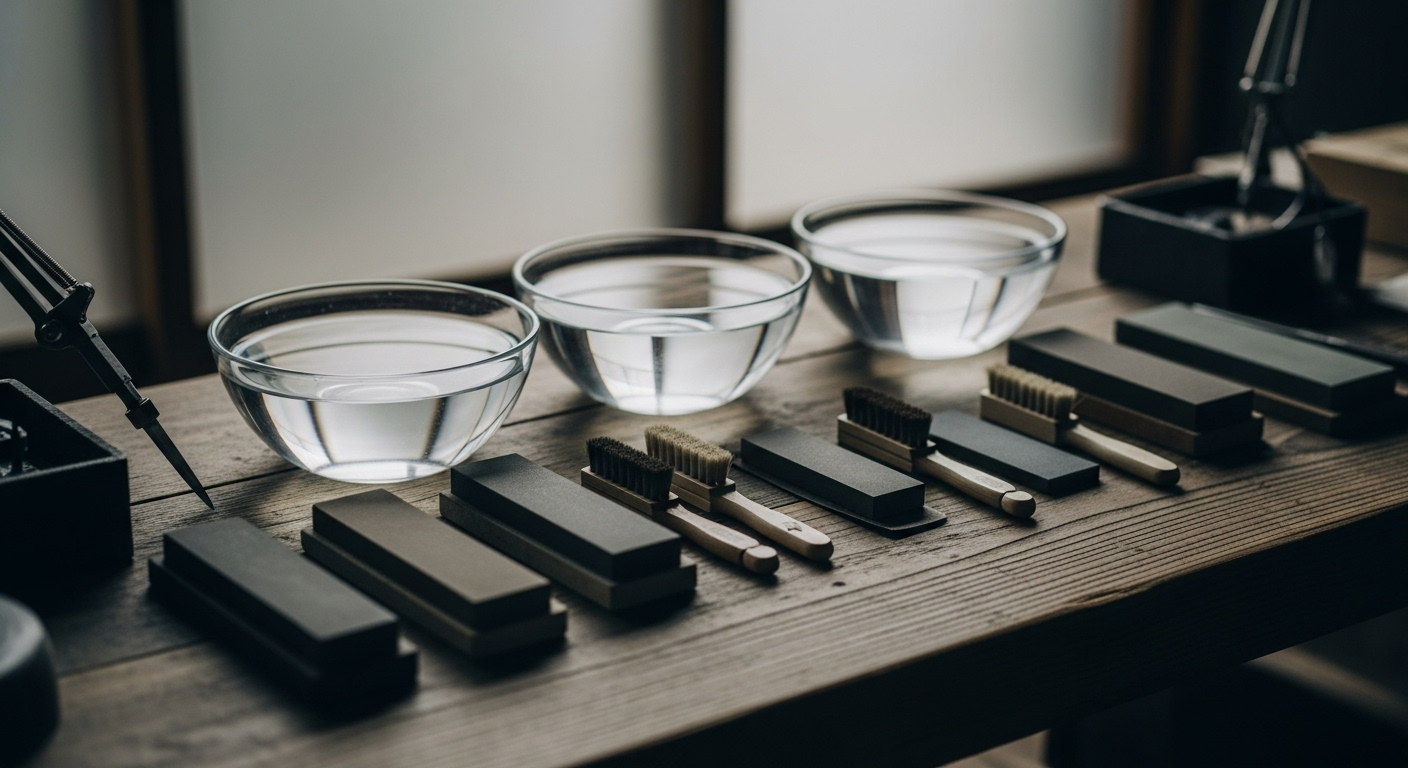
    Across many stages, from coarse to fine whetstones, the blade is refined with water-cooled precision. In ara-togi (rough sharpening), the knife’s geometry and foundation are set, shaping over 80% of its final character. Through hon-togi (main sharpening), its edge and surface are honed with balance and discipline, demanding mastery over every angle and ridge. With ura-togi (back sharpening), friction is minimized, allowing the blade to glide effortlessly, especially in sashimi preparation. Finally, in shiage-togi (final polishing), sharpness and beauty converge, often leaving the blade with a mirror-like finish and the spirit of its maker within.

    To sharpen is not merely to grind steel—it is to breathe life into it. In this quiet collaboration of stone, water, and human touch, the knife transcends its role as a tool and becomes a living partner in the hands of the chef.

Aike: The Human Mark Within Japanese Knives

  • When steel carries the quiet marks of the human hand, imperfection becomes meaning.

    In Japanese craftsmanship, true beauty is not found in flawless surfaces but in the traces of human touch.

    Within Japanese knives, one such mark is called Aike—a faint dark line or tiny black specks that appear where steel and iron have been joined. While often misunderstood as flaws, these subtle marks embody authenticity, proof that a blade was forged by fire, hammer, and skill rather than machines.

    Aike does not typically diminish performance. Instead, it serves as a quiet reminder of the centuries-old traditions that shape each knife, echoing the Japanese philosophy of wabi-sabi—the belief that beauty resides in imperfection. For those who understand, Aike transforms a blade from a mere tool into a living artifact of craftsmanship, culture, and spirit.

  • Epilogue: The Heartbeat of Fire and Steel

    To watch a Japanese knife being made is to see more than a craft—it is to witness a dialogue between fire, steel, and human spirit. Forging shapes resilience, quenching locks in strength, and sharpening reveals a blade’s true voice.

    These steps are not mechanical routines but rituals of continuity, where knowledge is passed from hand to hand, generation to generation. By understanding the crafting process, we recognize that a Japanese knife is never simply manufactured.

    It is born—through patience, discipline, and the unbroken chain of tradition. In every finished blade lives a story of materials transformed by human touch, carrying both the sharpness of steel and the soul of the artisan.

Knowledge Quiz: Crafting Process

Origins & History

From samurai swords to modern kitchens, discover how Japanese knives became cultural icons of sharpness, tradition, and identity.

Origins & History

Regions & Craftsmen

Explore Sakai, Sanjō, and Seki—the three great knife-making centers of Japan. And in Sakai, meet the master artisans whose hands preserve tradition and shape the future of Japanese blades.

Regions & Craftsmen

Materials

Discover the steels that shape Japan’s finest knives—from the razor-sharp purity of White Steel to the balance of Blue Steel, the resilience of Ginsan, and the innovation of Super Steels like ZDP189. Each material is more than metal—it is a philosophy forged through centuries of refinement.

Materials

Structure & Features

Uncover the secrets of single-bevel geometry, urasuki hollows, and design features that make Japanese knives precise and unique.
Structure & Features

Types of Knives

From Yanagiba to Deba to Usuba, learn why Japan developed so many specialized blades and how each reflects culinary culture.
Types of Knives

Blade Finishes

From the precision of Honbazuke sharpening to the elegance of mirror polish, the flowing patterns of Damascus, and the subtle refinement of kido finishing—each finish tells its own story of craftsmanship.

Blade Finishes

Usage & Care

Learn the daily practices—washing, drying, storing, sharpening—that preserve a knife’s sharpness, beauty, and spirit for decades.

Usage & Care

Mindset & Philosophy

Discover The Chef’s Code—principles of character, skill, knowledge, devotion, and professionalism that connect chef and knife

Mindset & Philosophy