• January 1, 2025

  • Quenching is a critical process in crafting high-quality blades. By cooling heated steel rapidly, it achieves the desired hardness and durability. Let us explore two primary methods of quenching: water quenching and oil quenching, each with its unique characteristics and challenges.

  • Water Quenching (Water Cooling)

  • Water quenching uses water as a coolant and is particularly suited for white steel (shirogami) knives. This method offers several advantages:

    • Faster cooling speed compared to oil quenching, resulting in higher hardness.
    • The ability to achieve the necessary hardness for white steel No.1, which has a high carbon content.
  • However, it also comes with significant challenges:

    • Risk of warping or cracking due to uneven cooling.
    • Requires extreme precision in temperature management, water temperature, agitation speed, and cooling duration.
  • The Complexity of Water Quenching

    Among the three quenching methods, water quenching is the most challenging. Even for master craftsmen, achieving consistent quality demands unparalleled expertise and focus. For white steel, which has lower hardenability, rapid cooling is essential to prevent insufficient hardness, making water quenching indispensab

  • What Is Hardenability?

    Hardenability refers to an alloy's ability to harden deeply through heat treatment. It determines how far the hard structure penetrates from the surface during quenching. Generally, hardening is accompanied by increased brittleness.

  • Mud Coating: A Crucial Step in Water Quenching

    In water quenching, a process called mud coating is essential. This involves applying a thin, uniform layer of specially formulated clay to the blade's surface, offering the following benefits:

    • Uniform heat distribution, reducing uneven cooling.
    • Suppression of the steam film effect, enabling faster and more efficient cooling.
  • What Is a Steam Film?

    When a hot blade is submerged in water, the surface water rapidly evaporates, forming a thin layer of steam. This steam acts as an insulating barrier, slowing down the cooling process and potentially leading to inadequate quenching. Mud coating absorbs and dissipates the steam, ensuring the rapid cooling necessary for successful quenching.

  • Oil Quenching (Oil Cooling)

  • Oil quenching uses oil as a coolant and is ideal for blue steel (aogami) knives. It offers distinct advantages:

    • More uniform cooling, reducing the risk of cracking or warping.
    • Greater stability, making it suitable for steels with higher hardenability.
  • However, the cooling speed is slower than water quenching, making it generally suitable for steels with better hardenability, like blue steel.

  • Characteristics of Blue Steel

    Blue steel contains trace amounts of chromium and tungsten, enhancing its hardenability compared to white steel. This allows it to be quenched in either water or oil, though the choice impacts performance. While water quenching may achieve superior martensite structures, it also increases the risk of cracking and reduced hardness due to residual austenite.

  • Both methods reflect the craftsmanship and dedication required in blade making. Whether employing the swift, high-stakes nature of water quenching or the steadier, reliable oil quenching, each technique breathes life into steel, transforming it into tools of exceptional quality and artistry.

The Making of Japanese Knives

For over six centuries, Sakai’s artisans have transformed raw steel into blades of extraordinary sharpness and beauty. From forging and heat treatment to sharpening and handle fitting, each step carries the spirit of tradition—revealing why Japanese knives are trusted by chefs around the world.
The Making of Japanese Knives
  • Embracing Flexibility: The Power to Carve New Paths

    In life, we all encounter barriers that feel unbreakable. This is no different in the world of traditional knife making. As artisans, we inherit centuries-old techniques, but we also face the challenge of adapting to new demands and sensibilities.

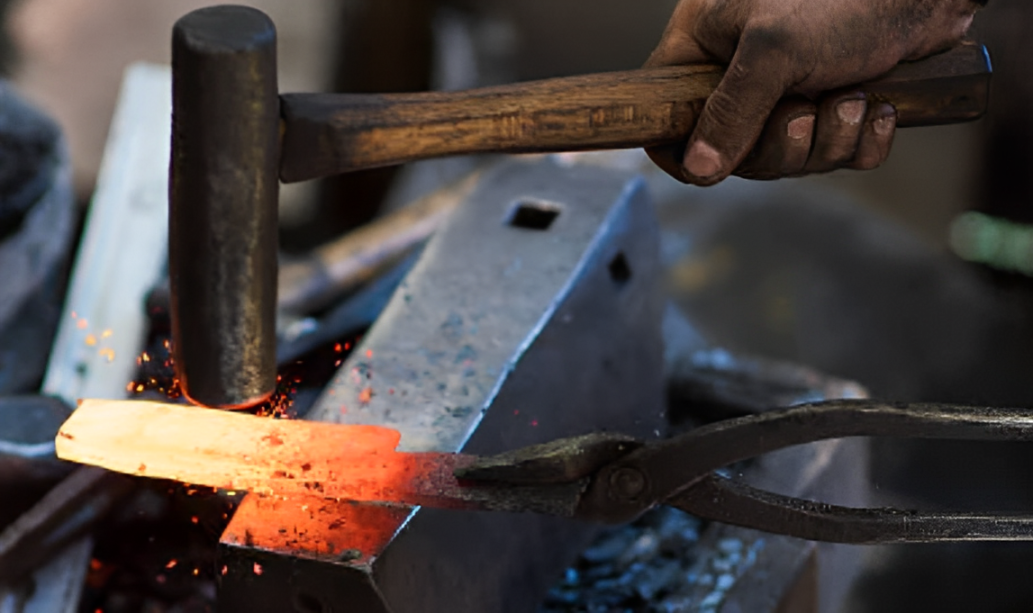
    I, too, have stood at the forge feeling lost. A method I once trusted no longer worked, and the steel in front of me refused to take shape. In that moment of doubt, I discovered something important: if I could shift my perspective, even slightly—change the angle of the hammer, alter the rhythm of the sharpening stroke—I could find an entirely new path forward.

  • What seemed like failure became a teacher. Challenges stopped being something to fear, and instead became sparks of possibility. In crafting, a subtle change in technique can transform a blade. In life, a small change in mindset can open unexpected horizons.

  • The truth is, each of us forges our own path. Sometimes the steel resists, sometimes it yields—but it is our courage to pivot, to adjust, that shapes the outcome.

    As a craftsman, I have learned this lesson: preservation of tradition is vital, but so is transformation. Just as a knife gains strength through countless strikes of the hammer, our lives gain depth through the courage to adapt.

  • I invite you to take that small step, to shift your perspective even slightly. Who knows? The path you uncover may lead not only to personal growth, but to something truly extraordinary—like a blade that carries both tradition and innovation within its edge.

  • japanese_knife_made_in_Sakai

    1. Forged in the Legacy of Sakai

    From Sakai City—Japan’s renowned birthplace of professional kitchen knives—each blade is crafted by master artisans with over six centuries of tradition. Perfectly balanced, enduringly sharp, and exquisitely finished, every cut carries the soul of true craftsmanship.

  • 2. Thoughtful Care for Everyday Use

    Every knife includes a hand-fitted magnolia saya for safe storage. Upon request, we offer a complimentary Honbazuke final hand sharpening—giving you a precise, ready-to-use edge from day one.

  • 3. A Partnership for a Lifetime

    A KIREAJI knife is more than a tool—it is a lifelong companion. With our bespoke paid aftercare services, we preserve its edge and beauty, ensuring it remains as precise and dependable as the day it first met your hand.