


Ⅰ. The Steel Behind the Steel — The Story of Yasuki
-

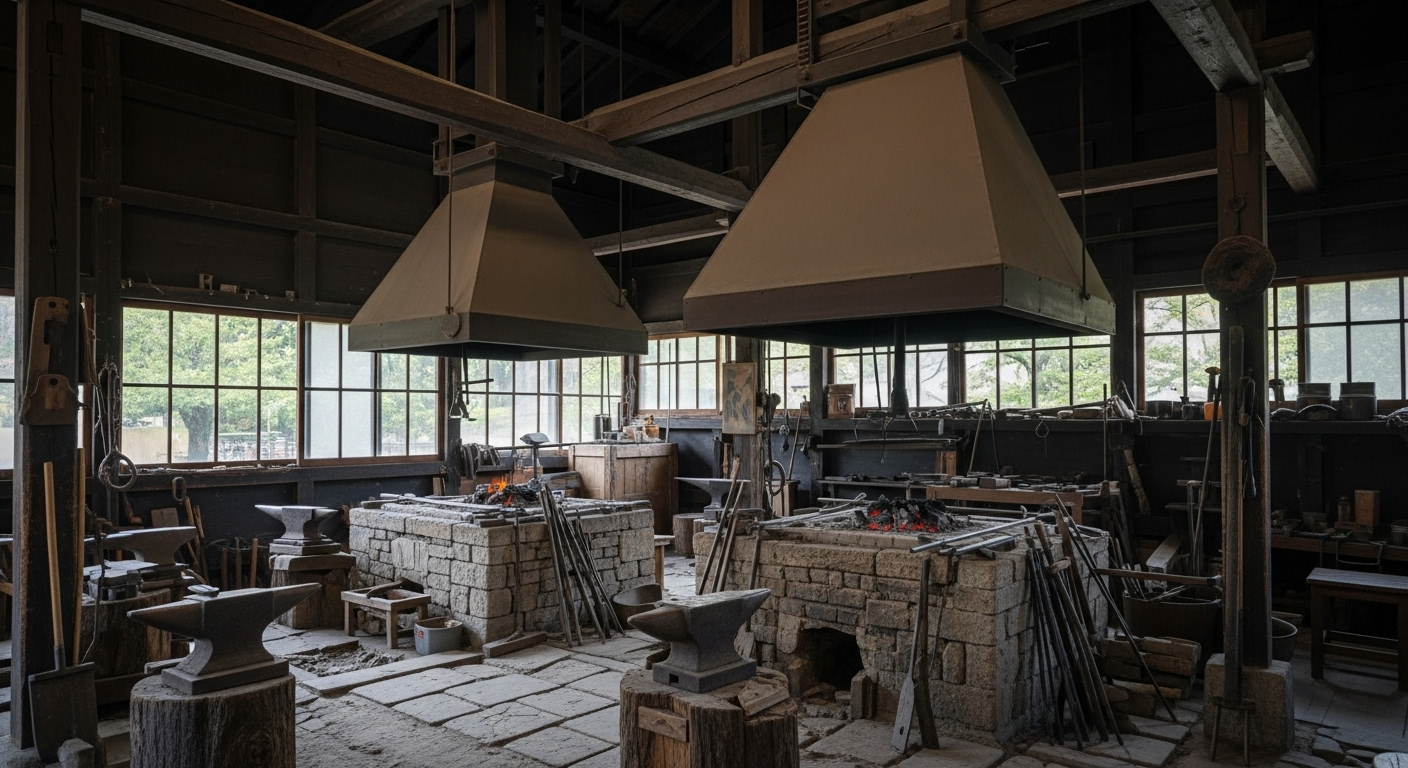
Iron From the Mountains
Like many stories of Japanese traditional craftsmanship, this story begins with the land itself.
The Chūgoku Mountains of western Japan contain abundant deposits of high-quality iron sand known as masago satetsu. This region has gathered and smelted iron sand since at least the eighth century.
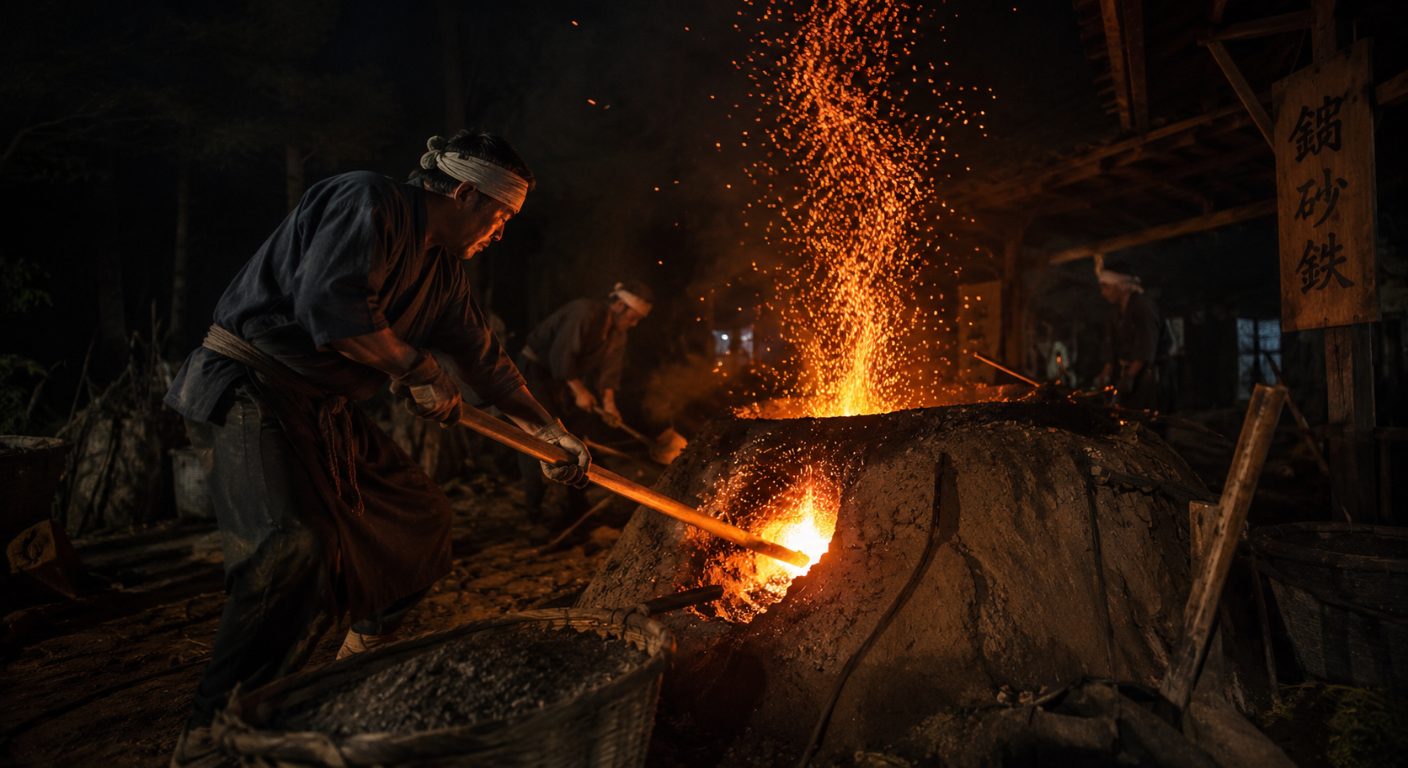
The uniquely Japanese process developed to transform this iron sand into steel is called tatara smelting.
Inside a massive clay furnace, iron sand and charcoal are layered alternately and burned continuously for three days and three nights without interruption. The result is an exceptionally pure bloom of steel called tamahagane — the very same material traditionally used for Japanese swords.
By modern standards focused on mass production, tatara smelting is profoundly inefficient.
It consumes approximately ten tons of iron sand and twelve tons of charcoal. It requires constant human supervision day and night to control heat and airflow. The resulting steel contains uneven carbon distribution and must be painstakingly sorted by experienced craftsmen.
The process cannot easily be scaled or accelerated by machines. It remains an intensely human craft.
Yet in the hands of people who inherited this knowledge across generations, tatara smelting produced steel with astonishing purity and highly distinctive microstructures.
Its exceptional qualities are not easily replicated by modern industrial blast furnaces.
This is not because modern steelmaking is inferior. Rather, industrial steelmaking optimizes for consistency, predictability, and manufacturing efficiency.
Tatara steel belongs to an entirely different realm:
a material whose character is shaped by specific natural resources and extraordinarily precise human control sustained over time.
-
Yasuki Steel and the Meiji Decision
By the late nineteenth century, Japan was undergoing the unprecedented industrial transformation of the Meiji Restoration.
Cheap Western steel produced through blast furnace technology flooded the market. Traditional tatara smelting faced rapid extinction under the pressures of a modern economy built upon scale and efficiency.
Many traditional industries disappeared during this period.
But in Yasugi, something very different happened.
A businessman named Yataro Matsuura, deeply involved in regional steel distribution and keenly aware of the value of Yasugi’s metallurgical heritage, made a historic decision in 1899 that would shape the future of Japanese specialty steel.
Together with local tatara operators and banking officials who shared his vision, he established the Unpaku Steel Limited Partnership Company.
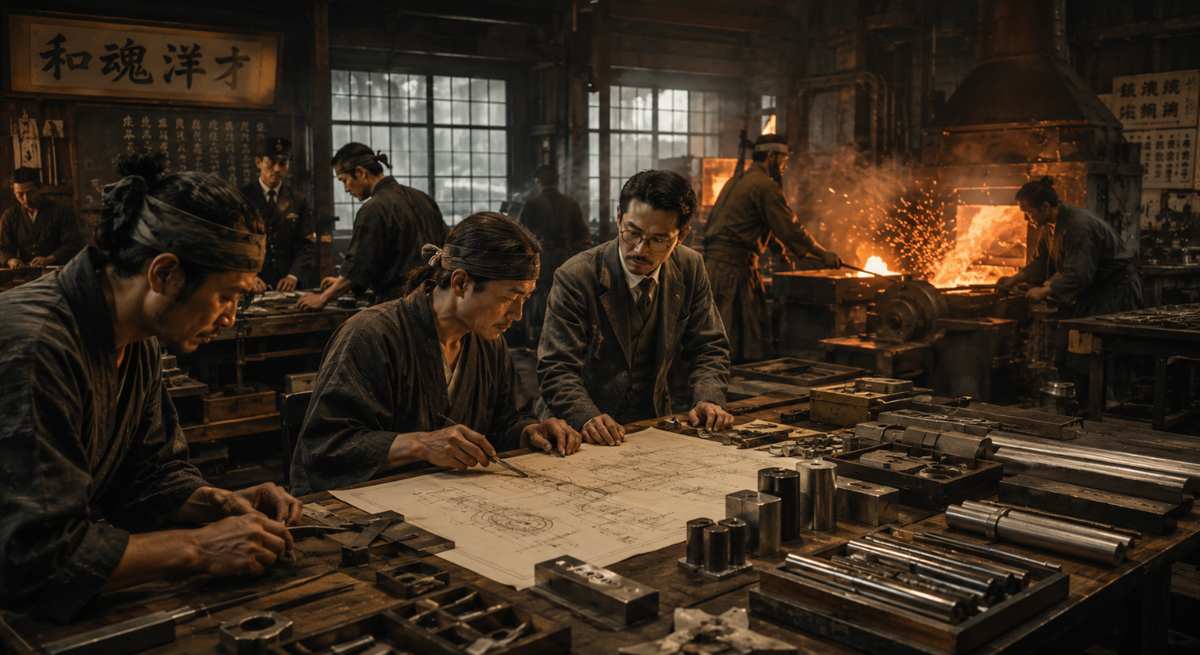
Their mission was neither simple preservation of the past nor complete surrender to industrial modernization.
Instead, they sought to fuse centuries of tatara knowledge with Western metallurgical science in order to domestically produce specialty steels of a quality neither tradition alone could achieve.
After overcoming severe financial difficulties and incorporating innovative technical methods developed by engineers such as Kisaku Ibe, Yasuki steel eventually evolved into the Yasugi Steel Works Company, and later into the Yasugi Works of Tobata Foundry — eventually becoming Hitachi Metals, now known as Proterial.
This process was not a compromise between tradition and science.
It was a true synthesis.
The family of high-carbon steels developed through this process gained extraordinary trust among knife craftsmen throughout Japan due to their exceptional heat-treatment response and sharpening characteristics.
The names later embraced by Sakai craftsmen — Shirogami and Aogami — originated from the colors of the paper used to wrap the steels for shipment.
A simple distinction in wrapping paper eventually became the names of some of the world’s most respected blade steels.
-
Why Yasuki Steel Continues to Be Chosen
Those who seriously devote themselves to knives eventually arrive at a deeper question:
What truly makes Yasuki White Steel and Blue Steel so special?
The answer exists across multiple layers of technical reality.
First and foremost is extreme purity.
Modern Yasuki Steel production no longer directly uses raw iron sand itself. However, the uniquely low impurity characteristics historically associated with Chūgoku iron sand — especially the remarkably low sulfur and phosphorus content — are now reproduced and controlled with even greater precision through Proterial Yasugi Works’ advanced electric furnace and secondary refining technologies.
By eliminating unnecessary impurities to the greatest possible extent, the steel responds to heat treatment with extraordinary precision and consistency.
Yet purity alone cannot fully explain the remarkable cutting sensation produced by White Steel.
The deeper secret lies within the steel’s microstructure.
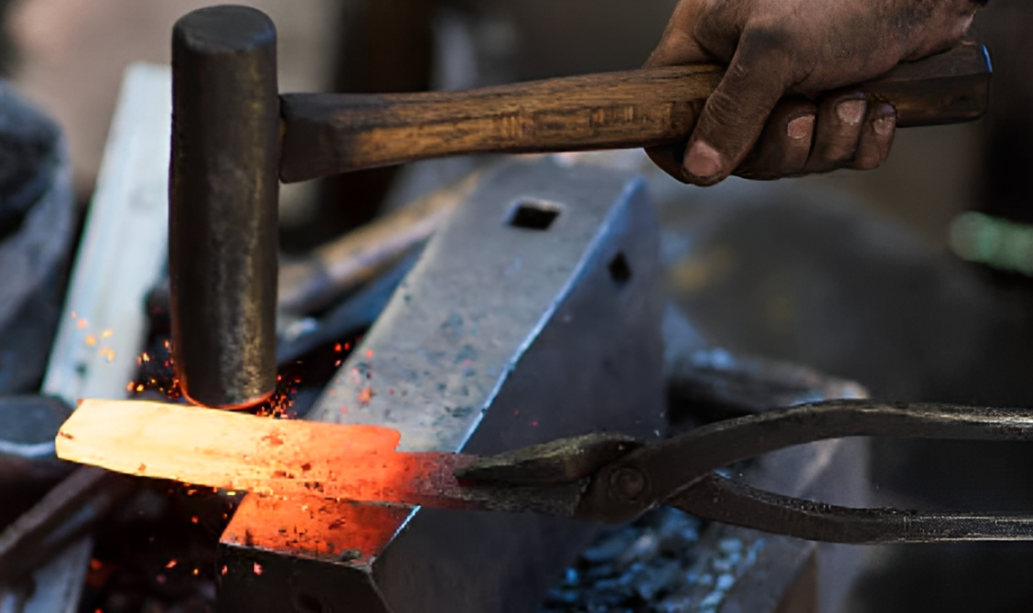
Properly heat-treated White Steel contains an exceptionally fine and uniform dispersion of carbon structures throughout the matrix. During final sharpening, the steel can be refined to an extreme degree of thinness and consistency at the edge itself.
When a master sharpener works on a Yasuki White Steel knife, they are not simply making the blade sharper.
They are organizing and refining the steel structure itself at an invisible microscopic scale — developing an edge that combines extraordinary sharpness with resilience.
This responsiveness is what fundamentally separates Yasuki Steel from ordinary industrial steels.
And it is why generations of elite craftsmen and chefs have continued to trust it.
-

White Steel and Blue Steel — The Ultimate Trade-Off
The choice between White Steel and Blue Steel is ultimately a question of what kind of performance a knife is optimized for.
White Steel (Shirogami), in its highest grades, is an extraordinarily pure carbon steel containing almost no alloying elements beyond iron and carbon.
Because there are few impurities or large alloy carbides interrupting the edge structure, it can theoretically achieve one of the finest and smoothest cutting edges possible in a kitchen knife.
But that purity comes with trade-offs.
White Steel is highly reactive to moisture, prone to rust, and relatively delicate in terms of wear resistance. Maintaining its finest edge requires frequent maintenance and highly developed sharpening skill.
Blue Steel (Aogami) builds upon White Steel’s base composition while adding carefully controlled amounts of chromium and tungsten.
Tungsten forms extremely hard carbides that dramatically reduce edge wear, allowing the knife to maintain sharpness over extended periods of cooking.
The trade-off is subtle:
the alloy carbides that improve durability may slightly reduce the almost frictionless smoothness achievable by the finest White Steel edges. Blue Steel is also significantly harder, making resharpening more demanding.
This is not a matter of superiority versus inferiority.
It is a matter of philosophy.
One pursues the absolute limit of purity and ultimate sharpness.
The other pursues practical durability and stable long-term performance.
Which steel a chef chooses depends upon the ingredients they work with, how often they sharpen, and how they care for their tools.
-

A Lineage That Continues
When a Sakai craftsman says they work with Yasuki steel, the words carry a lineage far heavier than simple material selection.
That lineage begins with laborers who once gathered iron sand by hand from the rivers of the Chūgoku Mountains.
It continues through the determination of those who refused to let the tradition disappear in 1899 and instead chose fusion with modern science.
And it lives on through the pride of the engineers and craftsmen who transformed Yasuki into one of the world’s finest specialty steel traditions.
When we hold a knife made from Yasuki Steel, we are holding far more than a cooking tool.
We are holding the ongoing dialogue between two uninterrupted traditions:
the tradition of steelmakers who devoted themselves to producing material of extraordinary purity and character,
and the tradition of blacksmiths and sharpeners who learned how to transform that material into blades of extraordinary precision.
That dialogue has continued for more than a century.
And even now, it continues quietly on the cutting boards of chefs around the world.


改变一切的钢铁:Proterial 的 AIGAMI 与安来钢的未来
-

AIGAMI 的实际功能
AIGAMI 技术的核心在于其精妙的科学原理。
专业厨师使用的高级厨刀通常由高碳钢制成,以其高硬度而著称(以 Proterial 产品名称“青纸™”销售)。然而,这种硬度是以牺牲耐腐蚀性为代价的。不锈钢解决了生锈问题,但在硬度方面历来难以与碳钢匹敌。Proterial
AIGAMI 通过 Proterial 在合金成分控制方面的精湛技术(即在分子层面对钢材成分进行精确工程设计)弥补了这一差距。
AIGAMI 2 具有极高的硬度,与青纸 2 相匹配或超越青纸 2,同时具有与 GIN® 3 不锈钢相当的耐腐蚀性。AIGAMI 1 的硬度高于 SUS440C 不锈钢,并结合了与 SUS420J 不锈钢相当的强大耐腐蚀性。Proterial
实际应用中:专业厨师现在可以拥有一把既能达到他们一直以来对碳钢要求的锋利度,又能获得更好的防锈保护的刀具。除了厨房应用之外,AIGAMI 系列的先进性能有望在包括户外刀具、替换剃须刀片和手术刀在内的各种应用中提供卓越的性能。Proterial
-

这对厨师、手工艺人和收藏家意味着什么
对于那些一直想要碳钢性能却又不想承担维护负担的专业厨师来说,AIGAMI 2 值得密切关注。它的锋利度得到了保证。虽然其防锈性并非绝对,但确实代表着一大进步。
对于户外运动爱好者或刀具收藏家来说,硬刃和改进的耐腐蚀性相结合,带来了以前的钢材类别无法提供的新可能性。
对于工匠——无论是选择材料的刀匠、给客户提供建议的磨刀师,还是建立声誉的小批量生产商——AIGAMI 都代表着一个新的创作平台。这是一种一年前还不存在的钢材。它为每个买家最终都会提出的问题:“我能两者兼得吗?”提供了一个新答案。
对于那些仅仅热爱钢铁故事的人——无论是“踏鞴”熔炉、山阴海岸的砂铁,还是从日本刀到专业厨房的悠久传承——所有这些都有一种无声的感动。
安来仍然在这里。它仍在生产世界上最好的刀片钢。而且它还没有结束。


日立安来钢是什么?
安来钢是日立金属株式会社安来工厂生产的钢品牌,该工厂位于岛根县。自古以来,该地区就以使用“Tatara”冶炼法生产钢铁而闻名,该地区生产的钢铁从安来港运出。如今,安来工厂继续这一传统,生产安来钢。
为什么要出售日立金属?
校对后的英文版本如下:
日立安来钢是什么?
安来钢是日立金属株式会社安来工厂生产的钢品牌,该工厂位于岛根县。自古以来,该地区就以使用“Tatara”冶炼法生产钢铁而闻名,该地区生产的钢铁从安来港运出。如今,安来工厂继续这一传统,生产安来钢。
为什么要出售日立金属?
日立公司出售其主要子公司是其专注于核心业务(如基于 IT 的企业服务)战略的一部分。在追求“选择和集中”的过程中,材料制造商日立金属似乎被认为与这些核心领域产生的协同效应较少。日立历来通过分拆和子公司公开上市来扩大其集团,此次出售被视为该更广泛战略的一部分。
玉钢(日本传统钢材)有何特别之处?
玉钢含有氧化物、硫化物等非金属夹杂物,质地非常柔软,容易拉伸,经过反复折弯、锻造,这些特性增强了日本刀的韧性,表面呈现出美丽的花纹,也提高了打磨的难度,因此玉钢是制作日本刀的理想材料。
安来钢的原材料有哪些?
蓝纸钢(Aogami)采用与白纸钢(Shirogami)相同的 100% 砂铁基原料制成,并添加了 0.4% 的铬 (Cr) 和 1.8% 的钨 (W)。这种成分增加了其在淬火过程中的韧性和硬化性能。由于原材料和制造工艺的差异,蓝纸钢比白纸钢贵得多。
Q5. Yasuki钢适合做专业厨刀吗?
当然。安来钢是日本餐具中最值得信赖的材料之一。它的纯度、硬度以及良好的刃口,使其成为那些追求扎根于数百年传统的高性能刀具的厨师的必备之选。
Q6. 安来钢铁为何在世界范围内受到如此高的评价?
安来钢业将日本数百年的炼钢传统与现代精湛工艺完美融合,为全球厨师带来独特的体验。刀具不仅是工具,更是文化的结晶,体现了日本工艺的精准、艺术性和可靠性。

安来钢:日本刀具之心——现状与未来展望
本文探讨了安来钢(Yasuki Steel) ——日本传统刀具背后的传奇材质——的现状和未来前景,并结合2023年日立金属公司(Hitachi Metals)向Proterial公司(Proterial)的过渡。文章重点介绍了白钢和蓝钢的持续生产(尽管存在不确定性)、新型高性能不锈钢(YBS1/YBS2)的推出,以及这些变化对全球刀具制造商、用户和收藏家的意义。随着行业正处于转折点,了解钢材比以往任何时候都更加重要。


KIREAJI 对您的三个承诺
-

1. 秉承堺的遗志
堺市——日本著名的专业厨刀发源地——每一把刀都由拥有超过六个世纪传统的工匠精心打造。完美平衡、持久锋利、精湛工艺,每一次切割都蕴含着真正的工艺精髓。
-

2. 贴心呵护,呵护您的日常使用
每把刀都配有手工镶嵌的木兰刀鞘,方便安全存放。我们可根据您的要求提供免费的“本刃付”手工磨刀服务,让您从第一天起就能拥有精准的刀刃。
-

3. 终生的伙伴关系
KIREAJI 刀不仅仅是一件工具,更是您一生的伴侣。我们提供定制的付费售后服务,以维护其锋利和美观,确保它始终如初,精准可靠,如同初次接触您的手。


