KIREAJI
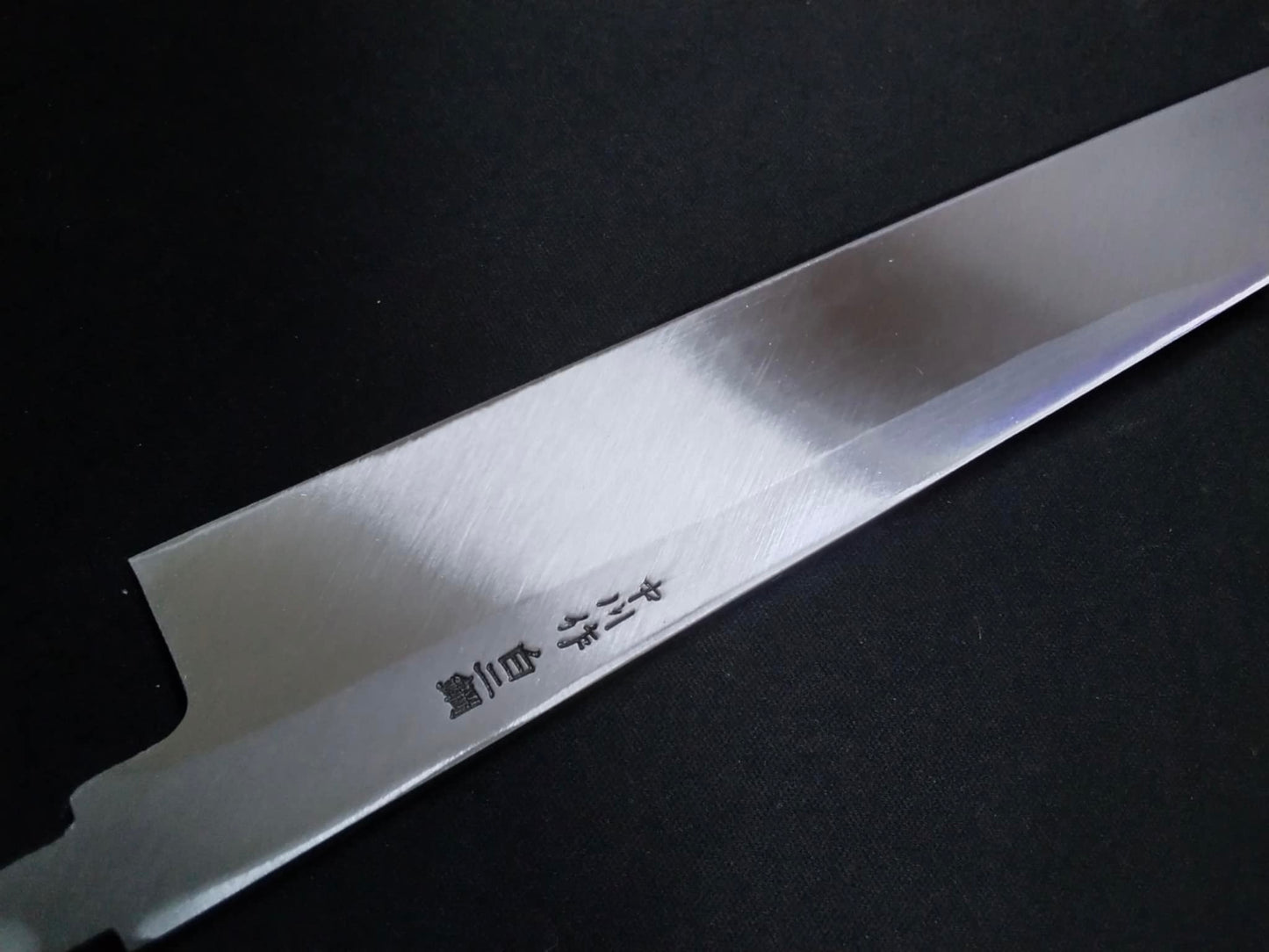
Super acier (Honyaki) Deba 210mm-poli miroir (des deux côtés)
Stock bas : 1 restant(s)
Shipping is free to the United States and Canada.
Impossible de charger la disponibilité du service de retrait
What is the difference between White Steel #2 and Blue Steel #2?
<Super acier (Honyaki)>
Le Super Steel Honyaki est un couteau japonais de pointe pour les professionnels qui résiste à la rouille et possède le tranchant durable du Honyaki. De plus, la lame est difficile à ébrécher et difficile à perdre.
Le terme "Honyakii" aurait son origine dans le fait que le processus de durcissement est très similaire à celui utilisé au Japon, où seule la lame est durcie afin d'augmenter sa dureté et d'améliorer son tranchant.
Finition miroir des deux côtés. Tout l'affûtage est fait par Tadayoshi Yamatsuka, un artisan traditionnel. On dit que la finition miroir de M. Yamatsuka est la meilleure de la ville de Sakai, à Osaka.
Ce produit est un incroyable couteau japonais.
Une chaîne de technique de cuisine japonaise sur YOUTUBE a présenté un couteau Yanagiba en acier super aiguisé de haute qualité. La personne qui est apparue dans la vidéo a en fait utilisé le couteau Yanagiba et a commenté sa netteté. Il a loué sa netteté comme "comme une lame de rasoir".
Un chef sushi représentant Kyushu, utilisant un couteau japonais de marque Shiroyama, a remporté la médaille d'or à l'exposition nationale des techniques de sushi qui s'est tenue au Japon en octobre dernier.
<Deba>
Deba dispose d'une lame plus épaisse et d'un tranchant fin et tranchant. Ce couteau est utilisé pour la cuisson du poisson. Il est utilisé pour enlever la tête des poissons et pour râper les poissons.
-Tranchant simple : droitier
-Miroir poli : les deux côtés
<Marque>
Shiroyama (fabriqué à Sakai, Osaka)
<Matériel>
- Lame : Super Acier
- Manche:Magnolia obovata & corne de buffle
<Taille et poids>
-Longueur de la poignée à la pointe : 214㎜
-Hauteur de lame : 63㎜
-Épaisseur : 7,6㎜
-Poids : 504g
Gratuit. Si vous souhaitez Honbazuke, veuillez sélectionner "Oui" lors de la commande.
Les nouveaux couteaux sont intentionnellement fabriqués avec un angle obtus sur la lame pour éviter l'écaillage. Par conséquent, la netteté de la lame n'est pas si bonne. Le processus de remodelage de la lame pour obtenir le tranchant d'origine s'appelle Honbazuke.
<Saya (gaine)>
Saya est gratuit.

What Makes This Knife Truly Special
A Bold, Heavyweight Blade Forged by a Young Sakai Artisan
Hand-forged by a rising young traditional craftsman from Sakai, this knife features an impressive 4.5mm spine thickness that delivers a commanding weight and presence—embodying both strength and refined craftsmanship.
Traditional craftsmen working on this product
Precautions
-
1. Honbazuke (Initial Sharpening)
To request Honbazuke, please select “Yes” when placing your order. This service is provided free of charge.
Honbazuke is a practical initial hand-sharpening intended to prepare the knife for use. Because sharpening preferences vary, it is not a final sharpening customized to the individual user.
Please note that hand-sharpening may leave visible sharpening marks that can appear similar to scratches. Customers with specific sharpening preferences, or those who intend to preserve the knife primarily as a collectible, may prefer to select “No” and receive the knife without Honbazuke.
-
2. Protective Coating on New Japanese Knives
New Japanese knives are coated with a transparent protective liquid vinyl coating to prevent rust during storage and international shipping.
Especially on mirror-polished blades, this coating may appear as a rainbow-like film depending on the lighting. This is not a defect in the steel or the finish.
How to remove the coating:
・Wash the blade gently with a sponge and mild dish soap, then rinse with lukewarm water.
・If difficult to remove, gently wipe while washing using tissue paper or a soft cloth.
・If residue remains, wiping with a cloth lightly moistened with alcohol (sanitizing ethanol) is effective.
・Never use metal scrubbers or abrasive cleaners, as they may damage the blade surface. -
3. Handcrafted Nature
Each knife is handcrafted by skilled artisans and is therefore unique.
Minor scratches or marks may be visible as a result of the handmade production process. These do not affect performance or functionality. We kindly ask for your understanding in advance. -
4. Measurements
Please consider the listed weight and length as approximate values.
-
5. Inventory
We carefully manage our stock. However, in the rare event that an item becomes unavailable after ordering, we will notify you by email.
If you have any questions, please feel free to contact us. (Estimated reply time: within 10 hours)
Features of White Steel #2
Recommended Users for White Steel #2
-
1. Those Who Value Sharpness with Manageable Upkeep
White Steel #2 delivers a keen edge with a forgiving sharpening response, making it well-suited for culinary enthusiasts and professional chefs who want reliable, consistent performance without demanding maintenance.
-
2. Those New to Japanese Carbon Steel Knives
A foundational steel in traditional Japanese knife-making, White Steel #2 is ideal for users beginning to explore the craft and characteristics of Japanese cutlery — offering an accessible entry point into high-performance carbon steel.
-
3. Those Seeking a Versatile Everyday Knife
With a strong balance of sharpness, ease of re-sharpening, and moderate rust resistance, White Steel #2 suits a wide range of users — from home cooks building their skills to professionals looking for a dependable all-purpose blade.
Before Using a Japanese Knife
A knife is more than a tool—it’s the heart of cooking. Learning how to use it properly helps protect its quality, durability, and safety, so you can enjoy it for years while elevating every meal.
Japanese Knife Care
With the right daily care, your knife will stay sharp and reliable for a long time. Here, we share the key points to keep it in peak condition and extend its lifespan.
Why Great Chefs Value a Good Knife
-
A great knife is more than a kitchen tool. It affects how ingredients are cut, how flavors are preserved, and how naturally a cook can work in the kitchen.
A well-crafted knife allows for cleaner cuts, greater control, and a more comfortable cooking experience — especially during long preparation sessions.
In this video, discover why professional chefs place such importance on high-quality knives, and how the right knife can deepen both precision and enjoyment in everyday cooking.
-