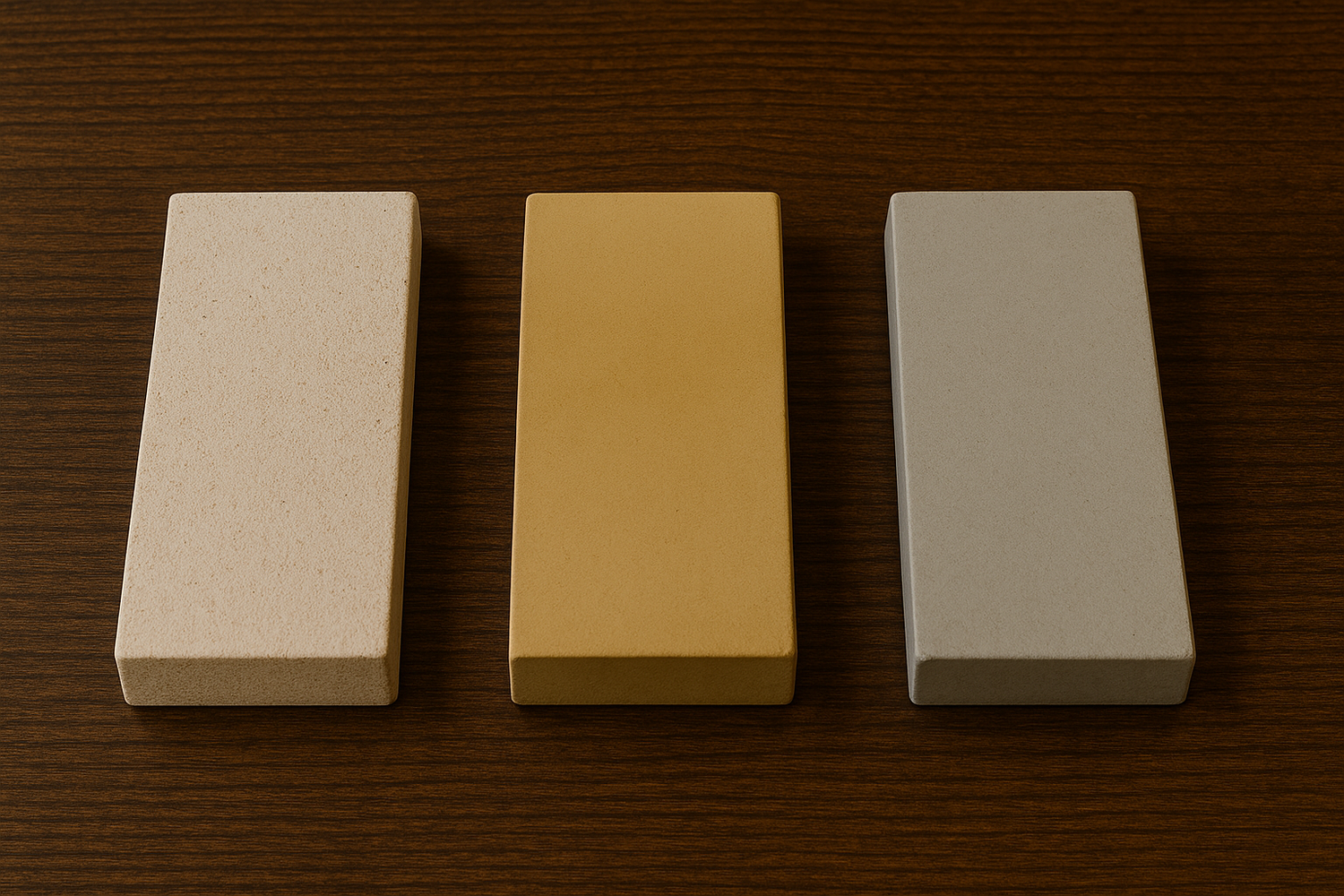
Why Two #1000 Whetstones Can Feel Completely Different
-
October 6, 2026
-
What Grit Numbers Really Tell You About Sharpening a Japanese Knife
You buy your first #1000 whetstone.
You learn how it feels, how quickly it removes steel, how much pressure it likes, and what kind of edge it leaves behind.
Eventually, you try another brand.
It also says #1000.
So you expect roughly the same experience.
But the moment your knife touches the stone, something feels different.
One stone bites quickly into the steel. The other feels smoother and slower.
One produces slurry almost immediately. Another barely seems to wear.
And after sharpening, the scratches on the blade may not even look the same.
So you begin to wonder:
How can two #1000 stones feel so different if they have the same number?
The answer is surprisingly important for anyone learning to sharpen Japanese knives.
A grit number is useful.
But just like HRC on a knife, one number cannot describe the whole tool.
-
What Does #1000 Actually Mean?
Numbers such as #400, #1000, #3000 and #8000 refer to the grit, or particle-size classification, of the abrasive.
In general, lower numbers indicate coarser abrasive particles, while higher numbers indicate finer ones.
That gives us the familiar progression:
#220 → coarse
#1000 → medium
#3000 → fine
#8000 → very fineThis is genuinely useful information.
If a knife has a damaged edge or needs significant material removal, you normally begin with a relatively coarse stone.
For ordinary sharpening, a medium-grit stone around #1000 is commonly used.
Finer stones can then refine the edge and reduce the scratches left by the previous stage.
But here is the important distinction:
Grit tells us something about abrasive particle size. It does not, by itself, tell us exactly how the stone will sharpen.
A #1000 label is not a complete description of sharpening performance.
-
A Whetstone Is More Than Its Abrasive Particles
It is tempting to imagine a whetstone as simply a solid block filled with tiny particles of one particular size.
In reality, an abrasive stone is a system.
Industrial grinding-stone manufacturers describe several important factors that determine how a stone performs, including:
the abrasive material, grit size, grade, structure, and bonding material.
The abrasive particles do the cutting.
The bond holds those particles together.
The structure determines how those particles and the spaces between them are arranged.
And the stone must continually manage what happens as abrasive particles become worn and steel is removed from the blade.
Change these characteristics, and you can change how the stone behaves—even when the grit number remains similar.
This is one reason two stones carrying the same #1000 designation can give a sharpener noticeably different experiences.
-
Hard Stone, Soft Stone — And Everything Between
One of the easiest differences to notice is how strongly a stone holds onto its abrasive.
Some whetstones feel relatively hard and wear slowly.
Others release abrasive more readily and quickly develop a mixture of water, abrasive and steel particles on their surface—what sharpeners often call slurry or mud.
Neither behavior is automatically better.
A stone that releases abrasive readily can continually expose fresh cutting particles and may give useful feedback while sharpening.
A harder stone may stay flatter longer and feel more controlled or precise to another user.
The important point is that these characteristics are not fully communicated by the number #1000.
Two stones can begin with broadly comparable abrasive size classifications while behaving quite differently beneath the knife.
-
The Abrasive Itself Matters Too
Not all abrasive particles are the same.
Different whetstones may use different abrasive materials, and those abrasives can have different hardness, toughness and fracture characteristics.
As sharpening continues, abrasive grains can wear, fracture or be released from the bonding material.
How this happens affects how fresh cutting surfaces are exposed.
That, in turn, influences the way the stone cuts and feels.
This is why the sharpening experience cannot be predicted from particle size alone.
Think of two pieces of sandpaper with apparently similar grit ratings but different abrasive materials and backing construction.
They may not feel identical in use.
A whetstone is considerably more complex, but the underlying lesson is similar:
the size of the abrasive is only one part of the system.
-
Why One #1000 Stone May Cut Faster Than Another
This leads to one of the most common misunderstandings about grit.
A higher or lower grit number should not be interpreted simply as a measure of speed.
Grit and cutting speed are related, but they are not the same thing.
A stone's ability to remove steel depends on the abrasive, how effectively fresh cutting surfaces are exposed, how the particles are held, the stone's structure, the steel being sharpened, pressure, water and sharpening technique.
That means a relatively aggressive #1000 stone may remove steel surprisingly quickly.
Another #1000 stone may feel gentler and leave a different surface.
This does not necessarily mean that one manufacturer is lying about its grit.
It means that “#1000” does not contain enough information to predict the entire sharpening experience.
-
The Scratch Pattern Tells Another Part of the Story
When you sharpen a knife, you are doing something very physical:
you are removing steel.
The abrasive leaves microscopic scratches on the surface and edge of the blade.
As you move to finer stones, those scratches generally become finer and the surface becomes more refined.
This is why sharpeners often examine the scratch pattern when deciding whether they are ready to move to the next stone.
But again, the number printed on the stone cannot tell you everything about the resulting finish.
The abrasive material, stone construction, condition of the stone, slurry and sharpening technique can all influence the surface that is produced.
So when someone says:
“This #1000 feels more like my other #800,”
they may be describing a genuine difference in practical experience.
That does not necessarily mean either label is fraudulent.
It may simply mean the two stones were designed differently.
-
So Are Grit Numbers Unreliable?
No.
Grit numbers are extremely useful.
Without them, choosing a sharpening progression would be much more difficult.
The mistake is not using grit numbers.
The mistake is expecting them to tell us more than they actually can.
Within a particular manufacturer's product line, grit numbers can be especially useful for understanding progression:
coarse → medium → fine → finishing.
When comparing stones from different manufacturers or different product families, however, the number should be treated as a starting point rather than a promise that two stones will feel or perform identically.
There are also established abrasive-grain standards, including Japanese Industrial Standards, so grit designations are not simply arbitrary marketing numbers.
But standardized particle classification does not make every finished whetstone with the same number an identical sharpening tool.
The finished stone is more than its grit.
-
What Should You Look For When Choosing a Whetstone?
Instead of asking only:
“What grit is it?”
it is often more useful to ask several questions together.
How quickly does the stone remove steel?
Does it feel hard or soft?
How quickly does it wear or dish?
Does it create slurry easily?
What kind of feedback does it give through your hands?
What kind of finish does it leave?
And perhaps most importantly:
What are you trying to accomplish?
Repairing a damaged edge is different from routine sharpening.
Creating a working kitchen edge is different from refining the surface of a traditional single-bevel knife.
Polishing is different from establishing a new bevel.
The right stone is not necessarily the one with the highest number.
It is the stone that performs the job you need at that stage of sharpening.
-
-
From Numbers Back to the Edge
Online shopping encourages us to compare specifications.
#1000.
#3000.
#6000.
#8000.
Numbers are convenient because they make complicated things appear easy to compare.
But sharpening is a physical conversation between steel, abrasive, water and the person holding the knife.
You feel whether the stone is cutting.
You watch the slurry develop.
You inspect the scratches.
You feel for the burr.
You adjust pressure and angle.
And eventually, you test the edge itself.
None of those experiences can be completely summarized by the number printed on the side of a whetstone.
So the next time two #1000 stones feel completely different, you do not necessarily have a problem.
You may simply be discovering something that experienced sharpeners have understood for a long time:
Grit tells you the size of the abrasive.
The stone tells you how it sharpens.
-
-
Types of Whetstones
Owning a fine knife means choosing the right whetstone to care for it. From coarse to finishing stones, each plays a role in sharpening and maintenance. Understanding their differences helps you keep your blade at peak performance and know how often to use each one.
Experience the Craftsmanship of Sakai City
Through our partnership with Shiroyama Knife Workshop, we bring artisan-crafted Sakai knives to customers around the world. Each knife includes a magnolia wood saya, carefully selected and prepared for the knife. Upon request, complimentary Honbazuke is also available as an initial hand-sharpening intended to prepare the knife for practical use.