

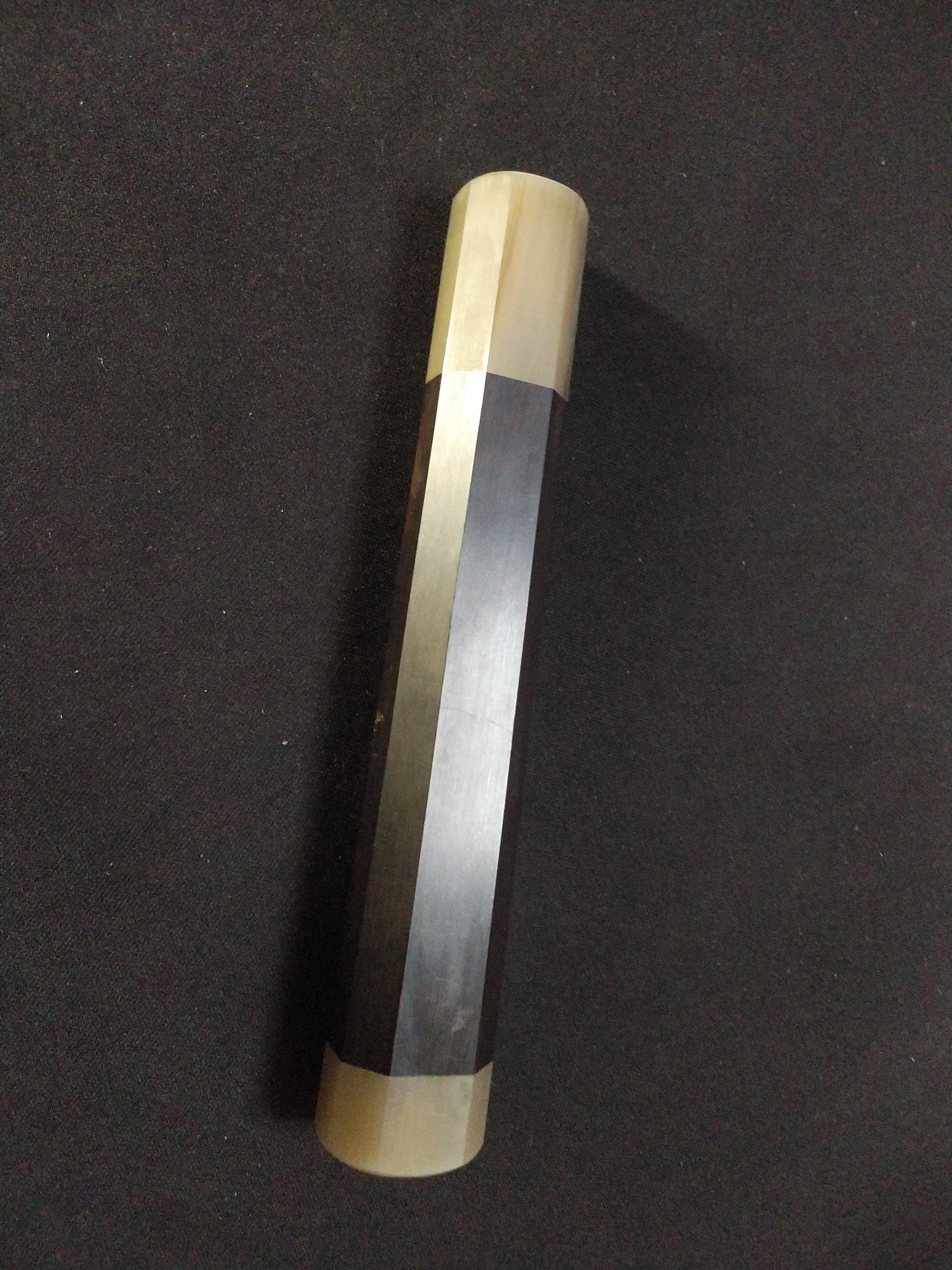
1-1. Ebony
Known for its deep black hue and rich texture, ebony has long been a symbol of luxury. This rare wood is often used for the handles of high-end Japanese knives, which are prized for their beauty and functionality by professional chefs and many others.
The unique properties of ebony make it an ideal material for knife handles. Its hardness and excellent water resistance are why it's often chosen for this purpose. Even after extensive use, it remains unchanged in color and shape, maintaining its beauty over time. As a result, ebony handles are often found on high-quality blades, such as those of traditional Japanese forged knives.
In addition, ebony is widely used in instruments, furniture, and crafts for its luxurious appearance. Its strength and durability allow for a wide range of applications. However, ebony is becoming increasingly rare, making it a difficult material to obtain, which further enhances the value of products made from it.
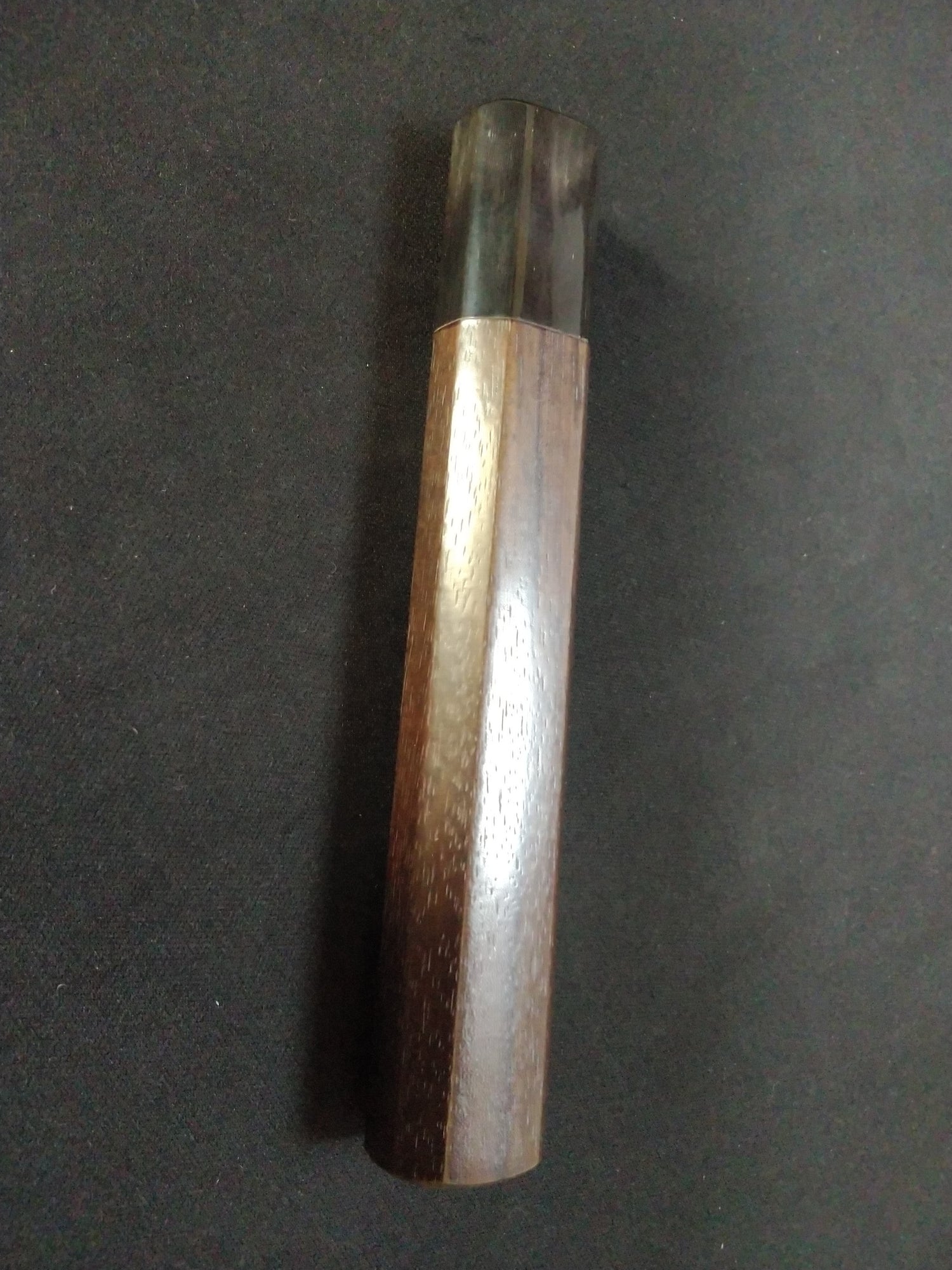
1-2. Rosewood (Shitan)
Known for its distinctive reddish hue, rosewood has a different appeal than ebony. This wood is hard, durable, and has an elegant luster, making it a favorite for knife handles, guitars, furniture, and many other uses. One of the greatest characteristics of rosewood is its resistance to moisture and dryness. Over time, the wood's color and texture will deepen, enhancing its beauty the more it is used.
Although rosewood is not as deep in color as ebony, its warmer tones are popular with many people and can be used as a substitute for ebony in some applications. However, ebony is more than just a substitute; its durability and value as a wood are highly prized. Every time you use a product made from ebony, you will be reminded of the quality of the material.
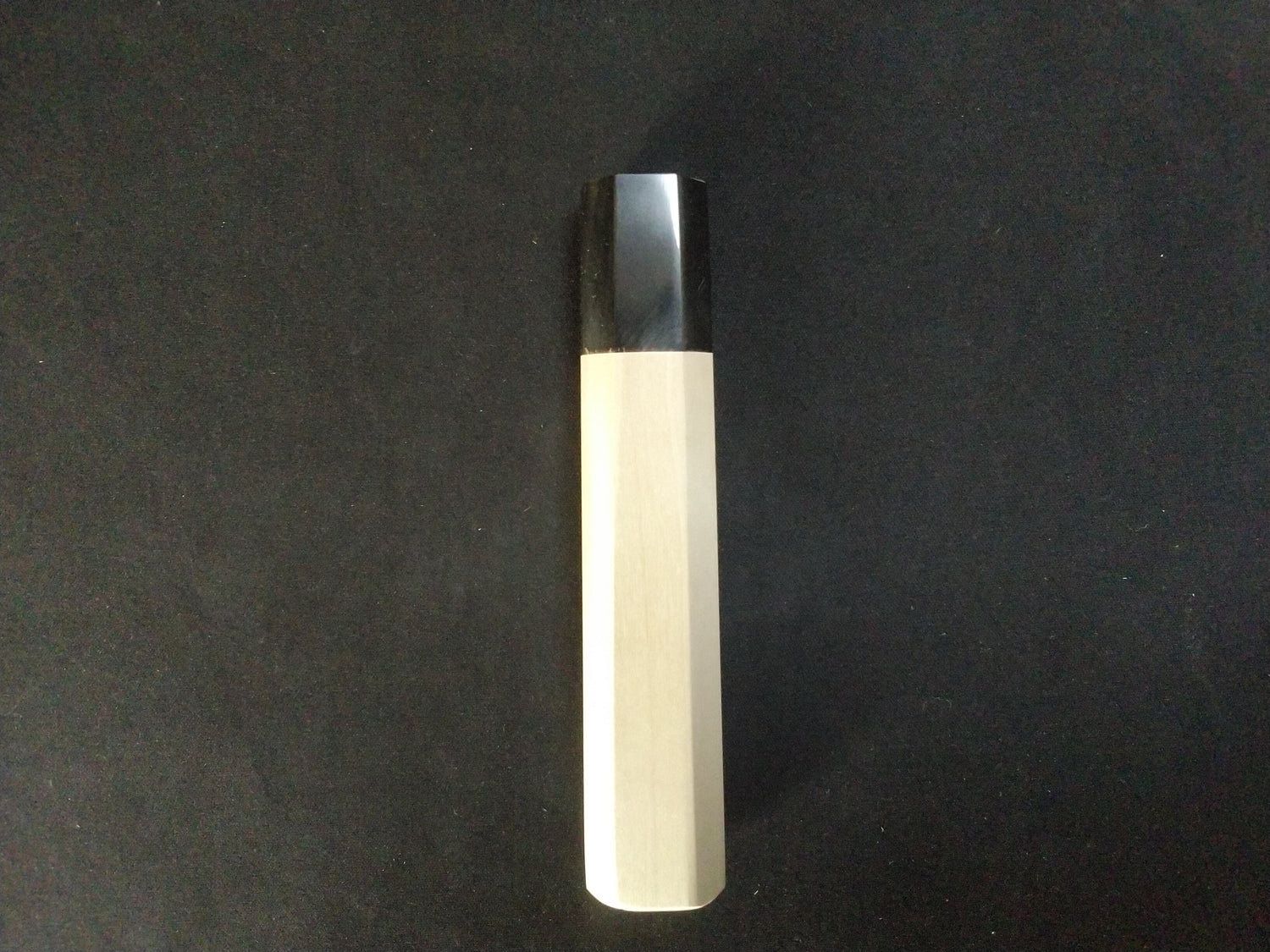
1-3. Magnolia Obovata (Ho Wood)
Japanese kitchen knives with traditional Ho Wood (magnolia) handles are chosen by professional chefs and food lovers around the world for their beauty and practicality. Ho Wood is the material of choice for many Japanese kitchen knives because of its white, smooth texture and its softness and warmth in the hand. This wood is water-resistant and durable enough to withstand prolonged use, and the more you use it, the more it conforms to your hand, increasing its comfort and appeal.
Magnolia wood is chosen for the handles of Japanese knives due to its unique properties. Not only does it have the practical advantage of being light and resistant to splitting, but it is also soft and comfortable to hold, making it easy to work with for long periods of time. For these reasons, it is especially appreciated by professional chefs, embodying the best of Japanese knife making by combining traditional techniques with modern needs.
Pros:
- Aesthetic Appeal: The natural beauty of wood adds a warm, classic look to the knife, with each wood type offering unique visual characteristics.
- Ergonomic Grip: These handles are designed for comfort, fitting snugly in the hand with some featuring anti-slip treatments for a better grip.
Cons:
- Maintenance: Wood handles require regular care, including oiling and thorough drying, to prevent damage.
- Moisture Sensitivity: Wood can swell or warp when exposed to water for prolonged periods, necessitating careful drying after use.
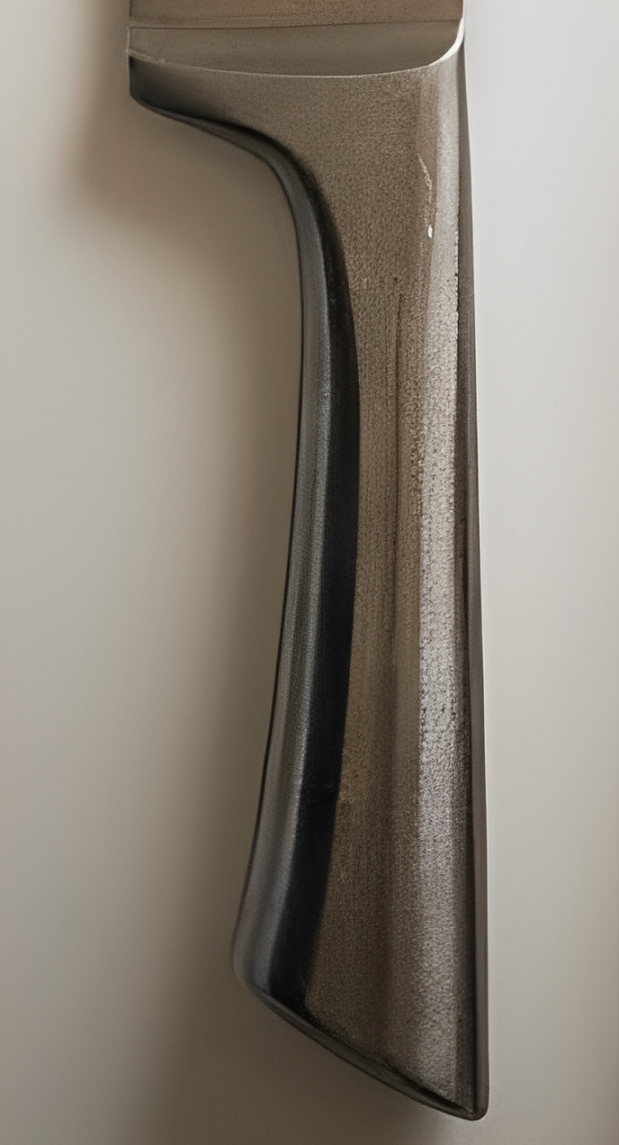
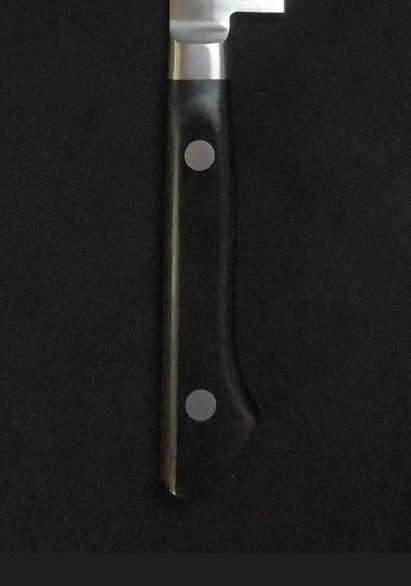
Pros:
- Durability: These handles are built to last, ensuring your knife withstands the test of time without the blade dulling or breaking.
- Ease of Cleaning: The smooth surface and minimal crevices make these handles simple to clean, maintaining hygiene with ease.
- Dishwasher Safe: Many stainless steel handles can safely be cleaned in a dishwasher, adding convenience to their maintenance.
Cons:
- Comfort: The lack of texture might make these handles slippery, particularly with wet hands, potentially reducing grip comfort.
- Aesthetic: Stainless steel handles might lack the warmth and character of wooden handles, which could be significant based on personal preference.
The Soul of the Blade: Why the Handle Matters as Much as the Edge
-

A Japanese knife’s handle is more than a grip — it is a bridge between the chef’s hand and centuries of tradition.
Different materials offer distinct stories of balance, comfort, and durability, shaping the knife’s character as much as the blade itself.


Choosing the Right Knife Handle — Where Tradition Meets the Hand
-

The Harmony of Blade and Handle
A blade forged from premium steel can last decades, maintaining its sharpness and elegance even under daily use. Yet, without the right handle, even the finest blade cannot perform at its best.
True precision and stability come from the synergy between blade and handle, allowing the knife to move as naturally as an extension of the chef’s hand. -

Materials That Carry Meaning
In Sakai, artisans carefully choose woods like ebony, prized for its weight, durability, and deep beauty. Its density provides balance, its smooth texture offers control, and its dark elegance reflects refinement in the kitchen.
Magnolia, rosewood, and other traditional materials are equally valued, each adding not only functionality but also a distinct personality to the knife.Lower-cost knives may rely on softer steel or synthetic handles. While practical at first, they lack the harmony and longevity of a handcrafted piece. A knife is more than a sharp edge—it is a lifelong partner, shaped by both blade and handle.
-

The Spirit of Sakai in Your Hand
To hold a Japanese knife from Sakai is to hold history, innovation, and trust.
The right handle does not simply balance the blade—it balances the chef’s spirit.
Selecting a handle is not just a choice of material, but a declaration of your passion for cooking and your respect for tradition.


How to Care for the Handle of a Japanese Knife — Protecting Tradition in Your Hands
-

1. Keep It Dry — Guard Against “Invisible Rust”
Unlike Western knives, Japanese knife handles are constructed simply: the tang is inserted into a wooden handle without screws or rivets. This elegance, however, requires vigilance.
If water seeps into the gap, rust can silently spread inside.Warning Signs:
- The knife suddenly feels unbalanced.
- When replacing the handle, the tang has thinned from corrosion.
Preventive Care:
- Always wipe the base of the blade dry after use.
- Never soak the knife in water or leave it on a wet board.
- Seal small gaps with beeswax or lacquer.
Even a few drops of water can slowly weaken the core of the knife. -

More Than Maintenance — A Relationship with Your Knife
A Japanese knife is not just a tool; it is a companion that grows with you.
The more you care for it, the more it becomes an extension of your hand, shaped by your style and spirit.Neglecting the handle shortens its life, no matter how sharp the blade remains. Many chefs discover too late that rust inside the handle has ended the journey of their trusted knife.
Sharpening is vital—but so is caring for the handle. With simple maintenance, your knife will serve you faithfully for decades, carrying forward both its beauty and the spirit of Japanese craftsmanship.


The Handle: Lifeblood of the Japanese Knife
-

Even the finest blade can fail from within. Protective care of the handle is essential, because a cared-for handle preserves the life and strength of the knife.

The Handle That Completes the Knife
-

The Language of Materials
Walk into the workshop of a traditional Japanese knife-maker and you will find, alongside the steel and the forge, a quiet collection of woods and composite materials — each with its own character, its own feel in the hand, its own relationship with time and use.
Natural wood is the oldest language. Ho Wood (magnolia), rosewood, ebony — each carries a warmth that no synthetic material has yet replicated. Natural wood responds to your hand: it absorbs the oils of your skin over years of use, shifting slightly in texture and feel, becoming incrementally more yours. That process of gradual personalization is, for many chefs, the whole point.
But natural wood requires a relationship. It asks to be dried after use, oiled occasionally, protected from the dishwasher and from prolonged contact with water. A neglected wooden handle will crack, warp, or loosen from the blade over time. The chefs who love natural wood handles most are the ones who understand that caring for a tool is not a burden — it is a practice.
For those who want the warmth of wood without the full commitment of maintenance, laminated composite woods — materials like Pakkawood and Micarta, where natural wood is saturated with resin and compressed under high pressure — offer a compelling middle path. The appearance and feel remain close to natural wood. The water resistance and durability improve substantially. The requirement for oiling disappears. These handles are particularly well suited to home kitchens where a knife moves frequently from prep to washing to storage.
At the more technical end of the material spectrum, G10 and carbon fiber represent the engineering approach to handle design. G10 is a fiberglass-reinforced laminate; carbon fiber is exactly what its name suggests. Both are extraordinarily hard, virtually immune to moisture, and feather-light relative to their strength. These materials ask nothing of the user in terms of maintenance. What they ask instead is a willingness to accept a purely functional aesthetic — there is no grain, no warmth, no character that develops over time. The handle performs, consistently and indefinitely, without change.
Between these poles sit synthetic resins — ABS plastic, nylon, and their variants. Durable, hygienic, impact-resistant, and available across every price point, these handles are workhorses. They are not the choice of a chef seeking a deep connection with their tools, but they are the reliable, unpretentious option for a kitchen where practicality comes first.
-

The Language of Shape
Material tells you what the handle is made of. Shape tells you how it thinks.
Japanese-style handles and Western-style handles approach the question of grip from fundamentally different philosophies — and understanding that difference changes how you hold a knife.
The round handle is the most forgiving shape in the Japanese tradition. Without angles or pronounced ridges, it accommodates any grip style without preference or correction. It suits chefs who switch naturally between pinch grip and handle grip, who don't want the knife to dictate their hand position.
The D-shaped handle is more opinionated. Its cross-section — flat on one side, curved on the other — fits the palm with a specificity that the round handle deliberately avoids. Most D-shaped handles are oriented for right-handed use, which gives left-handed chefs reason to pay attention before purchasing. Within that constraint, the D-shape offers something the round handle cannot: a consistent, repeatable orientation. Every time you pick up the knife, your hand finds the same position automatically.
The octagonal handle is the most precise of the three Japanese forms. Eight flat faces give the hand eight reference points, making fine adjustments to grip angle immediate and intuitive. Slippage under the pressure of long preparation sessions is dramatically reduced. This is why the octagonal shape appears most frequently on high-end traditional Japanese knives — it is not purely aesthetic. It is the shape that gives the most control.
Western-style handles approach the question of structure differently. The defining consideration is the tang — the extension of the blade's steel into the handle.
A full-tang construction runs the blade steel from tip to the end of the handle, sandwiched between two handle scales (slabs of material fixed on either side). The result is exceptional rigidity, a weight distribution that feels balanced and planted, and a construction whose structural integrity is visible and verifiable. Pull at a full-tang handle and nothing moves. For many Western-trained chefs, this solidity is deeply reassuring.
A semi-tang or hidden tang extends the steel only partway into the handle. Weight shifts toward the blade. The knife feels lighter at the back, more aggressive at the front — a quality that some chefs prefer for specific tasks where forward momentum matters.
Molded handles, constructed as a single seamless unit, eliminate the joints and seams where bacteria can accumulate. Many are dishwasher safe. In professional kitchens where hygiene protocols are strict and knives are cleaned repeatedly throughout a shift, this matters considerably.
-

The Handle as Philosophy
There is a reason that traditional Japanese knife-makers — including the craftspeople of Sakai who have shaped blades for 600 years — have always treated the handle as a serious decision rather than a finishing detail.
The handle is where the knife's story meets yours. The blade carries the maker's skill. The handle carries your daily life — the grip of ten thousand mornings of preparation, the particular pressure of your hand, the wear patterns that accumulate only through years of use.
To choose a handle carefully is to choose the terms of a long relationship. And in a kitchen where the right knife can change the quality of everything that follows, those terms are worth getting right.


Keep Knife Handles Clean
Remarkably, only 1 out of 50 individuals maintain clean kitchen knife handles, and an even smaller fraction,1 out of 100, keep the blade itself clean. Despite the diligence many exhibit in their cooking endeavors, kitchen knife care often falls by the wayside.


KIREAJI's Three Promises to You
-

1. Forged in the Legacy of Sakai
From Sakai City—Japan’s renowned birthplace of professional kitchen knives—each blade is crafted by master artisans with over six centuries of tradition. Perfectly balanced, enduringly sharp, and exquisitely finished, every cut carries the soul of true craftsmanship.
-

2. Thoughtful Care for Everyday Use
Every knife includes a hand-fitted magnolia saya for safe storage. Upon request, we offer a complimentary Honbazuke final hand sharpening—giving you a precise, ready-to-use edge from day one.
-

3. A Partnership for a Lifetime
A KIREAJI knife is more than a tool—it is a lifelong companion. With our bespoke paid aftercare services, we preserve its edge and beauty, ensuring it remains as precise and dependable as the day it first met your hand.


