A Knife Is Not Just Useful. It Is Meaningful.
-
Februray 9, 2026
-
Most products in the modern world are designed to be useful.
Faster. Cheaper. More efficient. More convenient.
That is not wrong.
But if we look at the world a little differently, we can describe almost every product using just two simple axes:
・Is it useful, or not?
・Is it meaningful, or not?
This creates four simple perspectives on value. And when we look at the world through this lens, something important becomes very clear. -
The Extreme of “Usefulness”
Let’s start with the world of pure usefulness.
A perfect example is a search engine.
Nobody chooses a search engine because it has a philosophy or a story.
They choose it because it works better.
In this world, only performance matters.
Speed, accuracy, convenience.
And when “usefulness” is pushed to its absolute limit, the result is simple:
One company takes almost everything.
There is no room for personality.
No room for story.
Only optimization.
This is what “useful” looks like at its extreme. -
Cars Explain the Four Worlds of Value
Now let’s look at cars.
1. Useful, but Not Very Meaningful
Many Japanese cars, such as Toyota and Nissan, are excellent machines.
They are reliable. Efficient. Well engineered. Affordable.
As tools for transportation, they are outstanding.
But emotionally, they are neutral.
You buy them because they make sense.
They are very useful, but the meaning is relatively thin.
That is why many of them live in the range of roughly $10,000 to $30,000.
2. Useful and Meaningful
Now look at Mercedes-Benz and BMW.
They are also excellent machines.
But they sell something more than function.
They sell an identity.
A sense of achievement.
A story about who you are.
A Mercedes is not just a way to move from A to B.
It is a statement.
Because of this added “meaning,” these cars often cost $50,000 to $200,000.
The difference in price is not function. It is meaning.
3. Not Very Useful, but Extremely Meaningful
And then there are Ferrari and Lamborghini.
From a practical point of view, they are almost absurd.
Two seats. Almost no luggage space. Too low. Too loud.
In daily life, they are not very useful at all.
And yet, they can cost hundreds of thousands or even millions.
Why?
Because they are not sold as tools.
They are sold as symbols.
They are machines made almost entirely of meaning. -
The Ceiling of Usefulness, and the Power of Meaning
This structure tells us something very important:
Usefulness has a ceiling.
Meaning does not.
When you compete only on usefulness, you are forced into:
・Price competition
・Endless optimization
・And eventually, sameness
But when you compete on meaning, you enter a different world:
・Identity
・Story
・Continuity
・And trust -
Now, Let’s Talk About Knives
Modern knives are extremely useful.
They are sharp, consistent, affordable, and easy to replace.
But most of them are also anonymous.
They have no face.
No history.
No story.
They are designed to be consumed. -
A Japanese Knife Is Something Else
A true Japanese knife, especially one born in Sakai, is not just a cutting tool.
It is the result of more than 600 years of accumulated knowledge.
Forged by artisans who devote their lives to mastering a single craft.
It carries:
・The hands of the maker
・The history of the place
・The philosophy of restraint and precision
In other words, it carries meaning.
-
-
A Knife That Stays With You, and Then Moves On
A meaningful tool is not something you simply use up.
It is something you live with.
We want you to use your knife for your entire life.
And then, one day, we want you to pass it on.
To your student.
To your child.
To someone who will continue the story.
A knife like this is not a product to be replaced.
It is a baton. -
What KIREAJI Exists For
KIREAJI does not exist to sell knives.
KIREAJI exists to build a bridge.
A bridge between:
・The maker and the user
・The past and the future
・One generation and the next
We deliver authentic Sakai knives from the workshop to kitchens around the world.
But what we are really delivering is not steel.
It is heritage.
It is connection.
It is story. -
The Real Question
A knife is not the goal.
A knife is a bridge on which stories travel.
So the real question is not:
“Which knife should I buy?”
The real question is:
Who will you pass it on to? -
About KIREAJI
KIREAJI connects the 600-year tradition of Sakai craftsmanship with kitchens around the world. We deliver authentic, handcrafted Japanese knives directly from master artisans—uniting heritage, innovation, and a lifelong respect for true craftsmanship.
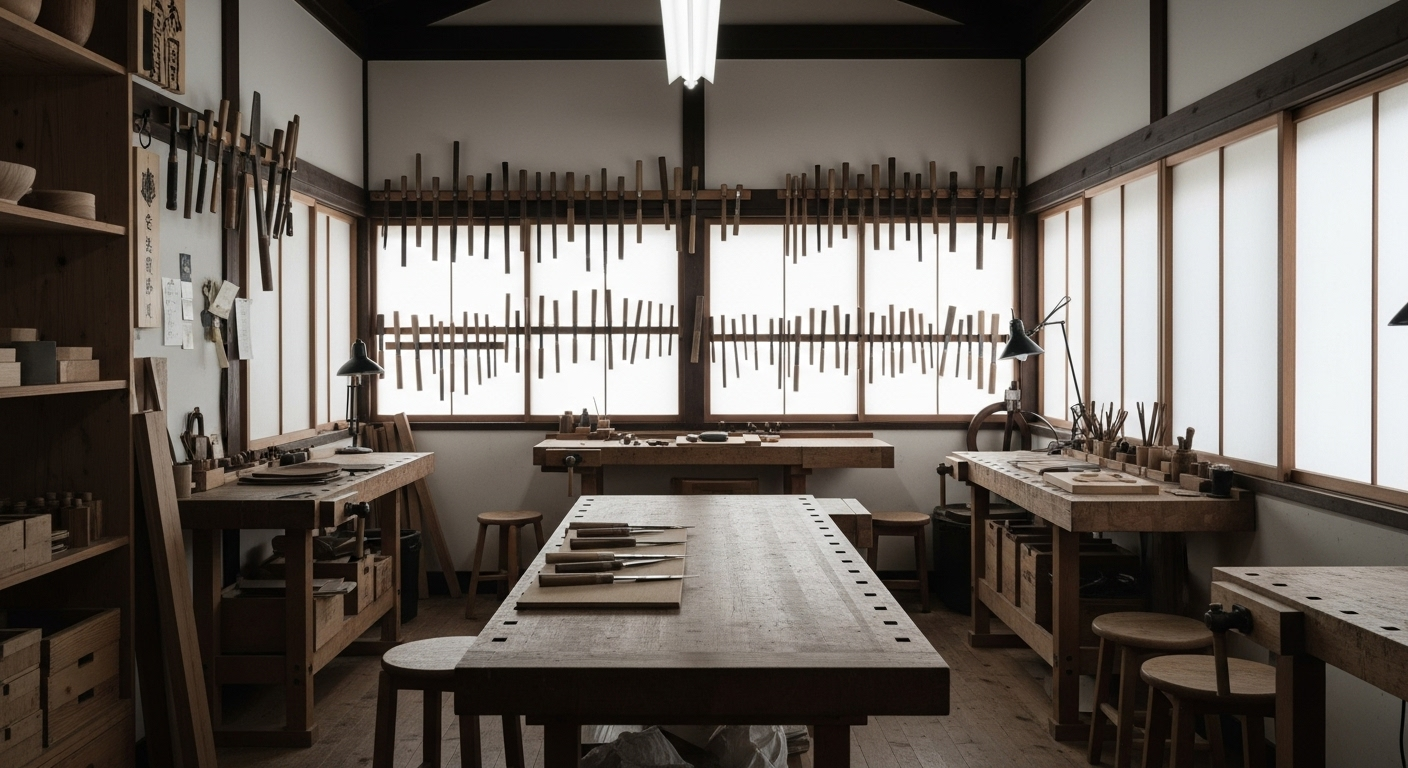
The Soul of Craftsmanship
-
From Our Hands to Your Life
When we forge a knife in Sakai, we are not thinking only about how sharp it will be on the day it is finished.
We think about how it will be used, how it will age, and whose hands it will pass through.
A good knife does not end its life in the workshop.
It begins its life there.
Every blade carries the time, the skill, and the spirit of the people who made it.
And when it is used with care, it slowly begins to carry the time and the story of its owner as well.
The greatest joy for us craftsmen is not when a knife is sold.
It is when we hear that the knife is still being used many years later — or even passed on to the next generation.
A knife is not just a tool.
It is something that lives in a kitchen, grows with a family, and becomes part of someone’s story.
I am grateful that KIREAJI does not simply send our knives to the world,
but also carries the spirit and the story behind them.
If a knife we made in Sakai becomes a part of your life, and one day a part of someone else’s life too,
then our work has truly been worth doing. -
Experience the sharpness trusted by 98% of Japan’s top chefs — handcrafted in Sakai City.
Through our exclusive partnership with Shiroyama Knife Workshop, we deliver exceptional Sakai knives worldwide. Each knife comes with free Honbazuke sharpening and a hand-crafted magnolia saya, with optional after-sales services for lasting confidence.
KIREAJI's Three Promises to You
-
1. Forged in the Legacy of Sakai
From Sakai City—Japan’s renowned birthplace of professional kitchen knives—each blade is crafted by master artisans with over six centuries of tradition. Perfectly balanced, enduringly sharp, and exquisitely finished, every cut carries the soul of true craftsmanship.
-
2. Thoughtful Care for Everyday Use
Every knife includes a hand-fitted magnolia saya for safe storage. Upon request, we offer a complimentary Honbazuke final hand sharpening—giving you a precise, ready-to-use edge from day one.
-
3. A Partnership for a Lifetime
A KIREAJI knife is more than a tool—it is a lifelong companion. With our bespoke paid aftercare services, we preserve its edge and beauty, ensuring it remains as precise and dependable as the day it first met your hand.