

Sakai Traditional Craftsman Collection: Mitsuo Yamatsuka
-

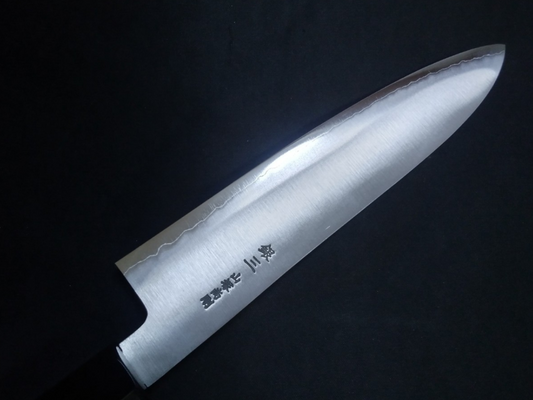 Sold out
Ginsan Gyuto 225mm
Regular price $810.00 CADRegular priceUnit price per$0.00 CADSale price $810.00 CADSold out -
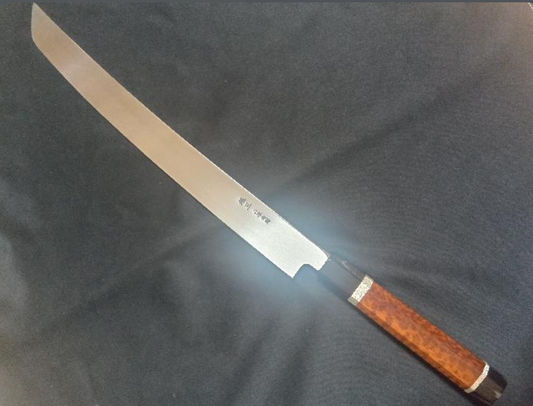
Ginsan Yanagiba (Sakimaru) 390mm - Hand-Engraved Dragon
Regular price From $4,000.00 CADRegular priceUnit price per$0.00 CADSale price From $4,000.00 CAD -
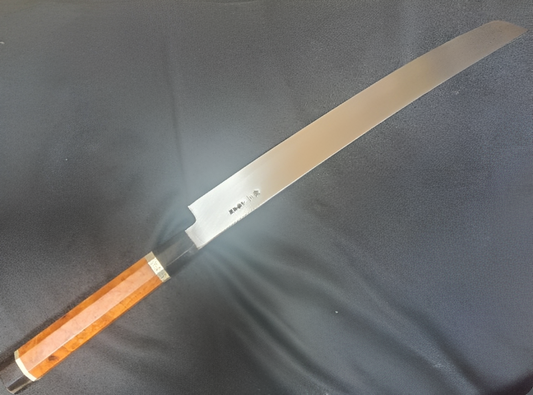
Ginsan Yanagiba (Sakimaru) 420mm - Hand-Engraved Dragon
Regular price From $4,250.00 CADRegular priceUnit price per$0.00 CADSale price From $4,250.00 CAD


Mitsuo Yamatsuka: The Pursuit of Sharpness Without End
-

The Path of a Sharpener: Began His Career in 1974
Mitsuo Yamatsuka began his career as a sharpener in 1974, dedicating himself to the traditional sharpening culture of Sakai knives. In 1985, he established the Yamatsuka Knife Polishing Workshop, where he continued refining both traditional and innovative polishing techniques.

Mitsuo Yamatsuka: The Sharpener Who Has Never Stopped Searching
-

The Craft He Inherited and Made His Own
Yamatsuka is a toishi craftsman — a sharpener — working within the tradition of Sakai uchihamono, the forged blades of Sakai City that have been produced for over six centuries. In Sakai's traditional knife-making structure, the roles are divided: the blacksmith forges and heat-treats, the sharpener grinds and finishes. The sharpener is not merely the last step in a production process. They are the person who brings the blade to its finished state — who takes what the forge has made possible and makes it actual.
This is the tradition that Yamatsuka entered in 1974, and in which he has worked ever since. In 1985, he established Yamatsuka Hamono Kenmasho — Yamatsuka Blade Polishing Workshop — formalizing what had already become a dedicated practice. In 1999, he received the certification of Dentō Kōgei-shi, Traditional Craftsman, the national government's formal recognition that his skill had reached the highest level the designation measures.
The certifications and awards that followed — the Osaka Prefecture Governor's Award for Craft Achievement in 2014, the listing in Sakai City's Maister Register in 2015, the Sakai Technical Skill Award in 2018, the Kinki Bureau of Economy Trade and Industry Director-General's Award in 2020, and the Osaka Prefecture Outstanding Technician Award — Naniwa no Meikō, the "Master Craftsman of Naniwa" — in 2023 — trace the arc of a career that has been recognized, repeatedly and from multiple directions, as representing something that the tradition values most.
But awards are not what Yamatsuka is known for among the craftsmen and professionals who work with him. He is known for the question. And for the answer, which keeps changing.
-

What He Specializes In: Three Kinds of Mastery
Yamatsuka's expertise spans the full range of knife finishing: single-bevel kasumi polishing, honto finishing with natural whetstones, and double-bevel sharpening. This breadth is not incidental — it reflects a sharpener who has studied the full landscape of what a blade can be and what it requires, rather than mastering one approach and applying it universally.
The single-bevel kasumi polish — the finishing technique specific to traditional Japanese knives with their laminated steel-and-iron construction — is the work that most directly expresses the aesthetic dimension of Yamatsuka's craft. The kasumi finish is not simply sharp. It is beautiful in a specific way: the matte iron of the blade's flat face, the polished steel of the cutting bevel, and the transition between them that gives the knife its characteristic misty appearance. Achieving this correctly requires understanding the blade's geometry, the properties of the materials, and the behavior of the stones — and then integrating all of this into a finished surface that is both functionally excellent and visually precise.
The honto finishing with natural whetstones takes this further. Natural stones — quarried from specific geological deposits, each with its own particle characteristics, hardness, and behavior — produce a quality of edge that synthetic stones cannot fully replicate. They are unpredictable in a way that demands skill: each stone is different, each combination of stone and steel produces different results, and the sharpener who works with natural stones must read what is happening in real time and respond. Yamatsuka's mastery of this finishing stage is one of the elements that makes his work distinct.
And the double-bevel sharpening — the technique applied to Western-style knives and to Japanese knives designed for bilateral use — completes a range that allows Yamatsuka to work across the full spectrum of professional kitchen blades. He does not have a single answer to what a blade should be. He has the knowledge to find the right answer for each blade he is given.
-

The Transmission: Teaching His Sons
There is a dimension of Yamatsuka's work that extends beyond his own hands and his own stones: the transmission of what he knows to the next generation.
His sons have entered the craft. They are learning alongside him — not from manuals or courses, but in the way that craft knowledge has always been transmitted most effectively: through presence, through imitation, through the gradual accumulation of embodied understanding that can only happen in the presence of someone who already has it.
This transmission is not a simple reproduction. Yamatsuka is not teaching his sons to do what he does in the way he does it. He is teaching them the fundamental principles — the reading of the blade, the management of the stone, the judgment about what the edge is doing and what it needs — that will allow them to develop their own answers to the question he has spent his career asking.
This is the deepest form of inheritance: not the specific technique, but the commitment to the question. The son who has learned from Yamatsuka has not learned a method. He has learned an orientation — the understanding that the answer to "how sharp can this knife be?" is never final, that the stone and the blade have more to say than any single sharpening session can reveal, that the work of a lifetime is the willingness to keep asking.
When Yamatsuka eventually steps back from the stone, this is what he will leave behind. Not the awards. Not the certifications. The question, alive in new hands.
-

What Fifty Years at the Stone Looks Like
It is worth pausing to understand what fifty years of dedicated practice in a single craft actually represents.
In 1974, when Yamatsuka began, the specific tactile knowledge he now carries — the knowledge of how this steel feels at this stage of sharpening on this stone, the knowledge of what the sound of the blade against the abrasive is communicating, the knowledge of when to apply more pressure and when to release it, the knowledge of when the edge is right — did not exist. It was accumulated, over five decades, through the repetition of the fundamental act: blade on stone, reading, responding, adjusting.
This knowledge is not in his memory. It is in his hands. It is in his eyes. It is in his judgment — the instantaneous assessment of a blade that tells him, before he has consciously processed anything, what this knife needs. This is the kind of knowledge that cannot be transferred through instruction alone. It requires time. It requires practice. It requires the long patience of someone who understands that the full depth of a craft is not available at the beginning, or in the middle, but only after the work has been sustained long enough for its full complexity to become familiar.
Yamatsuka has sustained it for fifty years. He shows no sign of stopping. The question is still not answered. The stone is still speaking to him.
-

The Question He Is Still Asking
Yamatsuka has been working in Sakai since 1974. He has held the certification of Traditional Craftsman since 1999. He has received recognition from the national government, the prefectural government, and the city of Sakai. His work has been demonstrated internationally, in contexts where the audience had never seen a Japanese sharpener work before, and the response has been the same as it is at home: something between respect and wonder.
And still, every morning, the question.
How sharp can this knife be?
The stone does not answer directly. It offers information — the resistance of the steel, the behavior of the abrasive, the way the edge is forming. Yamatsuka reads this information, responds to it, and the edge develops. When it is ready, he knows — not because a specification has been met, but because the blade is telling him it is done.
Then the next blade arrives.
The practice that began in 1974 continues today not because Yamatsuka has not yet found the answer. It continues because he understands, in a way that only fifty years of serious work can teach, that the answer is always in the process — in the next blade, the next stone, the next session at the sharpening bench where the question is asked again, with fresh attention, as if for the first time.
This is what a master craftsman is. Not someone who has completed the work. Someone who will not stop doing it.



Looking for a Knife by a Specific Craftsman?
Many of the most meaningful knives are found not through a catalogue, but through a conversation.
If there is a knife you have been searching for, tell us its story.
Whether you know the name of the craftsman, the type of knife, the steel, or only the feeling of what you are looking for, we would be pleased to hear from you.
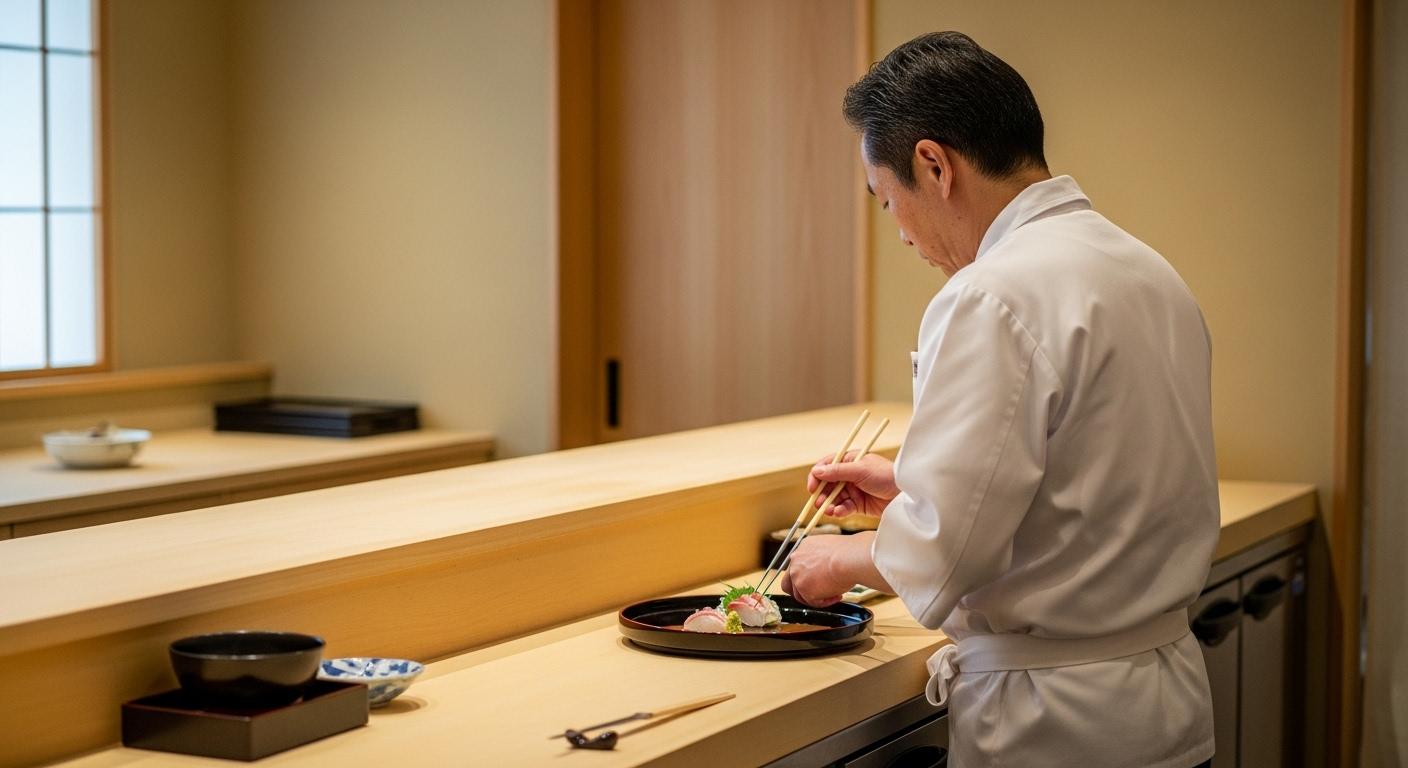
Why Do 98% of Japan’s Chefs Trust Sakai Knives?
For over 600 years, Sakai has perfected a unique craft where each stage—forge, sharpen, finish—is mastered by specialists. This tradition makes Sakai the birthplace of Japan’s most trusted knives.
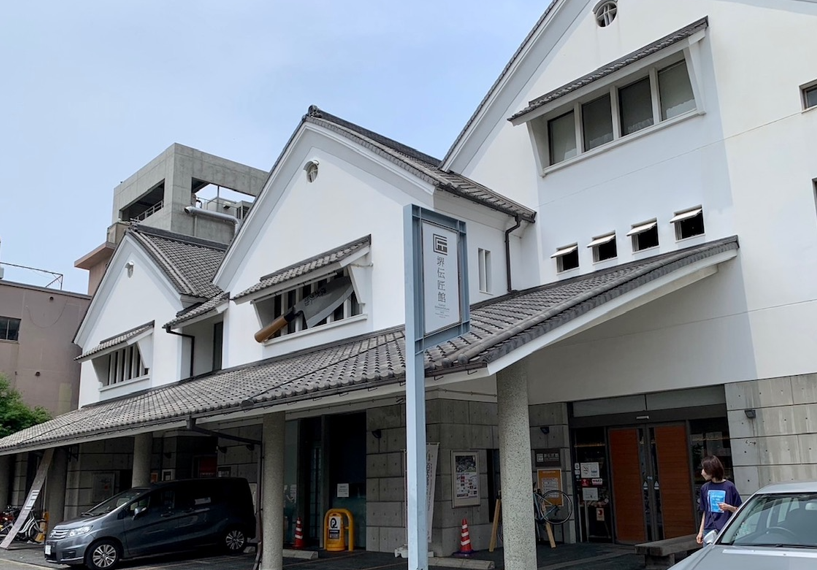
The 98% Statistic: More Than a Number
According to the Sakai Tourism Bureau, “98% of Japanese chefs use Sakai knives.” This figure isn’t just a claim—it reflects the deep trust chefs place in Sakai’s centuries-old craftsmanship.

Why are Sakai Japanese knives so sharp?
The answer is not one genius craftsman, but a system that makes compromise impossible.
This article explores how specialist masters, strict accountability, and a culture of focus create sharpness with meaning—one blade at a time.

The Master Craftsmen of Sakai Uchihamono
In Sakai, centuries-old techniques are carried forward by government-certified Traditional Craftsmen. Each knife is not just a tool but a living symbol of tradition, precision, and spirit—kept alive through their hands.

The Final Blades of a Retiring Blacksmith
A retiring blacksmith’s unfinished Blue Steel blades have arrived at KIREAJI.
Discover the quiet story of craftsmanship, legacy, and the continuation of Sakai knife culture.

Sakai’s Dwindling Masters: A Legacy at Risk
Once the heart of Japan’s finest cutlery, Sakai now has only a handful of blacksmiths left. With rising competition and fading interest among the young, new markets and fresh apprentices are vital to survival. Supporting these craftsmen means safeguarding a 600-year cultural legacy.
