

Sakai Traditional Craftsman Collection: Hirotsugu Tosa
-
Ginsan (Honyaki) Yanagiba (Sakimaru) 450mm -Mirror Polished (both sides)
Regular price $4,000.00 CADRegular priceUnit price per

Hirotsugu Tosa: The Spirit of Precision Without Compromise
-

The Path of a Sharpener: Began Apprenticeship at 19
Born in 1948, Hirotsugu Tosa entered the world of knife sharpening at the age of 19 under the guidance of his father. Through decades of dedication, he mastered difficult finishing techniques including Honyaki sharpening and mirror polishing for White Steel and Blue Steel blades.

The KIREAJI Difference
KIREAJI Complimentary Services
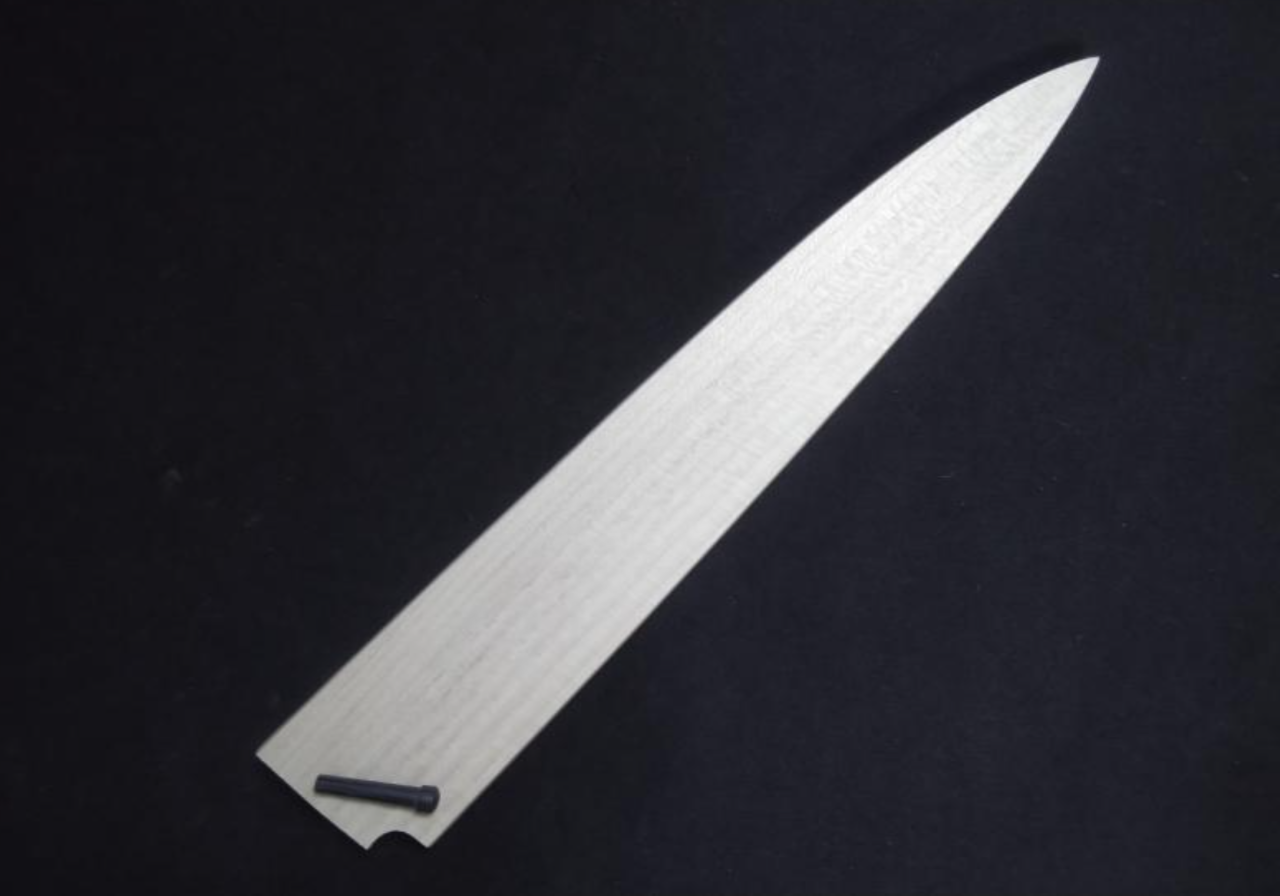
Every knife includes a magnolia wood saya, carefully selected and fitted to provide safe storage and protection. Upon request, we also provide complimentary Honbazuke, a practical initial hand-sharpening intended to prepare the knife for first use while allowing the owner to further refine the edge over time according to their own preferences.
Why Many Product Photos Show Only the Blade
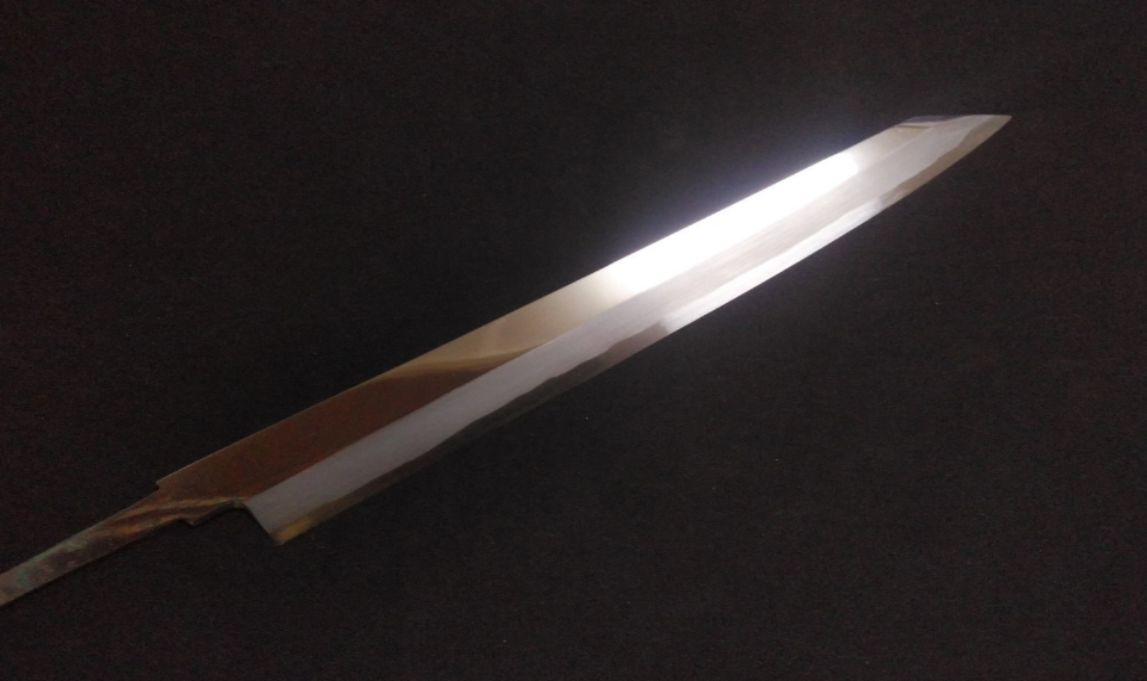
At KIREAJI, every knife is made to order in Sakai, Japan. Photos show the blade before the handle is attached, allowing artisans to perfect the balance and edge for your specific order. Your knife arrives fully finished — tailored just for you.

Global Delivery from Sakai
Across the world, discerning cooks seek authentic Japanese knives from Sakai — Japan’s legendary knife-making city with over 600 years of tradition.
At KIREAJI, we work alongside master artisans in Sakai to fulfill that desire, shipping genuine handcrafted knives directly from the workshop to kitchens worldwide.
Hirotsugu Tosa: The Sharpener Who Always Thought of the Cook First
-

Nineteen Years Old, and a Choice Made for Life
Tosa was nineteen when he began his apprenticeship under his father. The year was approximately 1967. The tradition he was entering had already been established for centuries — the toishi craftsman of Sakai, the sharpener who receives the forged blade and brings it to its finished state, was a role with deep roots and deep obligations.
An apprenticeship to a parent is a particular kind of beginning. The technical transmission is intertwined with something more personal — the knowledge of watching a specific person do this specific work, day after day, until the movements and the judgments and the standards of that person become part of your own understanding. Tosa learned sharpening from his father in this intimate way, and the depth of that learning became evident in everything that followed.
In 1990, more than twenty years after entering the craft, Tosa received the certification of Dentō Kōgei-shi — Traditional Craftsman — the national government's recognition that his skill had reached the highest standard the designation measures. Twenty years to the certification. The certification was not the beginning of the mastery. It was the acknowledgment of mastery already achieved.
-

The Work He Was Known For
Tosa's specialization placed him among the most technically demanding territory in Sakai's knife-making tradition: honkayaki sharpening and mirror-finish polishing.
Honkayaki — the single-steel blade that represents the pinnacle of Japanese knife construction — demands more of the sharpener than any other blade type. Because the entire knife is made from a single piece of hard steel, there is no soft iron back face to ease the sharpening. Every surface the stone touches is hard. The geometry that must be achieved is precise. The heat treatment that the blade has received — the quench that created the differential hardness visible in the hamon — must be fully realized by the sharpening rather than compromised by it. The sharpener of a honkayaki blade is not simply finishing a knife. They are the final participant in a process that began in the forge, and what they do either realizes or fails to realize everything that came before.
Mirror-finish polishing takes the blade to a level of surface refinement that makes its purpose primarily one of precision and beauty — the flat face of the blade, polished to the point where it genuinely reflects like glass, requiring a perfection of surface that tolerates no deviation. This is slow work. It is exacting work. It is work that cannot be hurried without compromising the result.
These were the specializations that Tosa was trusted with. The Sakai Takayuki-branded professional soba knives, the super-mirror finish blades, the Aogami No. 2 and Shirogami No. 2 honkayaki in their finished state — these represent the work that only a sharpener of the highest capability is given, because the consequence of error is not merely an imperfect blade but the loss of everything that went into making it.
He received the Osaka Prefecture Governor's Award at the Sakai Uchihamono Traditional Craft Competition in 2005. He was recognized in the 9th Japan Traditional Craftsmen's Association Exhibition in 2006, and again in the 12th Exhibition in 2009. In 2015, he received the Osaka Prefecture Outstanding Technician Award — Naniwa no Meikō — and was designated a Sakai City Monozukuri Meister, a Master of Making.
These recognitions were given because what Tosa produced was, consistently, at the level that the tradition's highest standards required.
-

The Devotion to Detail That Permitted No Compromise
The other quality that is consistently cited in every account of Tosa's work is his refusal to accept approximation in detail.
In craft production, there is always a moment — sometimes many moments — where the work is close enough to complete, where the additional time and attention required to close the remaining gap between what has been achieved and what is possible might seem disproportionate to the marginal improvement it would produce. Most production-oriented contexts reward the decision to accept close enough. The craftsman who insists on closing every gap, every time, works more slowly than the craft's commercial logic would prefer.
Tosa closed the gaps.
Not because he was unable to judge when a knife was commercially acceptable. But because his standard was not commercial acceptability — it was the best that the blade could be. And the best that a blade can be is determined by attending to the details that the casual observer does not see and that only the cook who uses the knife daily will eventually feel.
The mirror finish that is genuinely a mirror — not approximately a mirror, but actually reflective to the standard of glass — requires the elimination of every scratch, every unevenness in the surface, every trace of the previous stage of polishing. This is achieved through patience and through the willingness to look, and look again, and begin again if what is seen does not meet the standard. There is no technique that shortcuts this. There is only the willingness to keep going until it is right.
This willingness was what made Tosa the craftsman that other craftsmen trusted with their most demanding work. The blade that cannot afford to be approximately finished — because approximately finished, at this level of construction, is a blade that fails to be what it was made to be — was the blade that went to Tosa.
-

Six Hundred Years, and Every Day
The commitment that ran beneath everything Tosa did was expressed in a phrase that he is remembered for: continuing daily practice while protecting the 600-year tradition of Sakai uchihamono.
This phrase could be read as humble — the craftsman acknowledging their place within something larger than themselves. And it is humble. But it is also something else: a statement of understanding about what a living tradition actually requires.
A tradition of six hundred years is not preserved by reverence. It is preserved by practice — by craftsmen who go to their stones every day and do the work at the standard the tradition requires, who learn from the generation before them and transmit to the generation after, who apply the accumulated knowledge of centuries to each individual blade without treating that application as routine.
Tosa understood this. His daily practice was not the performance of tradition. It was the tradition itself, continuing through his hands.
When he began his apprenticeship in 1967, the tradition he was entering was already ancient. When he received his certification in 1990, it had accumulated more. When he accepted the Naniwa no Meikō award in 2015, it had accumulated more still. And each day he went to his sharpening bench, the tradition continued — not despite the passage of time, but through it, carried forward by the attention he brought to each blade that passed through his hands.
-

What He Left
Hirotsugu Tosa lived from 1948 to 2026. Seventy-eight years. More than fifty of them at the sharpening bench, every day — one knife at a time, one edge at a time, one cook's needs at a time.
He left the tradition stronger than he found it — not because he changed it, but because he practiced it with full seriousness for the entire length of a professional life. The craftsmen who came after him, who trained alongside him, who watched how he worked and understood what standard he held himself to — they carry something that was formed in part by his example.
He left knives in kitchens that will outlast him. The edges he put on those blades have long since been sharpened over, refined by other hands, evolved through the ongoing relationship between cook and stone that a Japanese knife requires. But the geometry he established — the profile he chose, the judgment he exercised about what this specific blade needed — persists in the form of the knife itself, shaping how it will respond to every sharpening it receives from this point forward.
And he left a way of thinking about the work. The belief that the cook is present, implicitly, in every decision the sharpener makes. That the edge is not an end in itself but a means — a means of ensuring that the person who picks up the knife can do their best work. That the six hundred years of tradition the craftsman inherits is not a burden to be maintained but a gift to be honored, by practicing it as well as it can possibly be practiced, every day, for as long as the work continues.
This way of thinking is not stored in any museum. It is alive wherever someone picks up a stone and asks, sincerely, what this knife needs in order to be its best — and then does not stop until the answer has been given.
Tosa gave that answer, in full, for fifty years. We are grateful for every blade he touched.



Looking for a Knife by a Specific Craftsman?
Many of the most meaningful knives are found not through a catalogue, but through a conversation.
If there is a knife you have been searching for, tell us its story.
Whether you know the name of the craftsman, the type of knife, the steel, or only the feeling of what you are looking for, we would be pleased to hear from you.
Why Do 98% of Japan’s Chefs Trust Sakai Knives?
For over 600 years, Sakai has perfected a unique craft where each stage—forge, sharpen, finish—is mastered by specialists. This tradition makes Sakai the birthplace of Japan’s most trusted knives.
The 98% Statistic: More Than a Number
According to the Sakai Tourism Bureau, “98% of Japanese chefs use Sakai knives.” This figure isn’t just a claim—it reflects the deep trust chefs place in Sakai’s centuries-old craftsmanship.

Why are Sakai Japanese knives so sharp?
The answer is not one genius craftsman, but a system that makes compromise impossible.
This article explores how specialist masters, strict accountability, and a culture of focus create sharpness with meaning—one blade at a time.

The Master Craftsmen of Sakai Uchihamono
In Sakai, centuries-old techniques are carried forward by government-certified Traditional Craftsmen. Each knife is not just a tool but a living symbol of tradition, precision, and spirit—kept alive through their hands.

The Final Blades of a Retiring Blacksmith
A retiring blacksmith’s unfinished Blue Steel blades have arrived at KIREAJI.
Discover the quiet story of craftsmanship, legacy, and the continuation of Sakai knife culture.

Sakai’s Dwindling Masters: A Legacy at Risk
Once the heart of Japan’s finest cutlery, Sakai now has only a handful of blacksmiths left. With rising competition and fading interest among the young, new markets and fresh apprentices are vital to survival. Supporting these craftsmen means safeguarding a 600-year cultural legacy.
