

A Tradition Forged in Steel and Spirit

-

1-1. Wakashitsuke (Forge Welding) — Inheriting the Spirit of the Samurai Sword
The first step in Japanese knife forging is Wakashitsuke (forge welding), where steel and soft iron are fused at high temperatures through precise hammering. Rooted in the traditions of samurai swordsmithing, this technique remains a cornerstone of Sakai’s knife-making heritage.
-

-

1-2. Sakizuke (Preliminary Forging) — Building the “Skeleton” of the Blade
After forge welding, the process moves into Sakizuke (preliminary forging). Here, the craftsman shapes the skeleton of the knife, while further refining the steel’s grain for strength and edge retention.
Using both a mechanical spring hammer and hand hammer, the smith repeatedly heats and hammers the billet. This cycle of fire and hammering compresses the metal’s grain structure, making it finer and denser—a foundation for long-lasting sharpness.
-

Each steel type responds differently:
- White Steel (Shirogami): stretches easily, shaped in about 20 minutes for a 300mm Yanagiba.
- Blue Steel (Aogami): harder, resisting the hammer and requiring nearly double the time.
This stage is not simply shaping—it is infusing the blade with strength and character, laying the groundwork for quenching and sharpening. -

1-3. Shaping and Core Adjustment — Where the Beautiful Form Begins
Once the skeleton is established, the knife enters the shaping stage, where its elegant outline takes form. The smith cuts the han-gata (basic profile) from the forged billet—an essential step that defines all subsequent processes.
Next, the tang (the part inserted into the handle) is created, usually from softer iron for stability. Though hidden, this component is vital for the knife’s balance and durability.
-

The tip and edge are then shaped with a taper structure—thick at the base, thinning toward the edge—optimizing sharpness, comfort, and weight distribution.
At this stage, the artisan’s eye for millimeter-precise angles and thickness determines the knife’s usability. It is the design phase where functionality and beauty merge, marking the transformation of raw steel into a culinary instrument.
-

1-4. Yakinamashi (Annealing) — Giving the Metal a Moment of Rest
After forging, steel contains invisible internal stresses that can lead to warping or cracking. To relieve this tension, artisans perform Yakinamashi (annealing)—a heat treatment that gently reheats and slowly cools the steel.
This slow cooling process refines the grain structure, softens the metal for further shaping, and ensures greater sharpness and durability in the finished blade.
-

In Sakai, the steel is often cooled over a 24-hour period, giving it a moment of “rest.” Some traditional smiths still bury hot blades in straw ash, helping reduce oxidation while supporting a refined grain structure.
Annealing is not just technical—it reflects the artisan’s sensitivity and patience, preparing the steel to reveal its full potential. It is a quiet yet essential step behind the outstanding reputation of Sakai knives.


-

What looks like simple hammering is, in fact, a testament to the craftsman’s intuition and training. Each blow carries years of discipline, preparing the blade for its most transformative trial—quenching, where fire and water breathe life into steel.
-

2-2. Urasuki — The Soul Embedded in the Back of the Blade
One of the most distinctive features of Japanese knives is Urasuki, a subtle concave hollow on the back of the blade. Though almost invisible, this minute adjustment dramatically improves performance.
By gently striking the blade’s backside, the craftsman reduces its contact surface with food. The result: smoother cuts, cleaner releases, and effortless slicing. For professional chefs—especially those preparing sashimi or usuzukuri—this detail is decisive.
But Urasuki is more than physics. It is the craftsman’s empathy for the chef’s hand, ensuring that every motion is fluid and efficient. In this nearly hidden hollow rests the soul of the blade—a quiet innovation born of care, foresight, and tradition.
-

2-3. Yaki-ire (Quenching)— The Balance Between Hardness and Toughness
Quenching is one of the most intense, critical, and irreversible stages in knife-making.
Before heating, a special clay mixture called yakibatsuchi is applied to the blade. It prevents uneven heating, enhances cooling, and helps achieve the delicate balance of hardness and resilience. The workshop is often darkened so the smith can judge the steel’s glow with precision—a skill that takes decades to master. -

At about 740–780°C, the blade is plunged into water. In an instant, its soft internal structure transforms into martensite, giving the steel its legendary sharpness and strength. Timing is everything: a fraction too soon or too late can mean success or ruin.
Because quenching creates immense internal stress, long and thin blades often warp. To counter this, artisans pre-bend the blade, so that after quenching it straightens perfectly—a master’s foresight at work.
- Water quenching yields maximum hardness but risks cracks.
- Oil quenching reduces damage but produces a slightly softer edge.
The choice depends on the steel and the knife’s intended character.
-

2-4. Yaki-modoshi (Tempering)— Too Much Is as Bad as Too Little
After quenching, steel becomes extremely hard—yet brittle. To prevent chipping, artisans perform tempering (yaki-modoshi), reheating the blade to restore flexibility without losing sharpness.
At around 180°C, the steel is heated and then cooled. This relieves stress, balances hardness with ductility, and ensures strength that can withstand daily use. A 330mm Yanagiba, for example, is tempered for 30 minutes at 180°C before cooling, achieving the ideal harmony.
If the temperature is too high, the blade softens too much. Too low, and it remains brittle. Here lies the craftsman’s judgment: true mastery is balance.
Tempering is a moment of calm after quenching’s violence—a deep breath that allows the steel to settle into its final state. Only through tempering does the knife gain the resilience and reliability demanded by professional chefs. The coexistence of hardness and flexibility is the very definition of Japanese sharpness.


Discover the Allure of Forged Knives
Forged knives embody the height of craftsmanship, where strength, durability, and beauty come together in every blade.

Subzero Treatment
At KIREAJI, steel is rapidly cooled to sub-zero temperatures, creating blades with greater hardness, durability, and edge retention. Rooted in artisan skill, this advanced process transforms steel into knives of superior sharpness and long-lasting performance.

How Cooling Transforms Steel into a Sharp Blade
A knife’s sharpness is born through cooling. This article breaks down how temperature and cooling speed transform metal at a molecular level, revealing why heat treatment is one of the most critical—and fascinating—steps in making a great knife.

Why Knives Warp: Inside the Craftsman’s Battle with Steel
Knife warping is not a flaw—it is a challenge born from metallurgy and time. This article reveals why blades warp, how craftsmen confront residual stress and metal structure, and why patience is one of the most essential tools in creating a truly stable Japanese knife.
Technical Explanation of Aike in Japanese Knives
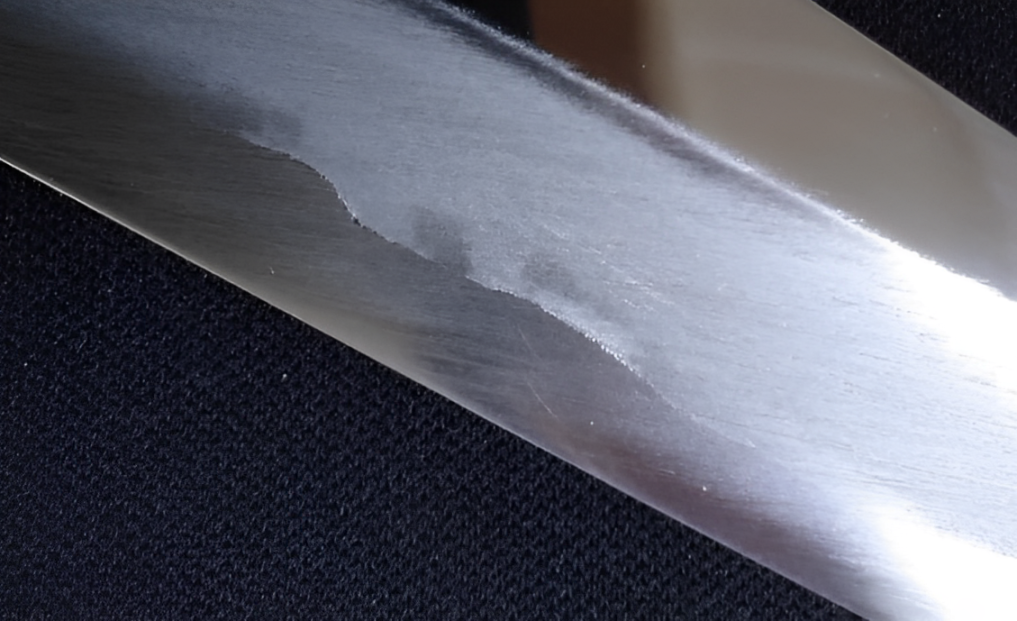
Traditional hand-forged Japanese knives may show very small natural variations that do not appear in machine-made products.
One of the most common examples is a phenomenon known as “Aike.” Aike is not a defect, but a characteristic sometimes seen in hand-forged knives, and it does not affect sharpness, safety, or overall quality in any way.

Forged vs. Stamped: Why Hand-Hammered Japanese Knives Are the Ultimate Choice
Choosing the right bevel is only the first step. To truly understand the soul of a Japanese knife, one must look into the fire. Discover how the traditional forging process creates a refined grain flow within the steel that mass-produced stamped knives simply cannot replicate.
-

3-1. Ara-togi (Rough Sharpening) — Laying the Foundation of Craftsmanship
Ara-togi (rough sharpening) is the first step, where the knife’s form and potential are established. Adjusting the blade’s thickness and geometry lays the structural foundation for everything that follows. It is no exaggeration to say that the future of the knife depends on this stage.
This stage has three core elements:
-

It is said that ara-togi determines over 80% of the knife’s final character. Far beyond grinding, it embodies the sharpener’s experience, intuition, and discipline, laying the true foundation of craftsmanship.
-

3-2. Hon-togi (Main Sharpening) — Defining the Knife’s True Identity
After ara-togi, the blade undergoes Hon-togi (main sharpening), where its final sharpness and appearance are refined. Here the blade is pressed against a whetstone to flatten surfaces, adjust thickness, and hone the edge.
The two primary objectives are:
- Hiramen-togi (Flattening the Blade Surface) — correcting irregularities and achieving uniform thickness for better sharpness and performance.
- Hasaki-togi (Sharpening the Edge) — carefully honing angle, thickness, and curvature, defining the knife’s cutting feel and usability.
-

The greatest challenge is preserving the shinogi (ridge line), where the bevel meets the flat surface.
“Sharpening the shinogi is the most difficult part. I hold my breath every time I do it.” — Master craftsman
-

3-3. Ura-togi (Ura Sharpening) — The Final Step That Defines Cutting Performance
The ura (back hollow) of the blade is carefully thinned and refined in ura-togi (ura sharpening). Though nearly invisible, it directly influences sharpness and cutting efficiency.
-

By reducing friction, the blade glides effortlessly through ingredients, producing clean, precise slices. With sashimi knives, the accuracy of ura-togi determines not only sharpness but also the texture and appearance of each slice.
Even the smallest adjustment in angle or pressure can make the difference between excellence and mediocrity. Ura-togi is thus the ultimate test of finesse and sensitivity, where the craftsman’s years of training converge.
-

3-4. Shiage-togi (Final Polishing) — Unlocking the True Potential of Sakai Knives
Shiage-togi (final polishing) is the last and most delicate stage, where the knife’s ultimate sharpness and beauty emerge. This is often described as the moment when the craftsman “breathes soul into the knife.”
Each blade is polished individually, with careful selection of whetstones—progressing from coarse, to medium, to fine. Through this gradual process, the knife attains both a razor-sharp edge and mirror-like finish.
This is not only technical work but a discipline of focus, patience, and devotion. Sometimes a single knife requires hours of polishing, every movement intentional, every detail considered.
At this stage, the knife transcends being a tool—it becomes a partner for the chef, reflecting their skill and amplifying their artistry.
And yet, the journey is not over. The blade now awaits its final union with the handle—only then is the Japanese knife truly complete.


4. E-tsuke (Handle Mounting) — Where Function Meets Comfort
-

After the blade is finished, the process moves to its crucial final stage: E-tsuke (handle mounting). Here, the knife transforms from a finely crafted blade into a complete instrument—not just a tool, but a true partner for the chef. Only when the handle rests naturally in the user’s hand does the knife truly come to life.
-


-

The diagram shows how different stages—steel selection, forging & heat treatment, edge finishing, and handle attachment—directly influence performance attributes such as sharpness, durability, balance, and comfort.
-

A knife becomes exceptional not by material alone but by the harmony of the steel that defines its potential, the forging that builds its core strength, the edge finishing that unlocks peak sharpness, and the handle attachment that shapes balance and feel.
When these elements work together with mastery, the blade achieves its full performance and lasting character.


Ⅱ. The Hollow That Changes Everything: Sakai's Hand-Crafted Japanese Knives
-

A City Built Around the Blade
Sakai, a city just south of Osaka, has been producing bladed tools for over 600 years. Its knife-making tradition grew from the manufacture of tobacco-cutting blades during the Edo period, and the expertise accumulated over those centuries has never left. Today, Sakai knives are recognized globally — not for their appearance, not for their marketing, but for what they do in the hand of someone who knows how to use them.
The secret, in large part, comes down to the ura-suki.
-

Not All Japanese Knives Have It
This is where it's worth slowing down, because there's a common misconception worth addressing.
Ura-suki is not a feature guaranteed by every Japanese knife, or even by every traditional single-bevel (kataba) knife. Other knife-making regions in Japan — Sanjo in Niigata, Echizen in Fukui — produce respected blades of their own, and some of their knives do include an ura-suki hollow. But the depth of commitment to this feature varies considerably from maker to maker, and mass-produced knives in particular often have a back that is nearly flat.
The honest summary is this: "Japanese knife" does not automatically mean ura-suki. You need to look at the individual knife.
When evaluating a knife, check the product description for phrases like ura-suki (裏スキ), ura-oshi (裏押し), or honbazuke (本刃付け) — the last referring to a proper final edge preparation that typically accompanies a correctly ground hollow. If you're buying a knife for breaking down whole fish or preparing sashimi, a genuine ura-suki hollow is worth seeking out specifically. For general home cooking, a high-quality knife without it may still serve you well — but for precision Japanese cutting techniques, the hollow earns its place.
What makes Sakai distinctive is not simply that its knives can have ura-suki, but that the tradition of making it correctly — with the right depth, the right curve, and the hand-finishing that the geometry requires — has remained consistently central to how the city's craftspeople work.
-

Why Mass Production Cannot Replicate It
The ura-suki hollow is also the reason Sakai's finest knives cannot be made by machine at scale.
The concave curve must be ground to precise tolerances — too shallow and it loses its effect, too deep and the blade loses structural integrity. Achieving it consistently, on each individual knife, requires a craftsperson who can feel the resistance of the steel and adjust in real time. There is no machine that has learned to do this.
And so each knife is finished by hand. One at a time.
This connects to a tradition that Sakai has maintained for centuries: the division of labor between specialists. The kaji — the smith — forges the body of the knife, shaping and hardening the steel through fire and hammer work. The togi — the sharpener — takes that rough blank and transforms it through a sequence of whetstones, each progressively finer, until the edge reaches its final geometry.
These are two separate crafts, each demanding years of apprenticeship. The togi alone works through multiple grades of stone, removing steel in increasingly fine increments, feeling for the exact angle and pressure that will produce an edge capable of slicing a ripe tomato with no downward pressure at all — just the weight of the blade. When that edge finally meets a halved avocado, passing through flesh and splitting the pit cleanly, it's the result of not one craftsperson's skill, but two.
-

How to Choose Wisely
If you're considering a Japanese knife and wondering whether ura-suki matters for your needs, here's a practical guide.
Look for it explicitly if you plan to fillet whole fish, prepare sashimi, or practice techniques that demand the clean, non-stick release a hollow back provides. In these contexts, the difference is not subtle — it's the difference between a knife that works with the ingredient and one that fights it.
For everyday cooking — vegetables, meat, general prep — a well-made knife without ura-suki may suit you perfectly well. The feature is most meaningful in precision applications.
And when shopping, don't assume that "single-bevel" or "Japanese-style" guarantees the hollow. Read the specifications. Ask the seller. Look at the back of the blade yourself if you can, holding it at an angle to the light. A genuine ura-suki will catch the light differently — you'll see the curve clearly once you know what you're looking for.
The regional origin is a useful signal — Sakai's commitment to the tradition is well-established — but it is not a substitute for examining the knife itself.


Differences Between Handcrafted Knives and Mass-Produced Factory Knives
There are two main types of knives: those carefully crafted by hand by artisans and those produced in large quantities by factories. Each type of knife differs significantly in terms of manufacturing process, quality, sharpness, durability, cost, and individuality.


KIREAJI's Three Promises to You
-

1. Forged in the Legacy of Sakai
From Sakai City—Japan’s renowned birthplace of professional kitchen knives—each blade is crafted by master artisans with over six centuries of tradition. Perfectly balanced, enduringly sharp, and exquisitely finished, every cut carries the soul of true craftsmanship.
-

2. Thoughtful Care for Everyday Use
Every knife includes a hand-fitted magnolia saya for safe storage. Upon request, we offer a complimentary Honbazuke final hand sharpening—giving you a precise, ready-to-use edge from day one.
-

3. A Partnership for a Lifetime
A KIREAJI knife is more than a tool—it is a lifelong companion. With our bespoke paid aftercare services, we preserve its edge and beauty, ensuring it remains as precise and dependable as the day it first met your hand.


