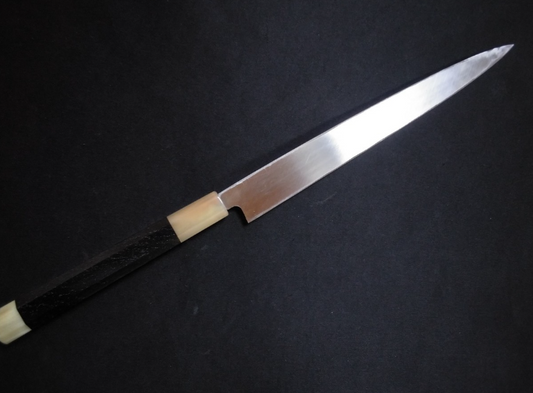
Left-Handed Japanese Knives
-
Not all knives are created equal—and not all hands are the same.
At KIREAJI, we offer traditional Japanese single-bevel knives crafted in Sakai in both right- and left-handed configurations, allowing cooks to choose a blade suited to their dominant hand.
In a traditional single-bevel knife, the orientation of the bevel and ura is designed for a specific hand, influencing how the blade moves through an ingredient and how naturally it can be controlled.
Choosing the correct orientation is not simply a matter of preference. For single-bevel Japanese knives, it is an important part of choosing a blade that works naturally with the person using it.
-
-
Crafted for the Hand That Leads
Most knives are made for the majority.
For left-handed cooks, that often means learning to adapt — not because they choose to, but because they have to.A knife that pulls slightly off course.
Cuts that require extra correction.
Movements that never quite feel natural.Over time, these small compromises become familiar.
You adjust your grip.
You change your angle.
You learn to work around the tool.Until the moment you hold a knife made for your hand.
And then, the difference can become clear.
The blade can feel more natural to guide.
The cut requires less compensation.
The knife begins to work with your dominant hand rather than asking you to adapt to it.This is why left-handed single-bevel Japanese knives matter.
-
Crafted with Care, Made in Limited Numbers
Creating a traditional left-handed single-bevel Japanese knife requires the blade to be made in the opposite orientation from its right-handed counterpart.
The bevel and the concave ura must be formed on the appropriate sides for left-handed use, so the knife works with the cook’s natural cutting direction rather than against it.
Producing this configuration requires the forging, shaping, and sharpening processes to follow the intended left-handed geometry from the beginning.
Because demand for left-handed single-bevel knives is smaller than for standard right-handed versions, they are generally produced in more limited numbers and may be more difficult to find.
When properly made for left-handed use, the reversed single-bevel geometry allows the knife to work more naturally with the user’s dominant hand.
What results is a knife that moves the way you move — and cuts the way you intend.
-
When a Knife Finally Fits
When a knife is made for your dominant hand, the difference becomes immediate.
Cleaner cuts.
More natural movement.
Greater control.But beyond performance, there is something else — a quiet sense of ease.
No adjustment.
No compromise.
Just the feeling of a tool that finally fits.For many left-handed cooks, it is the first time a knife truly feels their own.
Left-handed Japanese knives are not made for everyone.
They are made for those who have spent years adapting — and are finally ready to stop. -
Explore the Left-Handed Collection
Discover knives crafted for the hand that leads.
Left-Handed Japanese Knife Collection
-
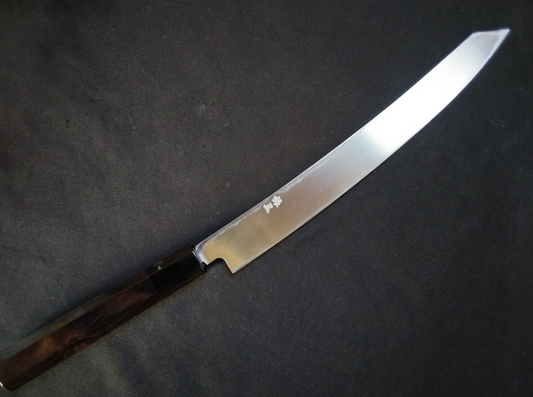
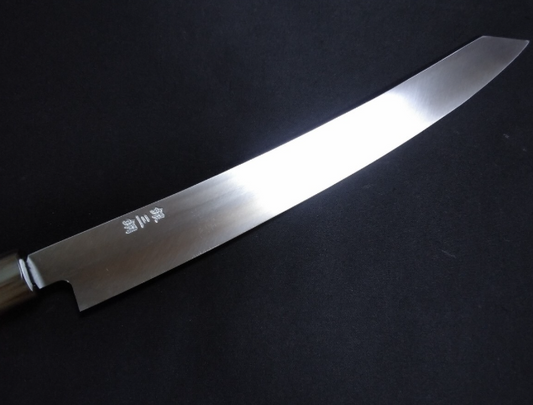
Ginsan Yanagiba (Kiritsuke) 270mm -Mirror Polished (one side) -Left handed
Regular price $530.00 CADRegular priceUnit price / per$0.00 CADSale price $530.00 CADSold out -
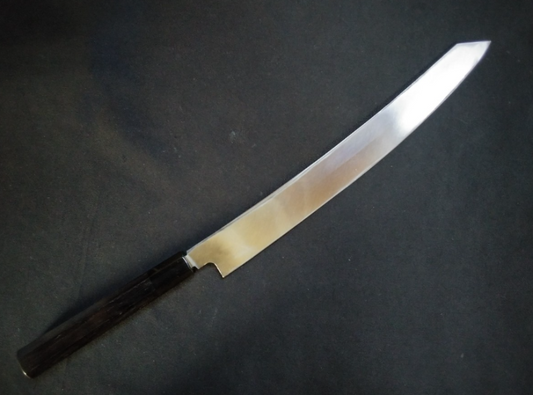
Ginsan Yanagiba (Kiritsuke) 300mm -Kido Finishing -Left handed
Regular price $550.00 CADRegular priceUnit price / per$0.00 CADSale price $550.00 CADSold out -
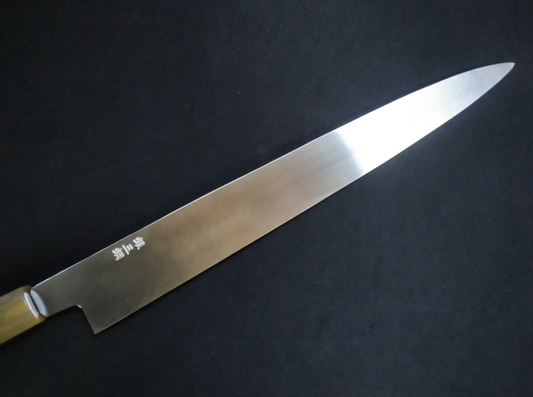
Ginsan Yanagiba 330mm -Kido Finishing -Left handed
Regular price $560.00 CADRegular priceUnit price / per$0.00 CADSale price $560.00 CADSold out -
Ginsan Yanagiba (Kiritsuke) 330mm -Mirror Polished (one side) -Left handed
Regular price $700.00 CADRegular priceUnit price / per$0.00 CADSale price $700.00 CAD -
Super Steel (Honyaki) Garasaki 180mm-Mirror Polished (both sides) - Left handed
Regular price $740.00 CADRegular priceUnit price / perSale price $740.00 CAD -
Super Steel (Honyaki) Fuguhiki 300mm-Mirror Polished (both side) -Left-handed
Regular price $870.00 CADRegular priceUnit price / per$0.00 CADSale price $870.00 CAD -
Super Steel (Honyaki) Yanagiba (Kiritsuke) 300mm-Mirror Polished (both side) -Left-handed
Regular price $1,000.00 CADRegular priceUnit price / per$0.00 CADSale price $1,000.00 CADSold out -
Super Steel (Honyaki) Yanagiba (Sakimaru) 300mm-Mirror Polished (both sides) -Left handed
Regular price $1,040.00 CADRegular priceUnit price / per$0.00 CADSale price $1,040.00 CADSold out -
White Steel #2 (Honyaki) Fuguhiki 240mm-Mirror Polished (one side)-Left handed
Regular price $1,280.00 CADRegular priceUnit price / per$0.00 CADSale price $1,280.00 CADSold out
-
Notice Regarding Left-Handed Sheaths
For left-handed knives, we currently provide the most suitable available right-handed sheath as an alternative.
Unfortunately, dedicated left-handed sheaths are not available at this time. We sincerely apologize for any inconvenience this may cause and greatly appreciate your understanding.
If you have any questions, please feel free to contact us.
-
Notice: Honbazuke Service for Left-Handed Knives Suspended Until Further Notice
At present, the craftsman who was previously responsible for the Honbazuke sharpening of left-handed knives is no longer available to provide this service.
In addition, our workshop is currently managing a very heavy workload, making it difficult to arrange the specialized coordination required for left-handed Honbazuke work.
As a result, we regret to inform you that this service is temporarily suspended until further notice.
At this time, we are unable to confirm when the service may resume.
We sincerely apologize for any inconvenience and deeply appreciate your understanding.
The KIREAJI Difference
KIREAJI Complimentary Services
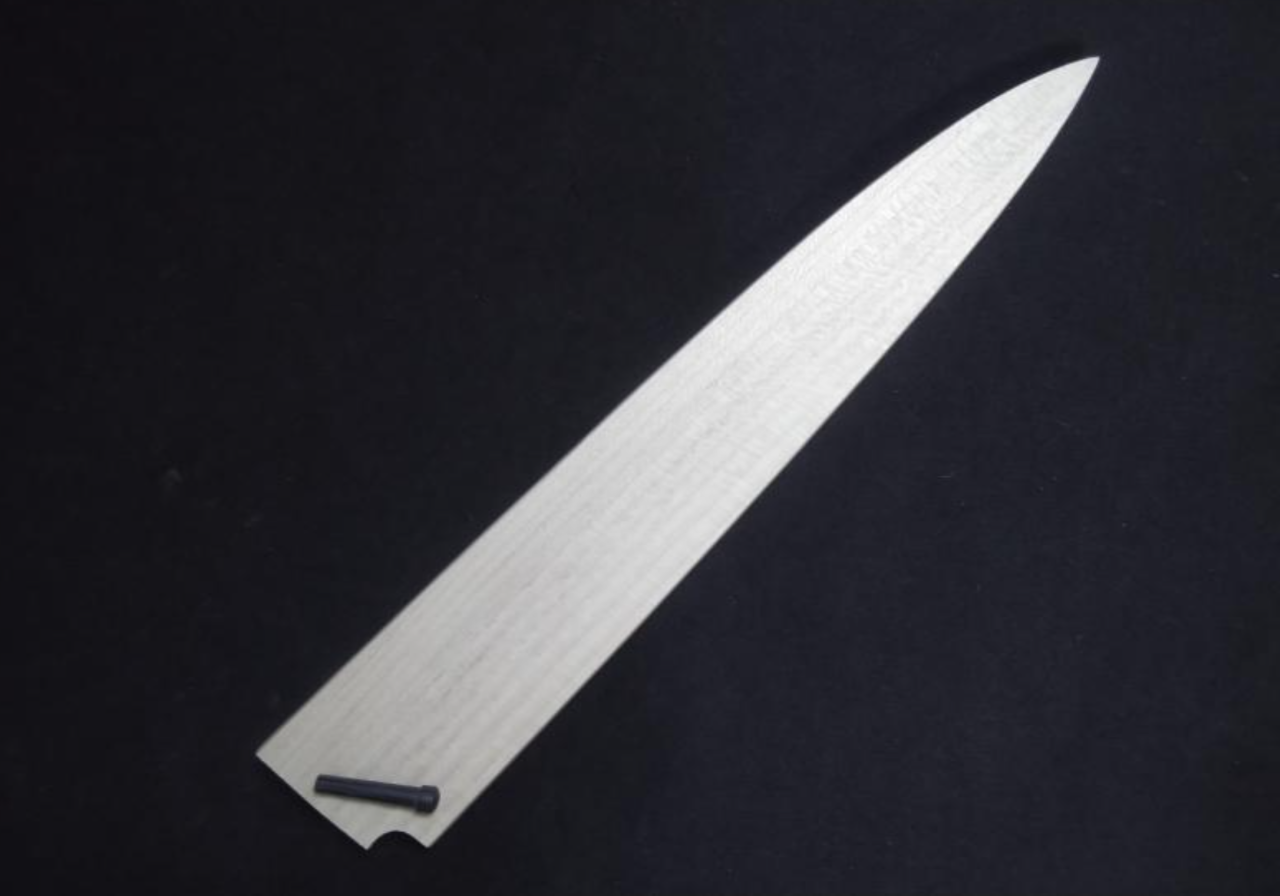
Every knife includes a magnolia wood saya, carefully selected and fitted to provide safe storage and protection. Upon request, we also provide complimentary Honbazuke, a practical initial hand-sharpening intended to prepare the knife for first use while allowing the owner to further refine the edge over time according to their own preferences.
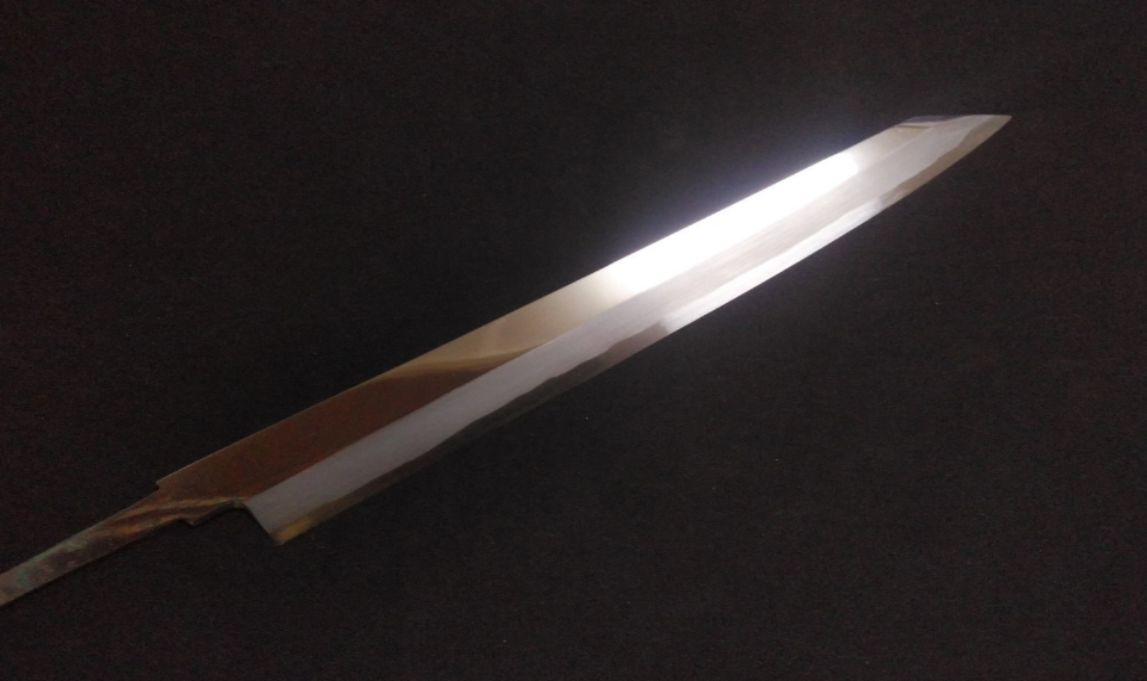
Why Many Product Photos Show Only the Blade
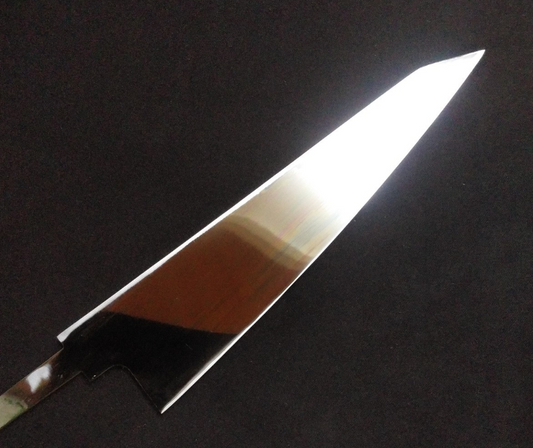
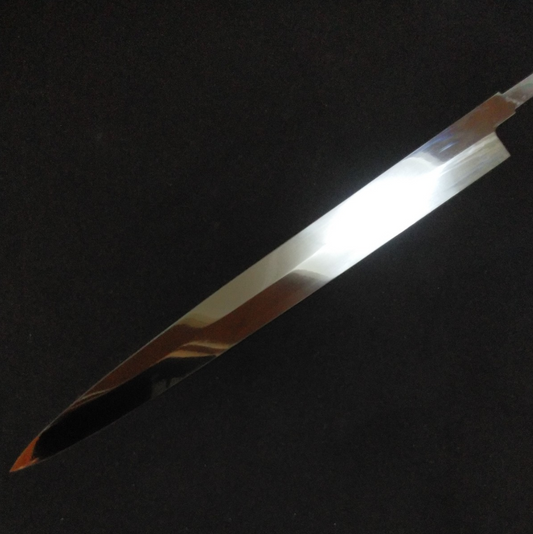
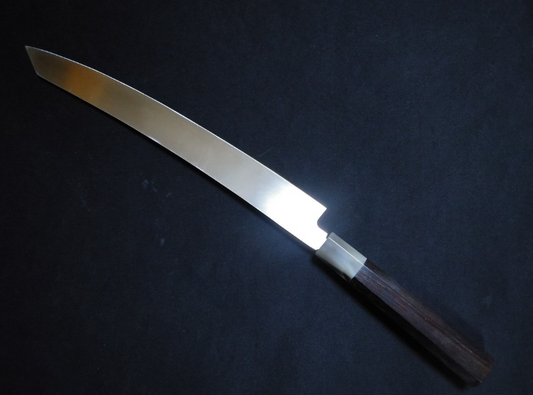
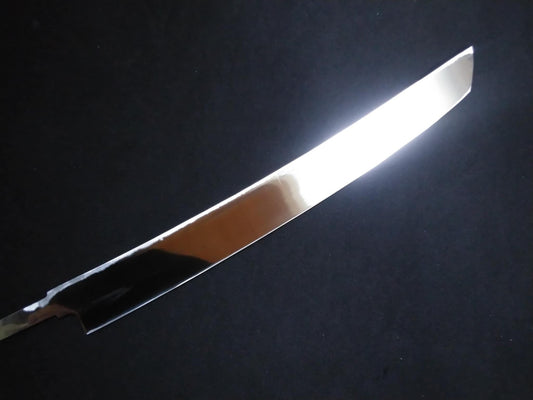
At KIREAJI, every knife is made to order in Sakai, Japan. Photos show the blade before the handle is attached, allowing artisans to perfect the balance and edge for your specific order. Your knife arrives fully finished — tailored just for you.
Global Delivery from Sakai
Across the world, discerning cooks seek authentic Japanese knives from Sakai — Japan’s legendary knife-making city with over 600 years of tradition.
At KIREAJI, we work alongside master artisans in Sakai to fulfill that desire, shipping genuine handcrafted knives directly from the workshop to kitchens worldwide.
Left-Handed Japanese Knives — Tradition, Craft, and the Perfect Fit
-
-
Why Left-Handed Versions Exist
In traditional Japanese single-bevel knives, the primary bevel is formed on one side, while the opposite side features a shallow concavity known as the ura. For left-handed use, this orientation must be reversed so that the blade geometry works naturally with the user’s dominant hand.
-
For this reason, left-handed single-bevel knives are made specifically for left-handed use. In Sakai, the bevel and ura are formed in the appropriate orientation from the beginning, allowing the knife to move through food in a way that suits left-handed technique.
-
-
Handedness in Japanese Culinary Tradition
Interestingly, in traditional Japanese cuisine, a chef’s handedness was not always determined by their dominant hand. For example, in the art of slicing sashimi, even left-handed apprentices were historically trained to cut with their right hand.
-
Why? Beyond mentor tradition, plating aesthetics played a key role: arranging sashimi from left to right allowed diners to pick up each slice easily with chopsticks—a gesture of hospitality and refinement. As a result, many left-handed chefs still use right-handed knives for specific tasks today.
-
KIREAJI’s Philosophy — Respecting the Hand’s Natural Sensitivity
At KIREAJI, we believe a knife should work naturally with the person using it, rather than forcing the user to adapt unnecessarily to the tool.
-
Our left-handed collection exists so that left-handed cooks can choose traditional single-bevel knives made in the correct orientation for their dominant hand. The goal is not simply convenience, but more natural control, greater confidence, and a closer relationship between the cook and the blade.
-
When the Knife Matches the Hand
-
For a left-handed cook, using a single-bevel knife made in the correct orientation can change the experience of control. The blade no longer asks the user to compensate for geometry designed for the opposite hand.
The difference is not simply technical. A knife that works naturally with the user can feel more intuitive, more personal, and more closely connected to the way they cook.
Why Are Left-Handed Knives More Expensive?
-
Around 10% of people are left-handed, yet most traditional single-bevel Japanese knives are produced primarily for right-handed use. For left-handed cooks, finding a knife made in the correct orientation is therefore more than a matter of convenience—it can make the blade feel more natural and easier to control.
But why do left-handed single-bevel Japanese knives often cost more than their right-handed counterparts? The answer lies largely in specialized production and lower demand.
-
-
1. More Time and Specialized Skill
Crafting a left-handed traditional single-bevel knife requires the blade geometry to be produced in the opposite orientation from a right-handed version.
The bevel and ura must be formed for left-handed use from the beginning, and because these knives are produced less frequently, they may require separate production planning, setup, or special-order work depending on the maker.
-
2. A Knife for Just 10% of the Population
Because demand for left-handed single-bevel knives is much smaller than for right-handed versions, production quantities are generally lower and some models are available only by special order.
Lower production volume can increase manufacturing and inventory costs, which is one reason left-handed versions may carry a price premium.
-
3. Precision That Passes the Most Rigorous Checks
Because left-handed single-bevel knives are produced in smaller numbers, their availability can be limited and lead times may be longer than for standard right-handed models.
-
A Tool Made for the Correct Hand
Owning a left-handed single-bevel Japanese knife means choosing a blade whose geometry is made for the way you naturally work. Rather than forcing the cook to compensate for a right-handed blade, the knife is configured to work naturally with the left hand.
For many left-handed cooks, that difference can bring greater control, confidence, and enjoyment to everyday cutting.
The Left-Handed Blade: Precision Crafted Against the Grain
-
Left-handed Japanese knives embody rarity shaped by mastery. Because artisans must reverse every step of the process, each blade demands far more time, focus, and control than a standard right-handed knife. With only 10% of the world able to use them, they become not just tools but personal, functional art—crafted with uncommon precision for those who need them most.
-
The Left Hand That Changed Everything
-
There is a particular kind of customer message that stays with you.
It is not the one that praises what you already offer. It is the one that shows you, quietly and without accusation, something you had not yet thought to provide. It arrives not as a complaint but as an expression of genuine love for the craft — and somewhere inside it is the recognition that the craft has not yet extended fully enough to include the person writing.
John's message was that kind of message.
-
A Customer from the USA, and a Question We Couldn't Ignore
John came to us as someone who already understood Japanese knives — not as a newcomer discovering the category, but as a person with a developed appreciation for what Sakai's tradition produces. He knew the difference between a blade made with genuine craft and one that borrowed the language of craft without the substance. He had found his way to KIREAJI because he was looking for the real thing.
And then he told us what he needed.
A left-handed Japanese knife. Not a Western knife with an ambidextrous bevel. Not a compromise. A true single-bevel Japanese knife, ground and balanced for a left hand, made by the craftspeople of Sakai in the same tradition that has produced some of the finest blades in culinary history.
We sat with that request for a moment. Not because we didn't understand it — we understood it immediately — but because we understood what fulfilling it honestly would actually require.
-
Why This Was Not a Simple Request
For anyone who has not handled a traditional Japanese single-bevel knife, the distinction between a right-handed and left-handed version might seem like a minor variation. It is not. It is a fundamental rethinking of the object from the ground up.
A single-bevel Japanese knife — the kind used by Japan's professional chefs for cutting fish, preparing sashimi, and executing the precise cuts that define Japanese cuisine — is asymmetrical by design. The geometry of the grind, the ura-suki hollow on the flat side, the balance of the blade as it moves through food: all of these are calibrated for a specific hand. The right-handed version and the left-handed version are not mirror images in any simple sense. They are different objects, requiring different geometry, different grinding sequences, different considerations at every stage of production.
Creating a left-handed Honyaki Yanagiba — the blade we committed to developing for John — means rebuilding that geometry entirely. The heat treatment must be reconsidered. The grind must be reconsidered. The balance must be reconsidered. Every decision that a craftsperson makes in the production of a right-handed knife must be re-examined in the context of a hand that approaches the blade from the opposite direction.
This is why left-handed traditional Japanese knives are extraordinarily rare. It is not that the demand hasn't existed. It is that meeting the demand honestly requires a level of craft commitment that most producers have found easier to decline than to undertake.
-
The Conversation with Shiroyama Knife Workshop
We brought John's request to Shiroyama Knife Workshop in Sakai — the craftspeople we work with, whose skill and standards we trust, who have been making knives in this tradition for decades.
We want to be honest about how that conversation went. It was not a simple "yes." It was a discussion — about what left-handed production actually requires, about the additional complexity at each stage of the process, about whether the result could genuinely meet the standards that both we and the workshop hold for every knife that leaves Sakai under our name.
What emerged from that conversation was something more meaningful than a straightforward agreement. It was a shared commitment. Shiroyama's craftspeople understood what was being asked of them — not just a custom order, but the development of a production capability that had not previously existed at this level of craft. They understood that doing it correctly would require time, care, and the willingness to work through the particular challenges that left-handed geometry presents at each stage.
They agreed to do it. Not quickly, not by approximation, but properly — the way Sakai does things.
-
What We Are Building Together
The first knife in this journey is a left-handed Super Steel Honyaki Yanagiba (Sakimaru) 300mm — a blade that, when completed, will represent something genuinely new: a left-handed knife made at the highest level of Sakai's craft tradition, produced through the same division of labor between smith and sharpener that defines everything Shiroyama makes.
Honyaki production — forging a blade from a single piece of high-carbon steel and hardening it through water quenching — is already among the most demanding techniques in Japanese bladesmithing. Only a small number of craftspeople in Japan possess the skill to execute it successfully. Doing it in left-handed configuration adds layers of complexity to a process that already has no room for approximation.
The work is currently underway. It will take the time it takes. We would rather wait for something made correctly than receive something made quickly.
But beyond this single knife, something larger has begun. We made the decision, as a direct result of John's request, to develop a left-handed collection — to ensure that what we are building is not a one-time accommodation for one customer, but a genuine and ongoing commitment to the left-handed cooks around the world who have been overlooked by an industry that has historically designed almost everything for the right hand.
-
The Larger Truth Behind This Story
John's request revealed something that we think matters beyond his specific situation.
Somewhere around ten percent of the world's population is left-handed. In kitchens around the world — professional and home, in every country — there are left-handed cooks who have spent their entire culinary lives working with tools designed for someone else's hand. They have adapted. They have compensated. They have made do with right-handed knives because there was nothing better available to them.
They deserve knives made for their hand, at the same level of craft that right-handed cooks have always been able to access.
This is not a niche. It is a community of people with the same depth of passion for cooking and the same appreciation for genuine craft that any of our customers bring. The fact that they have been systematically underserved by the knife industry is not their limitation — it is the industry's.
We intend to do something about it. One knife at a time, in collaboration with the craftspeople of Sakai, building the capability and the collection that left-handed cooks around the world have been waiting for.
-
To John, and to Everyone Who Has Waited
John's passion for Japanese knives moved us. Not in a sentimental way — in a practical one. It showed us a direction we needed to move in, and gave us the reason to begin.
We are grateful to him for trusting us with a request that went beyond what we offered. We are grateful to Shiroyama Knife Workshop for the seriousness with which they accepted the challenge. And we are grateful to every left-handed cook who has continued to love this craft despite the fact that the craft has not always loved them back equally.
The knife being made right now in Sakai exists because one person wrote to us and told us what he needed. That is what listening actually looks like, and that is what it can produce.
We hope John's knife, when it arrives, is everything the craft of Sakai is capable of being. We believe it will be.
And we hope that what begins with John's knife continues — quietly, carefully, knife by knife — until every left-handed cook who wants a genuine Sakai blade has one made for their hand.
That is the direction we are moving in. We will not stop until we get there.
The Soul of Craftsmanship
-
A Blade for the Left Hand — Honoring Every Chef’s Journey
For generations, most Japanese knives were made exclusively for right-handed users. For left-handed chefs, this meant working with tools that never truly fit—straining the grip, disrupting balance, and limiting precision.
That is why the left-handed knife holds such meaning. By reversing the structure of the blade—its edge, bevel, and spine—it becomes a tool that finally belongs in the left hand. With it, cutting feels natural, smooth, and confident. -
Creating left-handed knives is not a simple matter of flipping the design. Each one requires careful recalibration of angles and geometry, demanding extra time and skill from the craftsman. But this effort is worth it, because a knife should never limit its user—it should empower them.
Today, left-handed knives are more available than in the past, yet they remain a symbol of dedication to inclusivity in craftsmanship. For me, each blade I forge is a promise: every chef, regardless of hand, deserves a knife that feels truly their own. -
When a left-handed chef holds such a knife, it is more than a tool. It is an affirmation that their craft, too, has been honored with the same respect, care, and artistry.
How Japanese Knives Are Made: The Sakai Tradition
-
Sakai Forged Blades — Six Centuries of Craftsmanship
For more than 600 years, Sakai knives have been shaped through a tradition of specialized craftsmanship refined across generations.
Widely trusted by professional chefs in Japan and appreciated around the world, these knives are valued not only for their sharpness, but for the skill, precision, and consistency behind each blade.
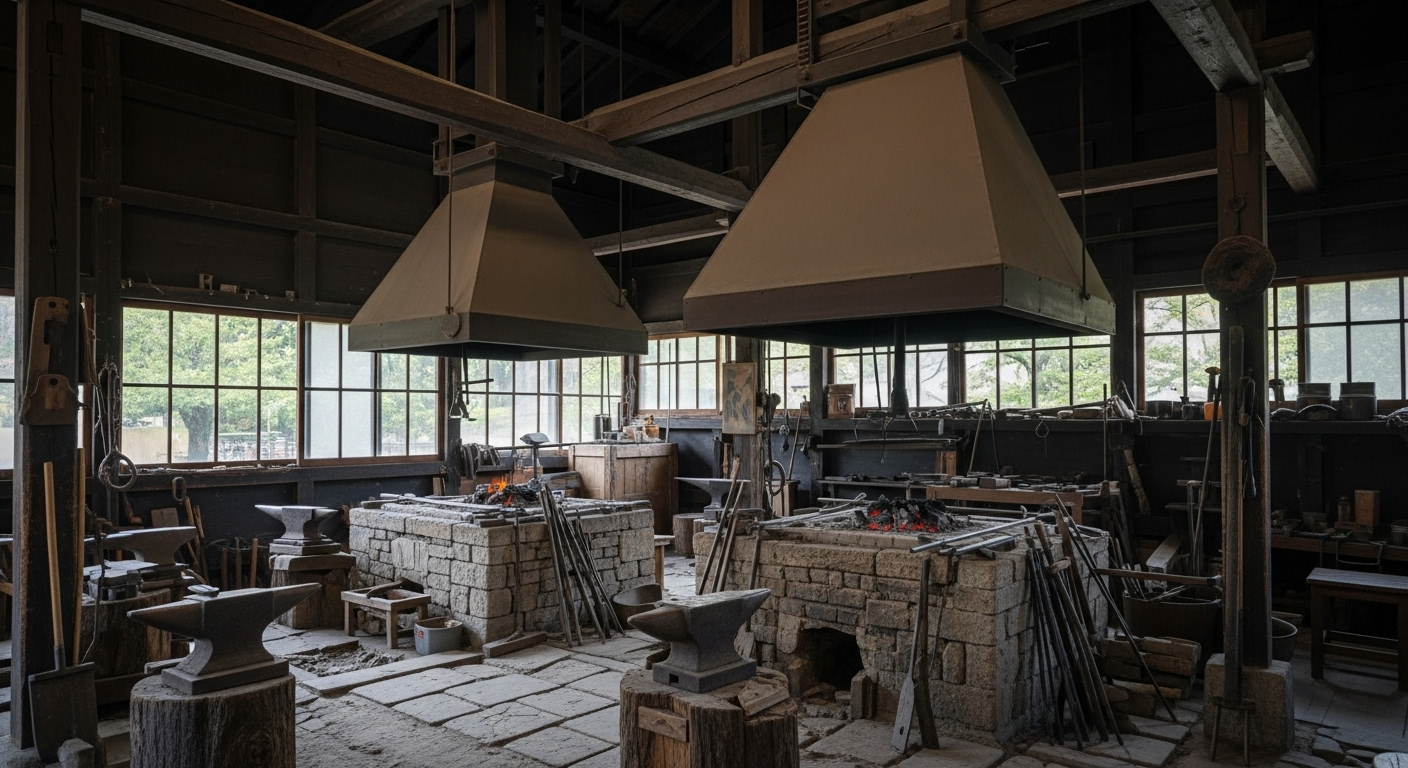
At KIREAJI, we work directly with the Shiroyama Knife Workshop in Sakai, Japan.Each knife is hand-forged, carefully finished by skilled craftsmen, and shipped directly from the workshop to kitchens around the world.
No mass production. No unnecessary intermediaries.
Only authentic Japanese craftsmanship, shaped one blade at a time. -
Video Provided: Japan Traditional Crafts Aoyama Square (YouTube)