Natural Whetstones
-
-
The Essence of Edge — Where Nature Refines Steel
At KIREAJI, we believe that the story of a Japanese knife finds its true soul not in forging, but in sharpening.
Our Japanese Natural Whetstone Collection celebrates this final chapter—where stone, water, and craftsmanship bring a blade to life.Each natural stone is born from Japan’s mountains, shaped by time, pressure, and the quiet work of nature. No two are ever alike. Their unique textures, hardness, and color tones invite each sharpener to discover their own rhythm — to feel the stone’s response through every stroke.
Natural whetstones are not merely tools—they are living materials that reveal the character of both the blade and the hand that guides it.
From the misty kasumi finish to the luminous mirror edge, they refine not only the steel but also the craftsman’s sensitivity.KIREAJI’s collection begins here, with select stones that embody the purest spirit of Japanese sharpening.
As our collection grows, we invite you to experience the timeless harmony of steel and stone — a dialogue that continues to shape the soul of every knife. -
Japanese Natural Whetstone Collection
-
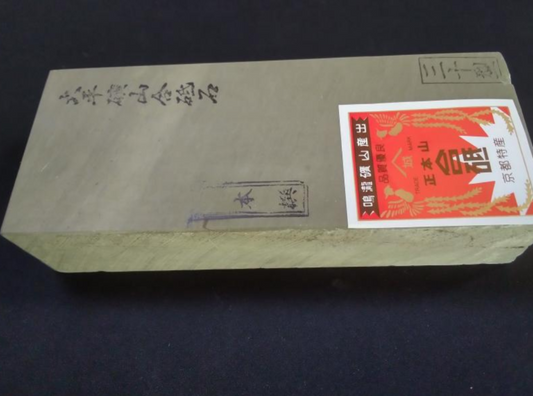
Ōhira Natural Finishing Whetstone (Ōhira Awasedo)
Regular price $360.00 CADRegular priceUnit price / perSale price $360.00 CADSold out
The Timeless Allure of Natural Whetstones
-
Long before synthetic sharpening stones became a global standard, Japanese craftsmen relied on natural whetstones quarried from the earth. Today, these stones are rare and increasingly difficult to obtain—but their charm has never faded.
-
Unlike synthetic whetstones, which offer consistency and industrial precision, natural stones are full of character. Each one has a unique grain, texture, and hardness that cannot be replicated in a factory. To chefs and sharpeners, this individuality is not a drawback—it is the very soul of the stone.
-
-
Why Natural Whetstones Still Matter
A knife polished on a natural whetstone achieves something extraordinary: a razor-sharp edge with a mirror-like finish that transforms the cutting experience. Ingredients are sliced cleanly, without tearing, allowing flavors and textures to shine as nature intended. This is why many Japanese chefs insist that true culinary artistry begins not with cooking, but with sharpening.
-
In Kyoto, a handful of historic quarries still operate, supplying stones that are coveted by professionals and collectors alike. To hold such a stone is to hold a piece of Japan’s cultural heritage—an unbroken link between earth, craftsman, blade, and cuisine.
-
The Challenge and Reward
Natural whetstones are not easy to master. Each stone behaves differently, demanding patience, sensitivity, and years of practice. But therein lies their appeal. Sharpening on a natural stone is not just maintenance—it is a dialogue between sharpener and stone, a ritual of refinement that brings both knife and skill to a higher level.
-
More Than a Tool
For enthusiasts, natural whetstones embody more than sharpening performance. They are symbols of tradition, artistry, and pursuit of perfection.
In a world of standardized tools, they remind us that perfection is not uniform — it’s personal.
Natural Stones, Crafted Edges: The Living Heart of Japanese Sharpening
-
Japanese natural whetstones offer a living connection between sharpness and craftsmanship. Their unique grain and organic hardness create depth and character that synthetic stones cannot replicate, rewarding patience with an edge that elevates flavor, texture, and the user’s own skill.
-
Ⅰ. Natural Whetstones Are Being Faked. Here's How to Protect Yourself.
-
The stone beneath your blade may be the most important — and most misunderstood — tool in your knife kit. It is also one of the most commonly counterfeited.
There is a particular kind of disappointment reserved for the serious knife enthusiast who has done their research, spent real money, and still ends up with something that doesn't perform the way it should. For buyers of natural whetstones, this disappointment is increasingly common — and it is not always the result of bad luck or uninformed choices. Sometimes it is the result of deliberate deception.
Natural Japanese whetstones — particularly the celebrated finishing stones from the mountains above Kyoto — occupy a unique position in the knife world. They are rare. The quarries that produced the finest examples are largely exhausted. Good stones command prices that reflect their scarcity: hundreds, sometimes thousands of dollars for a single finishing stone of genuine quality. And where there is scarcity and high value, there are people willing to misrepresent what they are selling.
This article is about how to protect yourself. But it begins with understanding why these stones are worth protecting.
-
What a Natural Whetstone Actually Is
A natural whetstone is not simply a piece of rock that happens to be abrasive. It is a geological formation that has been producing consistent, fine-grained abrasive material over millions of years — the result of sedimentary processes that no human manufacturing process can replicate.
The best Japanese finishing stones contain particles of a specific size, hardness, and distribution that allow them to refine a blade surface in a way that synthetic abrasives cannot fully match. The matrix — the binder material that holds the abrasive particles — is softer and more yielding than synthetic equivalents, which means the stone works the blade surface differently: abrading the peaks of the scratch pattern while leaving the carbide structure of the steel relatively intact.
The result, as discussed in previous articles in this series, is a surface finish that affects not just the appearance of the blade but the flavor of the food it cuts — less metallic transfer, cleaner release, better KIREAJI.
This is what genuine natural whetstones offer. It is also what makes them worth faking.
-
The Skin Tells the Story
Every natural whetstone has what Japanese practitioners call the kawa — the skin, or outer surface of the stone as it comes from the mountain. This skin is not cosmetically appealing. It is rough, irregular, and often uneven. It looks, to the uninformed eye, like something that should be removed.
But the skin is the stone's provenance document. It tells you where on the mountain the stone was quarried, how deep it sat in the formation, and what kind of material you can expect through the body of the stone. An experienced buyer reads the skin the way a gemologist reads inclusions — as evidence of authenticity and a guide to what lies beneath.
Counterfeit stones — or stones being misrepresented as higher quality than they are — often arrive with the skin removed. The seller's explanation may be that it was cleaned up for presentation, or that the skin was damaged. The real explanation, in many cases, is that the skin would have revealed something the seller did not want you to know.
If a natural whetstone is presented without its skin and no satisfactory explanation is given, treat this as a significant warning sign.
-
The Saw Mark Deception
One of the more sophisticated forms of misrepresentation involves artificial layering.
Natural whetstones are sedimentary formations. They have natural layers — visible striations in the stone that reflect different periods of deposition. These layers are a normal feature of genuine natural stone, and experienced buyers recognize them as evidence of authenticity.
Counterfeit stones — typically synthetic abrasives or low-quality natural stones dressed up to appear more valuable — sometimes have these layers artificially applied. A saw or grinding tool is used to cut parallel lines into the surface of the stone at regular intervals, mimicking the appearance of natural stratification.
The tell is in the regularity. Natural layers are not perfectly parallel. They vary in thickness, in spacing, in the angle at which they run through the stone. They follow the logic of geological time, not the logic of a machine. Artificial saw marks are too consistent, too evenly spaced, too geometrically precise to be natural. Once you know what you are looking for, the difference becomes visible — but only if you are looking.
-
The Price That Seems Too Good
The economics of natural whetstones are straightforward: genuine high-quality finishing stones are rare, their quarries are largely depleted, and the supply is finite and shrinking. A stone that performs at the level serious Japanese knife work demands costs accordingly.
This means that an unusually low price is not an opportunity. It is a question.
The question is: why is this stone priced so far below comparable stones? The possible answers are limited. The seller may have found a genuine bargain — rare, but possible. The stone may have a hidden flaw that explains the price. Or the stone may not be what it is represented to be.
For any natural whetstone priced significantly below the market rate for stones of comparable claimed quality, the appropriate response is not excitement. It is scrutiny. Ask for detailed photographs of the skin. Ask for documentation of provenance. Ask the seller to explain, specifically, why this stone is priced where it is.
A seller with a legitimate product can answer these questions. A seller who cannot, or who deflects, is telling you something important.
-
Natural Flaws Are Not Fraud — But Know the Difference
Not every disappointment with a natural whetstone represents deception. Some of what new buyers interpret as a defective stone is simply the reality of natural material — and it is important to understand the difference.
Natural whetstones contain inclusions — mineral intrusions, harder or softer than the surrounding material, that can affect how the stone performs in a localized area. As a stone is used down through its thickness, new layers are exposed. Sometimes those layers contain suji — striations of harder material that create an uneven sharpening surface. A stone that performed beautifully for a year may develop a patch that behaves differently as it is used deeper.
This is not fraud. It is the nature of sedimentary stone. The best sellers will tell you about this possibility before you buy; the best buyers understand it going in. A stone with a natural inclusion is not a counterfeit. It is a natural object, with the variability that implies.
What distinguishes this from fraud is intent. A seller who discloses that a stone may have inclusions at depth is being honest about the material. A seller who has removed the skin to hide evidence of problematic layers, or who has added artificial marks to suggest a stone is something it is not, is engaged in deliberate misrepresentation.
The stone cannot lie. But the seller can.
-
How to Buy With Confidence
The practical guidance that emerges from this is not complicated, but it requires patience and willingness to ask questions.
Buy from specialists, not generalists. A dedicated knife or whetstone seller with a reputation to protect has strong incentives to represent their stones accurately. A general marketplace seller with no specialty knowledge and no ongoing customer relationship has fewer of those incentives.
Ask to see the skin. Any reputable seller of natural whetstones should be able to provide photographs of the stone's skin — unedited, showing the surface as it came from the stone. If this is not available, ask why.
Understand the provenance. The best natural whetstones come from specific, named quarries in the Narutaki and Umegahata districts near Kyoto. Sellers who can name the quarry, and who can explain why that quarry produces stone of the character they are claiming, are demonstrating genuine knowledge. Sellers who can only say "Japanese natural whetstone" without further specification are not.
Be skeptical of extraordinary claims at ordinary prices. A stone described as the finest finishing stone available, priced at a fraction of what comparable stones cost on the verified market, is almost certainly not what it claims to be.
Handle if possible. For buyers with access to specialist shops — in Japan, or in cities with serious knife culture — handling stones before purchasing remains the most reliable method. The weight, the texture of the skin, the sound the stone makes when tapped — these are things that photographs cannot convey and that experience develops over time.
-
The Stone Deserves Its Reputation
The frustration that drives this article is not abstract. Buyers who have been deceived by misrepresented natural whetstones are not just out the money. They are cut off from a tool that, used correctly, represents one of the highest expressions of Japanese blade culture — a geological accident refined over millions of years, now capable of producing the surface finish that makes food taste the way the ingredient actually is.
Natural whetstones are worth what the genuine examples cost. They are worth the patience it takes to find a trustworthy seller. They are worth the time it takes to learn what you are looking at.
What they are not worth is paying full price for something that is not what it claims to be.
Buy carefully. Ask questions. And remember: the skin does not lie, even when the seller does.
Ⅱ. Sharpening and Polishing Are Not the Same Thing — And the Difference Affects the Flavor of Your Food
-
You have been sharpening your knife. But have you been polishing it? And do you know which one you actually needed?
In most of the world, the process of maintaining a knife edge is treated as a single activity. You take the blade to the stone, you work it until it is sharp, and you are done. The result is evaluated by one standard: does the knife cut better than it did before?
Japanese knife culture draws a line through this assumption. On one side of the line is togu — sharpening, the work of creating and correcting the geometry of the edge. On the other is migaku — polishing, the work of refining the surface of the blade after the geometry has been established. These are distinct techniques, with distinct tools, distinct purposes, and distinct effects on the food the knife eventually cuts.
Understanding the difference is not a specialist concern. It is the difference between a blade that cuts well and a blade that makes food taste the way it should.
-
What Sharpening Actually Does
To understand polishing, you first need to be precise about what sharpening is — and what it is not.
Sharpening, properly understood, is a geometric exercise. Its purpose is to establish the correct angle and profile at the cutting edge — the itoha, or wire edge, that forms the actual point of contact between blade and ingredient. For a single-edged Japanese knife, sharpening also includes urasoshi — maintaining the flat back face of the blade in the correct relationship to the bevel.
These are questions of precision and function. The sharpened blade does not need to be beautiful. It needs to be geometrically correct — the edge at the right angle, the surfaces in the right relationship, the geometry consistent from heel to tip.
What sharpening does not do, by itself, is address what that geometry looks like at a microscopic level — the texture of the surface, the character of the scratch pattern left by the abrasive, the way the steel presents itself to the ingredient at the cellular scale. That is the domain of polishing.
-
What Polishing Actually Does
Polishing, in the Japanese knife tradition, is a separate operation performed after sharpening — and with different intentions.
At its most visible level, polishing is aesthetic. A polished blade surface is uniform in appearance — either a consistent matte finish or, at the extreme end, a mirror surface that reflects light evenly across the entire face. This is the finish that appears in photographs of fine Japanese knives, and it is undeniably beautiful.
But polishing is not only aesthetic. And this is where the tradition becomes genuinely interesting.
When a blade is sharpened on a coarse or medium stone, the abrasive leaves a scratch pattern on the steel surface — a series of micro-grooves and peaks at the scale of the abrasive particles. These irregularities are functional in certain respects, but they also create a surface with a character that affects both how the blade releases from the ingredient and, unexpectedly, how the food tastes.
The iron smell — a metallic note that can be detected in delicate ingredients, particularly fish and vegetables, cut with a freshly sharpened blade — is partly a product of this surface condition. The peaks of the scratch pattern, exposed and reactive, interact with the ingredient as the blade passes through it. The result is a transfer of metallic character that a more refined surface would not produce.
Polishing addresses this by removing the peaks. Not deeply — the geometry established by sharpening is not disturbed — but at the scale of the scratch pattern itself. The surface becomes smoother, the reactive peaks are reduced, and the blade's interaction with the ingredient changes accordingly.
-
The Natural Whetstone as a Polishing Tool
This is where natural whetstones enter the story in a way that most Western knife users have never encountered.
In Japanese knife finishing, a natural whetstone is not always used as a sharpening stone in the conventional sense. It is sometimes used as a polishing instrument — a small piece of natural stone, broken thin, used to wipe across the surface of the blade in a motion that is closer to burnishing than to sharpening.
The distinction in how this works — compared to polishing with a synthetic stone — is subtle but significant.
A synthetic stone, when used to polish, removes material aggressively. The abrasive cuts deep enough to create new scratches, even as it removes old ones. The result is a surface that has been worked, but not necessarily refined — the micro-topography is different, but it still has peaks and valleys, and the valleys may be deeper than those left by the natural stone.
A natural whetstone, used lightly in a polishing motion, behaves differently. The matrix of the stone — the binder that holds the abrasive particles — is softer and more yielding than synthetic equivalents. When wiped across the blade surface, it abrades primarily at the peaks of the existing scratch pattern, leaving the valleys relatively undisturbed. The carbide particles in the steel are left proud of the surrounding matrix, while the softer iron between them is gently smoothed.
The result is a surface that is, at the microscopic level, organized rather than flattened — a fine, natural micro-topography that presents the carbide particles to the ingredient in a controlled way, rather than the random peaks and valleys of a conventionally sharpened surface.
-
Taste as the Ultimate Test
The practical consequence of this distinction is one that Japanese knife culture has always held to be primary: the effect on food.
A blade that has been sharpened but not polished — particularly one finished on a synthetic stone without further refinement — can impart a metallic quality to delicate ingredients. This is detectable. A chef who cuts raw fish with a freshly sharpened but unpolished blade may find that the fish carries a faint iron note that was not there before cutting. The knife is sharp. The food has been affected anyway.
The light polishing pass with a natural whetstone — described as harau, a wiping or sweeping motion — addresses this directly. By smoothing the reactive peaks of the scratch pattern without disturbing the underlying geometry, it reduces the metallic interaction between blade and ingredient. The iron smell diminishes. The food tastes cleaner. The cut releases more smoothly.
This is KIREAJI expressed at its most refined level — not just the geometry of the edge, but the character of the surface, and the way that surface participates in the flavor of everything it touches.
-
When Polishing Becomes Deception
Japanese knife practitioners are clear about one thing: polishing can be misused.
A beautifully polished surface can conceal sharpening errors — scratches, inconsistencies in the bevel angle, irregularities in the edge geometry — beneath an aesthetic finish that looks correct but isn't. A blade that shines is not necessarily a blade that performs. And a polishing pass used to hide technical deficiencies is, in the words of the tradition, not finishing — it is concealment.
This is why Japanese knife culture insists on the order of operations. Sharpening comes first, and it must be correct before polishing begins. The geometry must be established honestly before the surface is refined. Polishing that precedes correct sharpening is, at best, cosmetic. At worst, it is a way of making a poorly sharpened blade look like something it is not.
For professional cooks, this hierarchy is especially clear. In a working kitchen, a mirror finish is not the goal — it is an indulgence. What matters is a blade that is geometrically correct, cleanly finished enough to avoid metallic transfer, and capable of the KIREAJI that makes the ingredient taste the way it should. The shortest path to that result, executed honestly, is the professional standard.
Beauty may follow. But it must not lead.
-
Two Operations, One System
The distinction between sharpening and polishing is, ultimately, a distinction between two questions.
Sharpening asks: is the geometry correct? Is the edge at the right angle? Is the surface in the right relationship to produce the cut the knife was designed to make?
Polishing asks: does the surface present itself to the ingredient in the best possible way? Is the metallic interaction minimized? Does the blade release cleanly? Does the food taste the way it should?
Both questions matter. Neither can substitute for the other. A blade that is correctly sharpened but unpolished may perform well mechanically but affect the food's flavor. A blade that is beautifully polished but incorrectly sharpened has been given an answer to the second question without answering the first.
The natural whetstone, used as a polishing instrument, sits at the intersection of these two questions — refining the surface of a correctly sharpened blade in a way that no synthetic stone can fully replicate, and producing a finish whose measure, ultimately, is not in how the blade looks.
It is in how the food tastes.
The Soul of Craftsmanship
-
The Voice of the Stone- Where Steel Meets the Spirit of Nature
Every natural whetstone carries a quiet voice—the breath of mountains, water, and time.
When a blade touches its surface, something profound happens: the craftsman does not simply sharpen, but listens.
Each stroke reveals harmony between human and nature, between effort and patience. -
Unlike synthetic stones, natural whetstones are alive. Their texture, sound, and resistance change with each movement, guiding the hand toward perfection that cannot be measured—but can be felt.
This is why true sharpeners return to them, again and again—to experience not just sharpness, but connection. -
A natural stone does more than refine an edge.
It refines the spirit of the one who sharpens.
Experience the sharpness trusted by 98% of Japan’s top chefs — handcrafted in Sakai City.
Through our exclusive partnership with Shiroyama Knife Workshop, we deliver exceptional Sakai knives worldwide. Each knife comes with free Honbazuke sharpening and a hand-crafted magnolia saya, with optional after-sales services for lasting confidence.