
Genkai Masakuni Collection
-
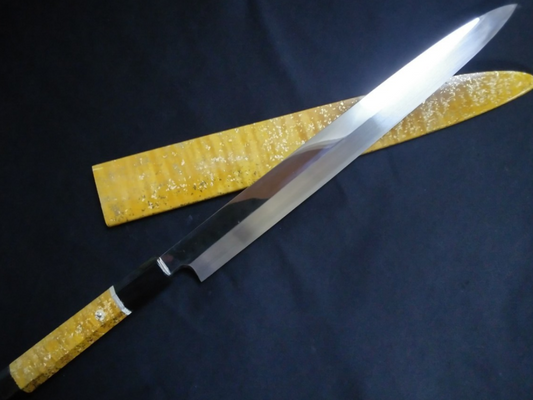
White Steel (Honyaki-Mizuyaki) Yanagiba 330mm-Mirror Polished (both sides)
Regular price $4,000.00 CADRegular priceUnit price per -
White Steel #2 (Honyaki-Mizuyaki) Yanagiba (Kiritsuke) 330mm-Mirror Polished (both sides)
Regular price $11,000.00 CADRegular priceUnit price per -
White Steel #2 (Honyaki-Mizuyaki) Yanagiba 400mm-Mirror Polished (one side)
Regular price $12,000.00 CADRegular priceUnit price per



The Craftsmen Behind the Work

Genkai Masakuni (Yoneo Mukou)
The Quiet Master of Mizuyaki Honyaki
Genkai Masakuni (Yoneo Mukou) was a legendary artisan who mastered the rare Mizuyaki Honyaki technique through decades of dedication and refinement.
Producing only a few knives per day, his works became renowned for their exceptional hardness, beautiful hamon patterns, and extraordinary sharpness — elevating each piece into a true work of Japanese craftsmanship.
When he passed away in 2025 at the age of 85, the knife world lost one of the last masters of Mizuyaki Honyaki. Today, his legacy lives on only through the extraordinary works he left behind.

Hakuho Sakaiminamoto (Minoru Hakui)
The Legendary Master of Japanese Sharpening
Hakuho Sakaiminamoto (Minoru Hakui) was a legendary sharpener recognized as the first officially certified Traditional Craftsman in Japanese knife sharpening.
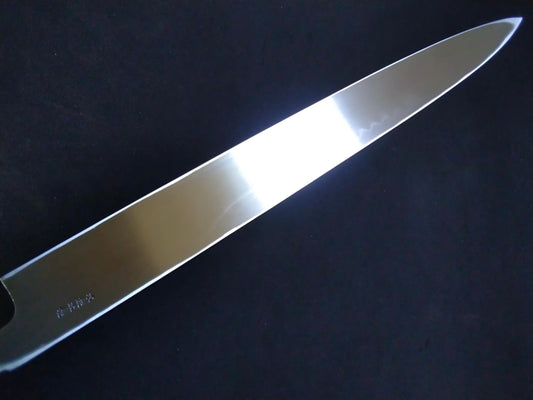
Renowned for his exclusive mirror-polished finishes created for Shiroyama Knife Workshop, his works elevated knives beyond tools into cultural masterpieces of extraordinary beauty and precision.
Since completing his life’s work in 2019, no new works by Hakuho will ever be created, making his remaining pieces exceptionally rare within Japanese knife culture.

Toshiyuki Terauchi
Master of Tradition, Creator of New Beauty
Toshiyuki Terauchi is a distinguished artisan who transforms Japanese knife handles and sheaths into works that unite functionality with artistic beauty.
Trained under the legendary craftsman Mr. Mizuno, whose collaborative works with Hakuhō and Genkai received a gold prize at a traditional crafts competition over 30 years ago, Terauchi continues to carry forward a refined tradition of craftsmanship with elegance and precision.
Within Sakai Cultural Works, his craftsmanship brings a final layer of sophistication and cultural depth to each piece.
Genkai Masakuni: One of the Last Masters of Water-Quench Honyaki
-

What Honkyaki Is, and Why It Matters
Honkyaki is the most technically demanding form of Japanese knife construction. A single piece of steel — no lamination, no soft iron cladding — is forged, shaped, and then subjected to a heat treatment that must simultaneously produce a hard cutting edge and a softer, more resilient spine, within the same continuous piece of metal.
The water-quench version, mizu-honkyaki, is the most extreme variant of this already extreme process. Quenching in water rather than oil produces a harder blade — but it also produces stresses that can fracture the steel if the timing, the temperature, or the movement is even slightly wrong. The failure rate is high. The stones that cool the blade sometimes find cracks that weren't visible before quenching. The knife that looked perfect going into the water does not always come out of it intact.
This is what Muko chose to spend his nights learning, in a time before instructional videos, before online communities, before anyone outside a small circle of specialists would have been able to explain why it was so difficult.
He developed his own approach through repeated experimentation, while also learning from what he observed during his years in Sakai. -

The Legend and the Truth
In the knife world, Genkai Masakuni is sometimes described as the sole student of Okishiba Masakuni — also known as Heianjo Masakuni — the legendary practitioner of mizu-honkyaki whose blades have achieved near-mythical status.
Muko himself, in recorded interviews, was direct about this: it was not true.
He and Okishiba were at Kobayashi Hamono at the same time. They knew each other. There are photographs of them together in the workshop. But there was no formal teacher-student relationship.
Muko did not appear to have had a formal master-apprentice relationship with Okishiba. Instead, he developed his own approach to mizu-honyaki through experimentation, while acknowledging that observing Okishiba’s work helped provide an important clue in completing the technique.This matters because it reframes what Muko accomplished. He did not inherit a tradition. He reconstructed one — arriving at the same destination by a different road, driven by the same obsession but guided by his own intelligence and his own hands. The comparison with Okishiba is flattering, but it understates what Muko actually did.
He didn't learn from the master. He became one independently.
-

Seventy Years. One Standard.
Muko Yoneo gave seventy years to the forge. Not as a career. As a commitment — to a single standard of what a knife could be, pursued with a consistency that most craftsmen never achieve in a lifetime of trying.
He did not seek students in any systematic way. He did not build a school or write down his methods. What he built was a body of work — knives that exist in the hands of cooks around the world, performing at a level that their owners cannot fully explain, doing something to the ingredients they cut that less refined blades cannot replicate.
When he passed away on September 25, 2025, at the age of 85, the knife world lost one of the rare craftsmen who had spent decades mastering mizu-honyaki at the highest level. Much of his individual judgment and technique now survives most clearly in the knives he left behind.
His son, Muko Toshimasa, continues at the workshop. The spirit, as the tradition demands, is being carried forward. What cannot be carried forward — what exists only in the accumulated judgment of a man who spent seventy years at a forge — is the irreplaceable thing. The hands that knew what the fire was doing. The eyes that could read a blade at the moment of quenching. The mind that could look at a wave pattern in steel and know, before anyone else could, whether it was right.


What Is a Traditional Craftsman?
Ever wondered what it takes to be officially recognized by the Japanese government as a “Traditional Craftsman”?
In Sakai City — Japan’s most celebrated hub of knife-making — only a select few artisans earn this prestigious title.
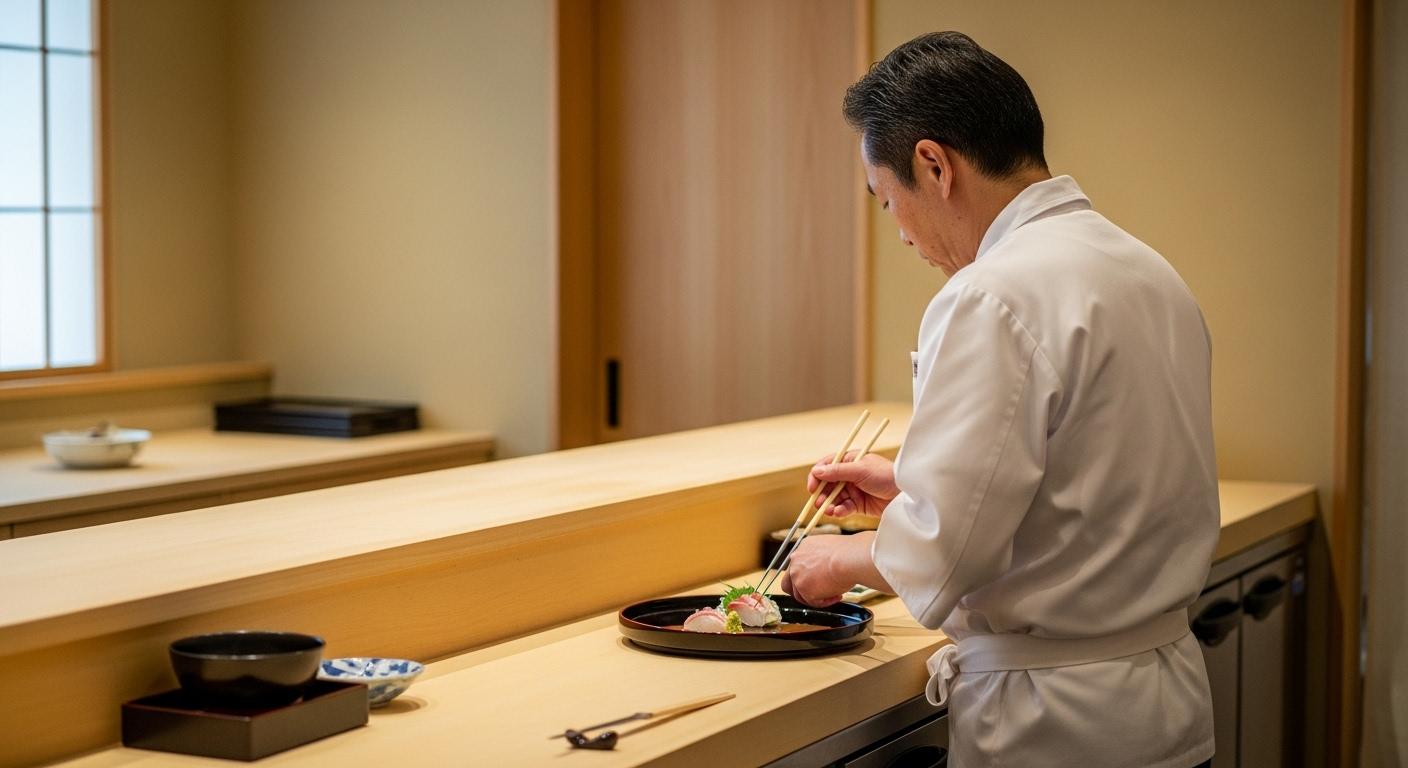
Why do 98% of Japanese Chefs Use Knives from Sakai?
The secret lies in Sakai’sdivision of labor and fully handcrafted process.
This feature explores thetradition and artisan culturebehind Japan’s most trusted knives.
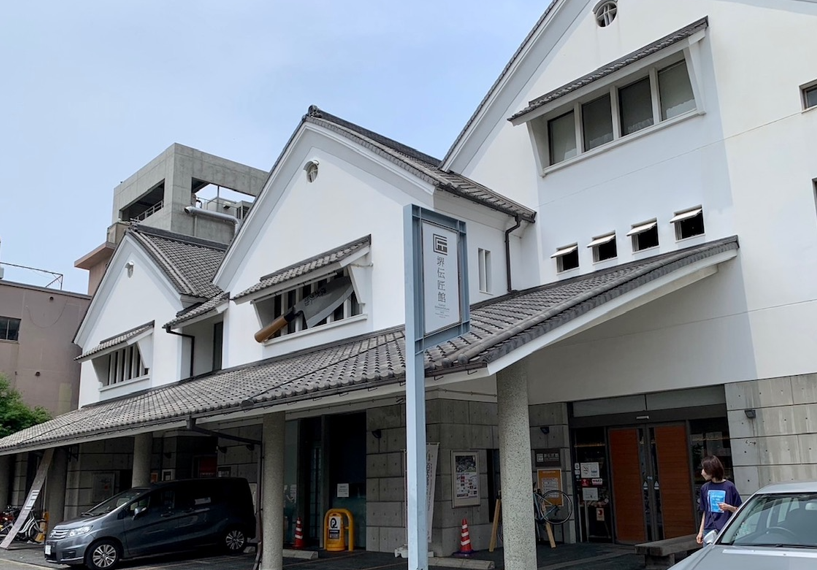
The 98% Statistic: A Trusted Source
The Sakai Tourism Bureau states that "98% of Japanese chefs use Sakai knives" in their articleAppeal of World Renowned Sakai Knives. This claim underscores the enduring reputation of Sakai craftsmanship.

Sakai's Declining Japanese Knife Craftsmen
Sakai's esteemed cutlery tradition, renowned for its sharpness and craftsmanship, is at risk with only a dozen blacksmiths remaining. Facing competition and declining interest, strategies such as exploring new markets and fostering youth interest are vital for survival. This situation underscores a broader challenge in cultural preservation. Supporting Sakai’s craftsmen is crucial to maintaining this legacy.