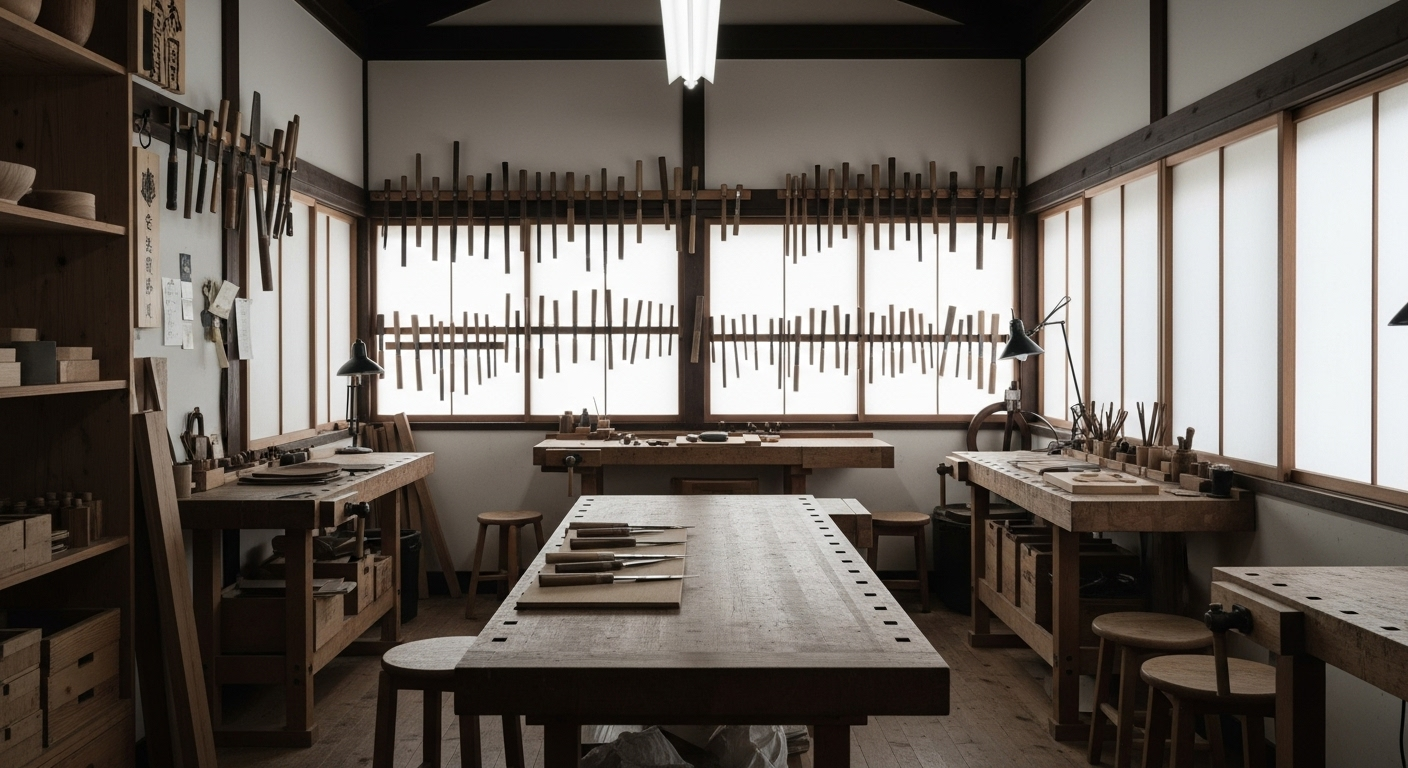
What Cannot Be Copied: The Meaning Behind Sakai Knives
-

The Importance of Meaning
Today, it is widely understood that meaning matters.
People no longer choose objects based only on function or price.
They increasingly want to understand the story behind what they use.
Where was it made?
Who made it?
Why was it created this way?
These questions help people connect with objects on a deeper level.
But at the same time, another reality is unfolding.
Technology continues to advance.
Production moves from handcraft to large-scale manufacturing.
Designs can be copied and distributed globally in a very short time.
As a result, the world is filled with products that look strikingly similar. -

The Same Reality in the Knife World
The knife world is no exception.
Today, many knives around the world are sold under the label “Japanese-style.”
They often resemble traditional Japanese knives in shape and appearance.
And thanks to industrial production, they can be made efficiently in large quantities.
Design travels quickly.
Technology spreads quickly.
But once again, something cannot be copied.
Meaning. -

The Meaning of “Made in Sakai”
Knives made in Sakai, Japan, carry more than 600 years of history.
Their origins trace back to sword-making traditions. Over centuries, the craft evolved alongside Japanese cuisine.
A single Sakai knife is not made by one person.
Blacksmiths forge the steel.
Sharpening masters shape the edge.
Handle craftsmen complete the final form.
Each artisan focuses on a specific skill refined over generations.
This unique system of craftsmanship is recognized as an important cultural tradition in Japan.
In other words, “Made in Sakai” is not simply a place of origin.
It is meaning. -

The Challenge We Face
However, there is an important difference between Sakai and brands like Apple.
The meaning behind Apple is widely recognized around the world.
But the meaning behind “Made in Sakai” is still not widely understood internationally.
When people visit large online marketplaces, they often see many knives that look similar.
Without knowing the deeper story, the decision becomes simple.
Choose the cheaper one.
When this happens repeatedly, inexpensive products sell quickly, while authentic knives carrying centuries of meaning struggle to compete.
Over time, this creates a serious concern.
If meaningful craftsmanship cannot survive economically, the tradition itself may slowly disappear. -

Why KIREAJI Exists
This is why KIREAJI exists.
KIREAJI is not simply a place to sell knives.
Our purpose is to share the meaning behind them.
The meaning of Sakai.
The history of the craft.
The people who dedicate their lives to making each blade.
Through the KIREAJI blog, we hope to make these stories visible to readers around the world.
Because when meaning becomes visible, people begin to see objects differently.
And when people understand meaning, they begin to value it.


-

From Meaning to a Living Tradition
If meaning cannot be copied, then the question becomes:
How can meaning continue to live?
We believe the answer lies in people.
Meaning survives when it is understood, experienced, and shared.
This is why, at KIREAJI, we value a simple cycle.
First, Know.
People learn where a knife comes from—its history, its makers, and the culture behind it.
Then, Use.
A knife is not meant to remain an idea. When people cook with it, care for it, and experience its balance and sharpness, the meaning becomes real.
Finally, Share.
When people talk about what they have learned and experienced, the story continues.
One conversation.
One kitchen.
One knife at a time.
This is the cycle we believe in.
Know.
Use.
Share.
Through this quiet cycle, the meaning of Sakai can continue to live—not only in Japan, but in kitchens around the world.
And this is the role we hope KIREAJI can play.
Because meaning survives not through products, but through people.


About KIREAJI
KIREAJI connects the 600-year tradition of Sakai craftsmanship with kitchens around the world. We deliver authentic, handcrafted Japanese knives directly from master artisans—uniting heritage, innovation, and a lifelong respect for true craftsmanship.

Win-Win for All
At KIREAJI, our purpose extends beyond providing knives. We strive to create a circle where customers, artisans, and the community of Sakai City all grow together.
Every blade represents living craftsmanship — supporting master artisans, honoring tradition, and bringing lasting meaning to your kitchen.
Discover how we connect people, craft, and community through a true win-win philosophy.

How We Decide
The Four Principles of KIREAJI
Everything we do is guided by four clear principles. They define what we stand for—and what we will never compromise.