The Test That Taught Me What a Knife Really Is
-
Jun 22, 2026
-
I did not grow up in a kitchen. I did not inherit a chef's apron or a family recipe. The path that eventually brought me to Sakai's knife-making world passed first through something more humble: a sushi school in Tokyo, and a graduation test that I was not at all sure I would pass.
The test was this: take a daikon radish. Using a usuba — the thin, single-bevel Japanese vegetable knife — peel it in one continuous, unbroken sheet. The sheet had to be at least 40 centimeters long, peeled from a section of daikon no less than 10 centimeters tall, and the finished sheet had to weigh at least 40 grams. It had to be uniform in thickness. And it could not break. All of this within a fixed time limit.
This technique is called katsuramuki. And I had never done it before.
-
What I Bought Instead of Confidence
When I realized what was coming, I did the only thing I could think of: I bought daikon. A lot of it. I went to the market and filled bags with radishes and brought them home and began practicing every day, alone, in my own kitchen, making mistake after mistake.
The early attempts were not attempts at all, really. They were collisions — between the knife and the radish, between my intention and what actually happened. The blade caught. The sheet tore. The thickness was uneven in ways I couldn't predict or control. I tried to go faster and it got worse. I tried to go slower and it still got worse.
What I was discovering, without having the words for it yet, was that katsuramuki is not a trick. It is not a technique you can learn by memorizing a sequence of steps. It is a conversation between the knife, the vegetable, and the hand holding them — and you cannot participate in that conversation until you have spent enough time in it to understand its rhythm.
The daikon pile got smaller. I bought more. I practiced more.
-
The Moment the Knife Started to Make Sense
Somewhere in those weeks of daily practice, something shifted.
It is difficult to describe precisely. The blade did not change. The radish did not change. But my relationship to both of them did. I began to feel — not just know intellectually, but actually feel in my hands — what the knife required. The angle. The pressure. The way the blade needed to travel in a continuous arc rather than a push-and-correct sequence of micro-adjustments.
The usuba is a knife designed for exactly this kind of work. Its single bevel, its thin spine, the geometry that allows it to enter a vegetable and move through it with a precision that a thicker blade cannot achieve — all of this exists to make katsuramuki possible. But the knife cannot do the work alone. It can only do what it was made to do when the person holding it has learned, through repetition, to work with it rather than against it.
This is what I had been learning, without realizing it. Not just how to peel a radish. How to hold a conversation with a blade.
-
The Test
When the day of the examination came, I was ready in a way that is different from confident. Confident suggests certainty. What I had was something quieter — a familiarity with the process, an acceptance of what the work required, a body that had done this enough times that it remembered what to do even when my mind was still catching up.
The daikon. The knife. The motion.
I passed.
The sheet came off in one piece, long enough, heavy enough, unbroken. Not perfect — I could see the places where the thickness varied, the moments where the rhythm had faltered and recovered — but complete. The test had been passed.
I stood there for a moment holding something I had made with my own hands and a blade, and felt something that I have carried ever since: the particular satisfaction of a skill that has entered the body, that cannot be undone, that will be there the next time you need it.
-
What the Knife Taught That No Classroom Could
My instructor once said something I have never forgotten. A skill like katsuramuki, once truly learned, is like riding a bicycle. You do not forget it. It becomes part of how you move through the world.
He was right. But what he didn't say — what I only understood later — is that the skill and the knife are inseparable. You do not learn katsuramuki in the abstract. You learn it with a usuba, with a thin single-bevel blade whose entire design is organized around the possibility of this precise, continuous movement through a vegetable. The knife is not the tool you use to practice the technique. The knife is the reason the technique exists.
This is the thing about Japanese knife culture that I want overseas readers to understand — the thing that gets lost when people talk about sharpness or steel grades or edge retention statistics.
Japanese knives are not optimized in the abstract. They are optimized for specific relationships between a blade and a food and a technique and a person. The usuba is thin because katsuramuki requires thinness. The single bevel exists because a double bevel creates different forces in the cut that would make this particular motion impossible at the required precision. The lightness of the blade allows the continuous arc without fatigue. Every design choice is the residue of a question asked and answered over generations: what does this specific work actually need?
When you understand this, the knife stops being a product. It becomes an argument — a position on what good cutting is, and how to achieve it.
-
-
What Those Daikon Taught Me About KIREAJI
Years later, standing in Sakai and holding blades made by craftspeople who have spent their lives in service of exactly this kind of precision, I understood something about why I was there.
The sushi school graduation test was not really about the radish. It was about the relationship between a person and a blade and a practice — the willingness to show up every day until the skill has settled into the body, until the conversation between hand and knife becomes fluent enough to produce something of quality.
That willingness — to practice, to fail, to return, to improve — is the same spirit that built Sakai's tradition. The sharpener who has spent twelve years at the whetstone. The smith who has spent decades at the forge. The handle-maker who understands that every detail of how the hand meets the knife affects what the hand can do. These people are not doing something categorically different from what I was doing in my kitchen with a pile of daikon. They are doing it at a different depth, for a different duration, with a different level of consequence — but the spirit is the same.
The knife that allows katsuramuki to be possible is the product of people who practiced with the same intensity that katsuramuki itself requires. This is not a metaphor. It is the actual connection between the craft of making the knife and the craft of using it.
At KIREAJI, this is what we are trying to carry — not just blades, but the understanding of what blades make possible, and what they ask of the people who hold them. A knife from Sakai, in the hands of someone who has put in the practice that the knife deserves, is not a kitchen tool in the ordinary sense.
It is the continuation of a conversation that has been going on for six hundred years.
And like katsuramuki, once you have learned it — really learned it, in the body — you do not forget.
-
Knife Types
At KIREAJI, each knife is designed with a specific purpose in mind: Yanagiba for sashimi, Deba for preparing fish, Usuba for vegetables, Gyuto as an all-purpose chef’s knife, Petty for delicate tasks, and Garasaki for precise meat and fish preparation.
Usuba
The KIREAJI Usuba is a vegetable knife with a thin, flat blade ideal for peeling and intricate cuts. Especially suited for katsuramuki (rotary peeling), it is a fundamental knife for mastering traditional Japanese vegetable techniques.
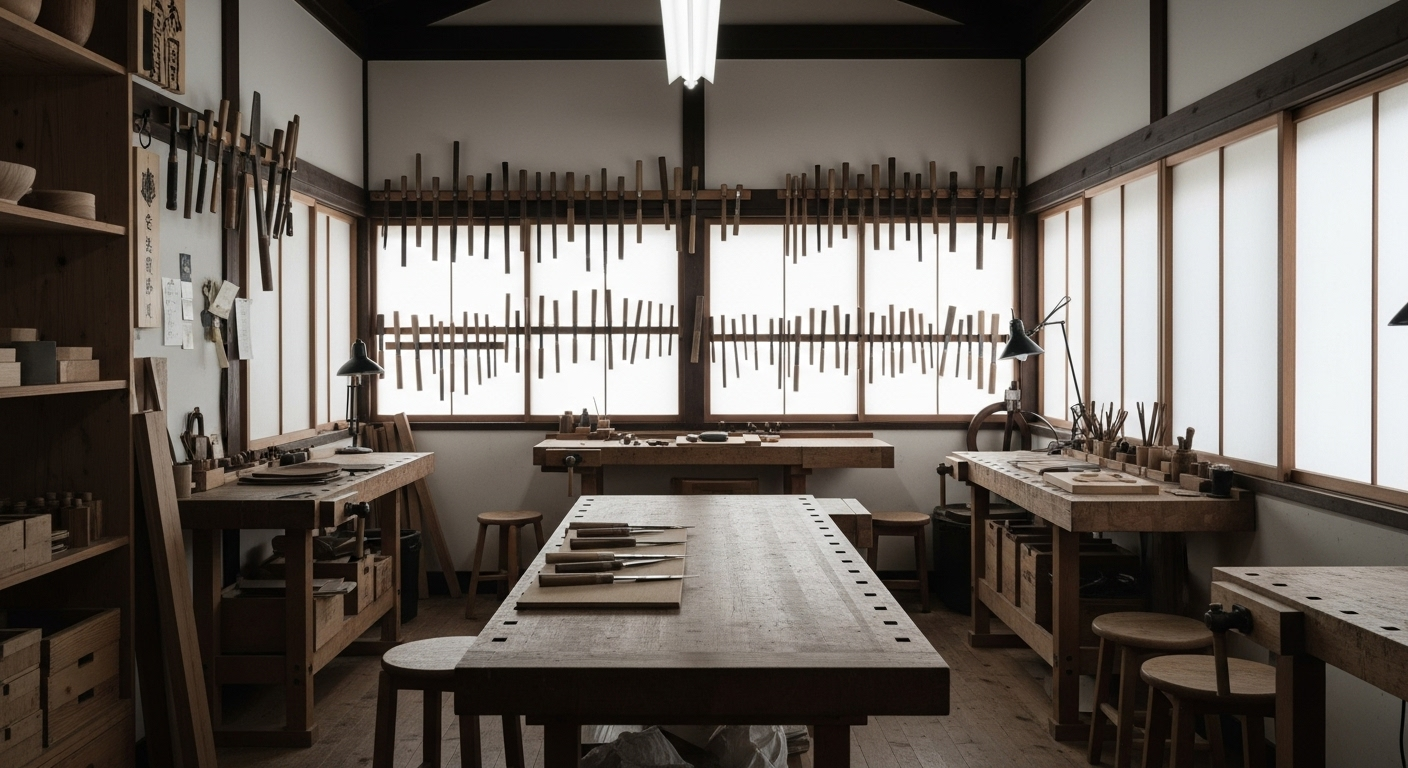
The Origin of Craftsmanship
-
The Art of Embracing Worry
Being naturally anxious and feeling a vague sense of unease about the future is not uncommon, even for us artisans. Every time I forge a new knife, I wonder, "Will this meet the expectations of the chef or cook who uses it? Will it truly serve its purpose?" These doubts often linger in the back of my mind.
-
However, as I work—hammering the steel, shaping the blade, sharpening its edge—that worry begins to fade. Worry, I’ve realized, is not an obstacle but a guide, reminding me to focus not on the unknown future but on the present moment. It urges me to pour my heart into every step of the process.
-
The presence of worry means there’s still a future to strive for. By confronting each task with sincerity, the worry transforms into quiet confidence, much like a blade emerging from raw steel. This is the lesson I’ve learned through my craft: anxiety isn’t a weakness—it’s the foundation for growth.
-
If your fears of the future are holding you back, I encourage you to focus on the “now.” Move your hands, engage your heart, and take even the smallest step forward. In time, those worries may become the very force that sharpens your strength.
-
Every journey begins with a single blade. For us artisans, it’s our calling to forge it with care.
Experience the sharpness trusted by professional chefs across Japan — handcrafted in Sakai City
Through our exclusive partnership with Shiroyama Knife Workshop, we deliver artisan-crafted Sakai knives worldwide. Each knife comes with free Honbazuke sharpening and a hand-crafted magnolia saya. Optional after-sales support is also available to help you care for your knife with lasting confidence.
KIREAJI's Three Promises to You
-
1. Forged in the Legacy of Sakai
From Sakai City—Japan’s renowned birthplace of professional kitchen knives—each blade is crafted by master artisans with over six centuries of tradition. Perfectly balanced, enduringly sharp, and exquisitely finished, every cut carries the soul of true craftsmanship.
-
2. Thoughtful Care for Everyday Use
Every knife includes a hand-fitted magnolia saya for safe storage. Upon request, we offer a complimentary Honbazuke final hand sharpening—giving you a precise, ready-to-use edge from day one.
-
3. A Partnership for a Lifetime
A KIREAJI knife is more than a tool—it is a lifelong companion. With our bespoke paid aftercare services, we preserve its edge and beauty, ensuring it remains as precise and dependable as the day it first met your hand.