Isshōmono — Something Worth Keeping for a Lifetime
-
October 19, 2026
-
Some things are chosen for now.
Others are chosen with the future in mind.
A coat we hope to wear for many winters.
A watch we imagine still using years from now.
A cooking tool we choose not simply because we need one today, but because we hope it will remain beside us through countless meals.
In Japanese, there is an expression for something we believe may stay with us for a very long time:
Isshōmono(一生もの).
It is often translated as “something for a lifetime.”
But the idea can mean more than simply buying something durable.
It asks us to imagine a relationship with an object before that relationship has even begun.
Could this be something I want to live with for many years?
That small question can change the way we choose.
-
1. The Japanese Expression — Isshōmono(一生もの)
The expression is made from:
一生(isshō) — a lifetime, one's whole life
もの(mono) — thing
Literally, isshōmono suggests “a thing for a lifetime.”
In everyday Japanese, the expression can be used for objects we expect — or hope — to use for many years.
A well-made piece of furniture.
A watch.
A bag.
A cooking utensil.
Perhaps even a tool connected to one's profession.
Calling something isshōmono does not necessarily mean that it will literally last until the final day of someone's life.
Life changes.
Objects wear.
Sometimes things break, become unsuitable, or need to be replaced.
The expression is better understood as an intention.
When we call something isshōmono, we are saying:
“This is not something I want to treat as temporary.”
That makes the word as much about the person choosing the object as about the object itself.
-
2. Meaning & Background — Choosing Beyond the Present
Many of our everyday decisions begin with immediate questions.
How much does it cost?
Do I need it now?
Does it look good?
Is it convenient?
There is nothing wrong with these questions.
But isshōmono introduces another one:
“How might I feel about this years from now?”
That changes the perspective.
Instead of looking only at today's price, we may begin thinking about materials, construction, repairability, maintenance, usefulness, and whether the design will continue to feel right in our lives.
More importantly, we may ask whether we are willing to care for it.
Because something does not become isshōmono simply because it is expensive.
A high price does not guarantee a long relationship.
And durability alone is not enough.
An object may be capable of lasting for decades, but if we do not enjoy using it, understand it, or care for it, that potential may never become reality.
A lifetime object is not only made to last. It must also be something we are willing to continue living with.
In this sense, isshōmono is partly about craftsmanship.
But it is also about commitment.
-
3. In Everyday Life — Buying Less Often, Choosing More Carefully
Imagine choosing a dining table.
One approach is to ask:
“What works for my home right now?”
Another is to imagine the table years into the future.
Meals eaten around it.
Guests welcomed.
Small marks appearing on its surface.
Perhaps a different home.
Perhaps a different stage of life.
Suddenly, the decision is no longer only about furniture.
You are choosing something that may become part of your memories.
The same idea can apply to smaller objects.
A bag used for years.
A cooking pot that appears at hundreds of family meals.
A pair of scissors that always sits in the same drawer.
A fountain pen used to write important words.
None of these needs to be luxurious.
What matters is that we choose them with a longer horizon.
This does not mean that everyone should always buy the most expensive option or keep every possession forever.
Sometimes an inexpensive object serves us perfectly well.
Sometimes replacement is the sensible choice.
Isshōmono is not a rule against buying new things.
It is simply another way of asking what kind of relationship we want with the things we bring into our lives.
When we expect to live with something for a long time, we often choose differently from when we expect to replace it soon.
-
4. Through the Japanese Knife — Can a Knife Be Isshōmono?
A Japanese knife is sometimes described as isshōmono.
It is an appealing idea.
A carefully made knife can be sharpened repeatedly, maintained, and used for many years.
As the owner becomes familiar with its weight and balance, the knife may gradually become an increasingly natural part of cooking.
But does that mean every Japanese knife will literally last a lifetime?
Not necessarily.
A knife is a working tool.
Every time it is used, its edge changes.
Every time it is sharpened, a very small amount of steel is removed.
Its lifespan depends on many things — the knife itself, how often it is used, how it is sharpened, how it is maintained, and what happens to it over the years.
Perhaps, then, the more meaningful question is not:
“Will this knife last forever?”
but:
“Is this a knife worth building a long relationship with?”
A craftsman can give a knife the qualities needed for a long working life.
Good steel.
Careful heat treatment.
Thoughtful geometry.
Skilled sharpening.
A handle fitted for use.
But once the knife enters a kitchen, part of its future passes into the hands of its owner.
It needs to be used appropriately.
Cleaned.
Dried.
Sharpened.
Observed.
And, over time, understood.
This connects isshōmono naturally with the words we have already explored.
Mottainai helps us recognize value.
Aichaku can grow through time.
Kodawari asks us to care about the details that matter.
Teire keeps a working tool in good condition.
Dōgu o sodateru describes how tool and user can develop together.
And isshōmono asks a question at the beginning of that journey:
“Is this something worth giving years of my life to?”
A Japanese knife does not need to remain untouched to have a long life.
It exists to be used.
Its edge may be sharpened many times.
Its appearance may change.
Its handle may eventually need attention.
What matters is not keeping it forever new.
The goal is not to preserve the first day. It is to make many good days possible after it.
Perhaps that is a more useful meaning of a “knife for a lifetime.”
-
-
5. A Thought for This Week
The next time you are about to buy something, try looking beyond the moment of purchase.
You do not have to do this for everything.
Choose just one thing that matters.
Then ask:
“Would I still want to use this years from now?”
And perhaps one more question:
“Am I willing to take care of it?”
If the answer to both is yes, you may begin to see the object differently.
Not simply as something to own.
But as something that could accompany part of your life.
We cannot know exactly how long any object will remain with us.
That uncertainty is part of life.
But we can choose with the intention of staying.
Choose carefully. Use fully. Care for it. Let time decide how long the story becomes.
That may be one way to understand isshōmono.
-
-
Beautiful Japanese Words
Discover more Japanese words and the ideas, values, and ways of life behind them.
About KIREAJI
KIREAJI connects the 600-year tradition of Sakai craftsmanship with kitchens around the world. We deliver authentic, handcrafted Japanese knives directly from master artisans—uniting heritage, innovation, and a lifelong respect for true craftsmanship.
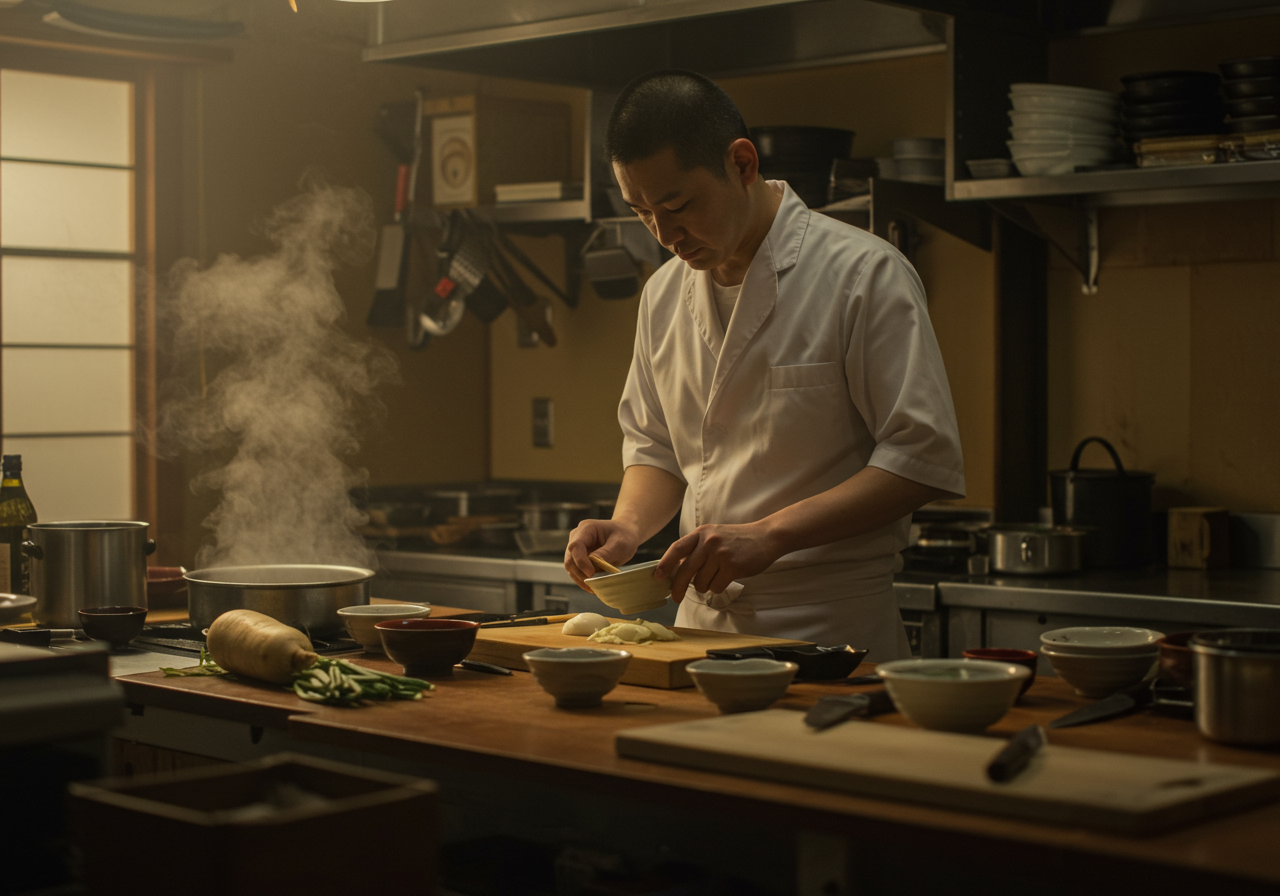
The Japanese Chef’s Way
The Japanese Chef’s Way is more than technique—it is a philosophy of character, mindset, and respect. Based on real experiences from the sushi counter, this series shares timeless lessons such as “Earn respect as a person first” and “Mastery is a lifelong journey.”
Experience the Craftsmanship of Sakai City
Through our partnership with Shiroyama Knife Workshop, we bring artisan-crafted Sakai knives to customers around the world. Each knife includes a magnolia wood saya, carefully selected and prepared for the knife. Upon request, complimentary Honbazuke is also available as an initial hand-sharpening intended to prepare the knife for practical use.