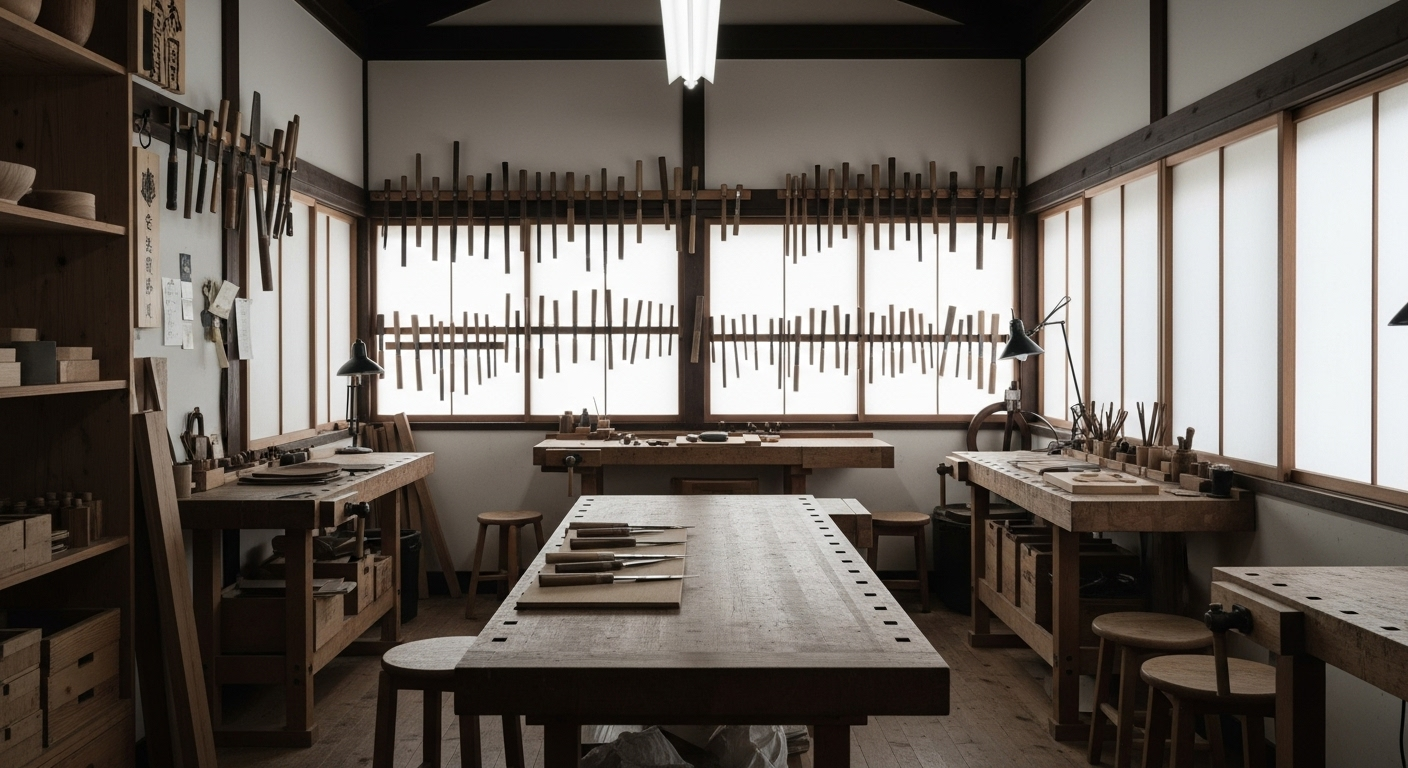
Inside a Sakai Blacksmith Workshop: Where Japanese Knives Begin
-

A Workshop Is Not a Museum
There are many places in Japan where you can learn about traditional craftsmanship through exhibitions.
Those places are valuable.
But entering a working workshop is different.
The Sakai Tourism & Convention Bureau currently offers an official blacksmith-workshop visit at Enami Cutlery Manufacturing, where visitors can observe techniques used in the forging of Sakai knives.
This is not a reconstructed forge created for an exhibition.
It is a place connected to the living craft of Sakai knife-making.
Visitors can watch steel being heated in a high-temperature forge and repeatedly hammered toward the shape of a knife. They can also observe later stages including rough hammering, shaping with a rotating grinding wheel, and rough cutting.
Suddenly, the finished knife you know so well looks very different.
Because before there was polish, there was scale.
Before there was a perfect edge, there was rough steel.
And before there was a knife, there were decisions made by human hands.

-

Fire, Steel, Hammer
From the outside, forging can look almost primitive.
Heat the steel.
Hit it with a hammer.
Repeat.
But that simplicity is deceptive.
The official Sakai program allows visitors to observe the steel being heated at the forge and the rough hammering process. A limited number of participants can even try part of the hammering process together with the craftsperson.
The value of such an experience is not that a visitor becomes a blacksmith.
Quite the opposite.
It reveals how much knowledge is hidden inside movements that may initially appear simple.
How hot should the steel be?
Where should the hammer fall?
How much should the material move?
When should you stop?
A skilled craftsperson makes hundreds of judgments that may be almost invisible to someone watching for the first time.
The hammer is easy to see. The judgment behind the hammer is much harder to see.
And that judgment takes years to develop.
-

Why Seeing the Beginning Changes the Way You See the Finished Knife
When we buy something, we usually encounter it at the end of its story.
Everything difficult has already happened.
The rough surfaces are gone.
The imperfections of the process have been refined.
The blade is polished.
The handle is fitted.
The edge is ready.
That can make a beautifully finished Japanese knife appear almost effortless.
A workshop changes that perception.
You see the heat.
You see the unfinished steel.
You hear the hammer.
You begin to understand that the elegant object sitting in your kitchen started in a much harsher environment.
Seeing how rough the beginning is makes the refinement of the finished knife easier to understand.
The beauty of the final blade is not separate from the forge.
It is the result of everything that happened there.
-

Sakai Knives Are Made by More Than One Pair of Hands
There is another reason why visiting a Sakai blacksmith workshop matters.
It helps explain something fundamental about Sakai knife-making.
A Sakai knife is traditionally created through a specialized division of labor.
The blacksmith forges the blade.
A sharpener develops its geometry, surface and cutting edge.
Other specialists may contribute to later stages of finishing.
This means the forge is not the entire story.
It is the beginning of a journey through multiple highly specialized hands.
That is one reason KIREAJI places so much importance on introducing not only the knife itself, but also the craftspeople behind it.
A finished blade can hide the complexity of the system that created it.
A visit to the forge begins to make that invisible system visible.
-

You Are Watching a Living Craft
There is an important difference between watching someone demonstrate an old technique and watching a craft that still produces tools people use every day.
Sakai knives are not archaeological objects.
They leave workshops in Japan and enter kitchens around the world.
They slice sashimi in restaurants.
They prepare vegetables in home kitchens.
They become working tools for chefs who may never visit Japan.
And yet the beginning of that global journey can still involve something remarkably physical:
fire,
steel,
a hammer,
and a craftsperson standing in front of a forge.
That contrast is extraordinary.
A knife can begin in a small workshop in Sakai and end up becoming part of someone's daily life on the other side of the world.


-

From Watching the Craft to Understanding the Craftsperson
Once you have seen forging, the name of a blacksmith begins to mean something different.
It is no longer simply a name printed on a product page.
It represents years spent developing judgment around fire, steel, timing and force.
This is also why KIREAJI introduces the work of individual Sakai craftspeople.
Among the blacksmiths whose knives we are honored to present is Tadashi Enami, a fifth-generation blacksmith and certified Traditional Craftsman whose work continues Sakai's long forging tradition. KIREAJI currently introduces a collection of knives connected to his craftsmanship.
For us, showing the person behind the blade is not simply about adding a famous name.
It helps answer a more important question:
Who is carrying this knowledge forward?

-

Perhaps This Is What Travelers Are Really Looking For
Why would someone travel thousands of kilometers to see a person hammer steel?
The finished knife can already be purchased elsewhere.
Videos of forging can be watched online.
Photographs are everywhere.
But perhaps information is not what people are searching for.
Perhaps they are searching for proximity.
To feel the heat that a screen cannot reproduce.
To hear the hammer without speakers.
To stand close enough to realize how small a traditional workshop can be.
To watch an experienced craftsperson notice things that you cannot yet see.
There is a difference between knowing that something is handmade and standing in the place where human hands actually make it.
That difference may be one of the reasons craft travel is becoming so compelling.


About Shiroyama Knife Workshop
Discover the philosophy, history, and direct-to-customer approach that has defined Shiroyama Knife Workshop for nearly four decades.