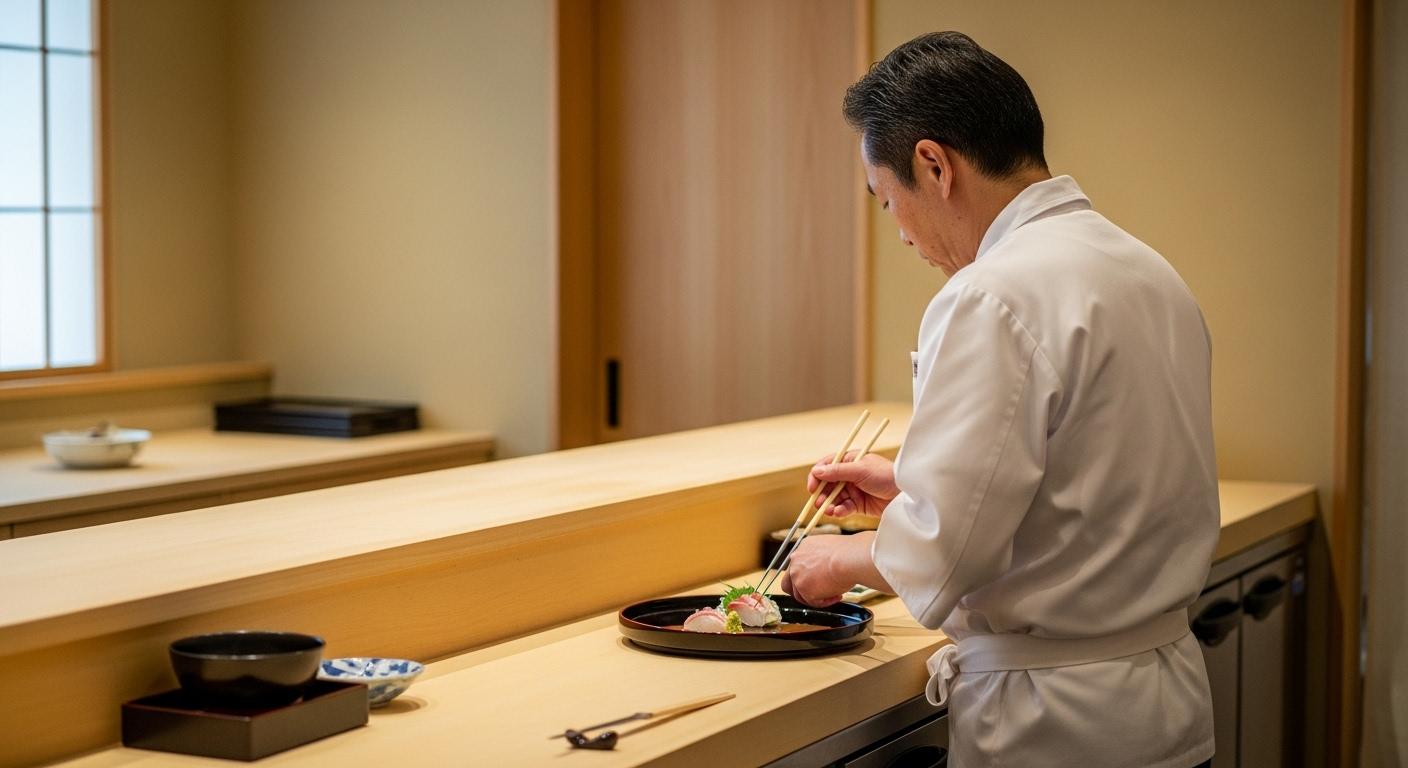
How to Hold a Japanese Knife
-
The Right Grip Unlocks Full Potential
A Japanese knife is not just sharp — it’s designed to be held in a very specific way. The right grip and posture unlock its full potential: safer handling, smoother cutting, and more precise results.
In this video, we’ll show you the essential techniques to hold and use Japanese knives correctly, so you can cook with confidence and grace. -
Video Provided: Sabakeru Channel (part of the Nippon Foundation's "The Ocean and Japan Project")
The Foundation of Proper Knife Control
-
Japanese knives are celebrated for their sharpness and elegance — but to unlock their true potential, they must be held and used correctly. The way you stand, grip, and move the blade not only ensures safety but also brings out the craftsmanship built into every knife.
-
Basic Posture
Stand about a fist’s distance from the cutting board, with your dominant leg half a step back. Turn your body slightly at a 45-degree angle, feet shoulder-width apart, and lean forward. This angled stance allows smoother movement, especially when using long blades such as the Yanagiba. Your guiding hand should stay relaxed, with fingers tucked in and the index and middle fingers resting lightly against the blade’s belly.
How to Hold a Usuba
For precision vegetable cutting, hold the base of the blade firmly between your thumb and index finger while wrapping the handle with your remaining three fingers. This secure grip gives control and balance across different ingredients.
How to Hold a Deba or Yanagiba
When handling fish or slicing sashimi, grip the handle with your middle, ring, and little fingers. Place your index finger along the spine of the blade and your thumb against the side for control. With this grip, you guide both pressure and movement, ensuring accuracy and grace.
Advice from a Traditional Craftsman
-
-
-
Japanese knives are designed not for forceful chopping but for sliding cuts — smooth, deliberate motions that let the blade glide through ingredients. This technique minimizes strain on the edge, extends the knife’s sharpness, and elevates the quality of each slice.
-
A craftsman once said: “A knife’s life depends on how it is held and used.” Treat your blade with care, and it will not only last longer but also transform cooking from a routine task into a more precise, joyful experience.
The Art of the Grip: Unlocking the Japanese Knife
-
A Japanese knife performs at its best only when the body and grip work together.
Mastering proper stance and knife-specific grips ensures true control, safety, and precision. -
Ⅰ. The Pull Cut: Japan's Secret to Better-Tasting Food
-
The difference between pushing and pulling a knife sounds trivial. The difference it makes on the plate is not.
Most of the world cuts by pushing. The blade goes down and forward, pressing through the ingredient with force and intention. It works. Food gets cut. Dinner gets made.
But in Japan, the dominant motion has always been the opposite — drawing the blade back toward the body in a long, controlled pull. And this isn't stylistic preference or cultural quirk. It is a deliberate technique, developed over centuries, with a measurable impact on the taste of everything it touches.
-
It Began With Ceremony
The pulling cut didn't originate at a chef's cutting board. It began in ritual.
Japan has a tradition called hochoshiki — a ceremonial preparation in which a whole fish is broken down using only a knife and chopsticks. The hands never touch the ingredient. The practice grew from the belief that sacred food must not be contaminated by human contact, and it demanded a technique that could perform precise, controlled work without the stabilization of fingers.
The answer was the pull. A long, drawing motion — deliberate, unhurried, exact. And in finding that answer, Japanese culinary culture discovered something that went far beyond ceremony: that pulling through an ingredient, rather than pressing through it, produced food that tasted better.
That discovery shaped everything that followed.
-
What Happens Inside the Ingredient
The difference between a push cut and a pull cut comes down to pressure — and what pressure does to food at a cellular level.
When you push a blade through an ingredient, force concentrates ahead of the edge. Cells compress before they separate. This compression ruptures cell walls, releasing enzymes and bitter compounds that the intact cell would have contained. The food is cut, but it has also been stressed — and that stress shows up in the flavor.
A pull cut works differently. The blade enters the ingredient and draws through it with minimal downward force. Rather than compressing and rupturing, the edge slices cleanly along the cell boundaries. The cellular structure remains largely intact. What stays inside the cell, stays there.
The result is measurable. The same carrot, cut with the same knife, will taste sweeter when pulled through than when pushed through. The same fish will be cleaner on the palate, without the faint bitterness that comes from cellular damage. This is not refinement for its own sake. It is a technique that genuinely changes what ends up in the mouth.
-
The Knife Was Built for This
Japanese knife design and the pull cut are inseparable. Each shaped the other.
The yanagiba — the long, slender sashimi knife — is the clearest expression of this relationship. Its length exists precisely to enable a single, uninterrupted pulling stroke through a fillet of fish. One motion, no repositioning, the blade traveling the full length of the ingredient without interruption. The geometry is specific: thicker at the spine, tapering toward a fine edge, designed so that the knife passes through the ingredient cleanly as it moves back, without resistance or drag.
The urasuki — the hollow concave ground into the flat face of a single-edged blade — reduces the surface contact between steel and ingredient. Less contact means less friction during the pull, which means less resistance and less cellular disruption. Every structural element of the traditional Japanese knife reinforces the same principle: the ingredient should experience as little force as possible during cutting.
Western knives are designed for a different motion. Their geometry — symmetric double bevel, robust cross-section — is optimized for the push cut and the rocking chop. Neither is wrong. They are answers to different questions about what a knife should do.
-
Influence of the Sword
The pull cut also carries the influence of Japanese sword culture — and this connection is more than symbolic.
Japanese swordsmanship developed the drawing cut over centuries: a technique in which the blade is moved along its edge rather than driven straight through. The physics favor a slicing motion over a chopping one — more efficient, more precise, requiring less brute force. When that logic migrated from the dojo into the kitchen, it found a natural home in a culinary culture already oriented toward minimal intervention and maximum respect for the ingredient.
The parallel runs deep. A sword that chops through its target and a sword that draws through it perform the same function but with fundamentally different relationships to force. The same is true of a knife that pushes through a tomato and one that pulls through it.
-
Why It Matters for Anyone Who Cooks
You don't need a yanagiba to benefit from pull-cut thinking. The principle applies to any sharp knife and any technique that involves drawing the blade back rather than pressing it down.
When slicing proteins — fish, chicken, cured meats — a long pulling stroke through the fibres preserves their structure in a way that a push cut cannot. The texture stays cleaner, the moisture stays in, and the ingredient responds better to heat or seasoning.
When cutting delicate vegetables, the same logic applies. A sharp knife drawn lightly through a tomato, a shallot, a fresh herb releases far less cellular stress than one pressed through the same ingredient. The flavors are brighter, the bitterness lower, the result closer to what the ingredient actually tastes like before force is applied to it.
The pull cut asks something of the cook: a sharp knife, a relaxed grip, and the restraint to let the blade do the work rather than the arm. In exchange, it offers something back — food that tastes more like itself.
-
Three Hundred Years of Evidence
Japanese cuisine is the most precise culinary tradition in the world in its handling of raw ingredients. The emphasis on texture, freshness, and the clean, unadorned flavor of the ingredient itself is not accidental — it is the product of centuries of technique refined around a single idea: the less you disturb the ingredient, the more of it survives to the plate.
The pull cut sits at the center of that idea. Born from ceremony, shaped by sword culture, encoded into the geometry of the knife itself, and validated by the simple, repeatable fact that food cut this way tastes better.
In Japan, how you cut is part of how you cook. And how you cook is part of what you serve.
Ⅱ. Why a Knife Cuts Better When You Pull Than When You Push
-
Here is a question that most people who cook have never stopped to ask: when you move a knife through an ingredient, does it matter which direction the blade is traveling?
The answer is yes. It matters enormously. And understanding why changes not just how you think about cutting, but how you think about knives themselves — why they are shaped the way they are, why Japanese knife geometry is what it is, and why a professional cook who has spent thirty years behind a blade makes different choices than someone who reaches for whatever knife is at hand.
-
The Saw, Not the Axe
Start with an image that makes the physics clear.
When you need to cut a piece of hardwood, you use a saw. The saw does not strike the wood from above — it moves back and forth across the grain, each pass removing a small amount of material until the cut is complete. The action is horizontal, or at an angle to the surface. The force is applied through motion, not through impact.
An axe works completely differently. The axe head is driven downward with tremendous force. It does not cut the wood so much as split it — the wedge geometry of the axe head drives the grain apart, using the wood's own structure against itself. The result is a split surface, not a cut one. The cut face of an axe-split piece of wood is not smooth. It is torn.
These are not just different tools. They are different physical principles. The saw cuts by moving a blade parallel to the surface of the material. The axe splits by driving a wedge perpendicular to it. The difference between the two principles is the difference between a clean cut and a split, between a smooth face and a torn one.
A kitchen knife is a saw, not an axe.
This sounds obvious when stated plainly. In practice, many cooks use their knives like an axe — driving the blade downward with force, relying on the sharpness of the edge and the weight of the arm to do the work. This cuts through things. It does not cut them well.
-
The Two Directions: Push and Pull
When a knife moves through an ingredient in a back-and-forth sawing motion, there are two primary directions that motion can take: the push cut, where the blade travels away from the body, and the pull cut, where the blade travels toward the body.
Both work. The question is what they do to the ingredient.
The push cut — blade moving forward, away from the cook — begins with the strongest part of the stroke. The heel of the blade, the heaviest part, is closest to the hand and receiving the most direct force. As the blade moves forward, the arm extends, the elbow straightens, and the mechanical advantage decreases. To compensate, the natural tendency is to add downward force — to drive the blade into the ingredient from above as it moves forward. This is the push cut's characteristic motion: forward and down simultaneously, using the combined force of the arm's extension and the hand's downward pressure.
This motion works very well for dense, resistant materials. Hard vegetables — winter squash, large root vegetables, thick-skinned ingredients that require force to penetrate — respond to the push cut's combination of forward motion and downward pressure. The heel of the blade, applying concentrated force at the strongest point of the stroke, can drive through resistance that a lighter cut would not manage.
But this same downward pressure becomes a problem when the ingredient is soft, delicate, or structurally fragile.
-
What Happens to the Ingredient
When a knife is driven into a soft ingredient with significant downward force — even a very sharp knife — the ingredient responds to that force before it responds to the edge. It compresses. The cells at the cut site are pressed together before the blade separates them. If the force is significant enough, or the ingredient soft enough, this compression is visible: the cut face is not clean and smooth but crushed and irregular.
For ingredients like raw fish — a piece of tuna or salmon for sashimi — this is catastrophic. The protein structure of the fish is held together by delicate connective tissue and cellular membranes that are not capable of withstanding significant downward pressure. A push cut applied to a piece of sashimi-grade fish with any real downward force does not produce a clean slice. It produces something that more closely resembles a tear — the cut face is rough, the edges are ragged, and the structural integrity of the piece has been compromised. For sashimi, where the visual clarity and textural integrity of each piece is part of what is being presented and tasted, this matters completely.
The pull cut solves this problem through a different physical mechanism.
-
Why the Pull Cut Works Differently
When a knife pulls toward the body, the mechanics of the stroke change in a specific way that reduces downward force.
As the blade draws back, the contact point between the blade and the ingredient moves progressively from the heel toward the tip. The heel — the heaviest, most mechanically advantaged part of the blade — is no longer in contact. The tip — lighter, with less mechanical advantage — is doing the work. This geometry makes it more difficult to apply significant downward pressure as the stroke progresses. The arm's natural motion when pulling shifts from a combination of downward and forward pressure to something more purely horizontal: a slicing motion rather than a pressing one.
The pull cut, in other words, creates a physical situation in which the ingredient is sliced sideways rather than pressed from above. The blade separates the ingredient by moving through it, not into it. The downward pressure that causes compression is structurally reduced by the mechanics of the motion.
The result at the cut face is different. A piece of raw fish cut with a proper pull cut — blade drawn smoothly from heel to tip in a single stroke — has a face that is clean, smooth, and structurally intact. The cells at the cut site have been separated rather than compressed. The protein structure is undamaged. The piece holds together, looks clean, and tastes the way the fish actually tastes, rather than the way compressed fish tastes.
-
The Long Blade and the Single Stroke
This is why the yanagiba — the long, slender Japanese sashimi knife — is the length it is.
A short blade cannot complete a pull cut on a large piece of fish in a single stroke. Partway through the cut, the blade runs out of length, the stroke must be reversed or restarted, and the clean single motion becomes multiple partial cuts. Each restart is an opportunity for compression, for deviation from the intended cut line, for the structural damage that the pull cut exists to prevent.
A yanagiba of 27 to 33 centimeters — the standard professional length — is long enough to take a piece of sashimi-grade fish from one end to the other in a single uninterrupted stroke. The length is not aesthetic. It is functional. The blade length determines whether the pull cut can be completed in one motion, and whether that motion can do what it is supposed to do.
This is also why the geometry of the yanagiba is what it is: single bevel, with the concave urasuki hollow on the flat face, reducing surface contact with the ingredient during the pull. Less contact means less friction during the stroke. Less friction means the blade moves through the ingredient more cleanly. Every structural element of the knife reinforces the same principle — the blade should pass through the ingredient with the minimum possible disturbance.
-
When to Push and When to Pull
The professional answer to which cut to use is not that one is always better. It is that different ingredients and different tasks call for different approaches.
The push cut is appropriate when force is needed and the ingredient's structural integrity is not the primary concern. Cutting through a hard squash, breaking down a large piece of meat, working through dense root vegetables — in these situations, the push cut's mechanical advantage and downward force are assets. The ingredient is robust enough to absorb the pressure without being damaged in ways that matter.
The pull cut is appropriate when the ingredient's structure must be preserved — when the cut face needs to be smooth and clean, when compression would cause damage that affects flavor or presentation, when what is being cut is fragile enough that force itself is the enemy of the result.
For most general kitchen work — dicing vegetables, slicing cooked meat, rough preparation work — the distinction matters less. The ingredient is robust enough that either motion produces an acceptable result.
For the finest work — sashimi, precision vegetable cuts, fine protein slicing — the pull cut is the correct choice, and the reason is not tradition or preference. It is physics.
-
What This Reveals About Japanese Knife Design
Understanding the pull cut explains something about Japanese knife culture that can otherwise seem puzzling to Western cooks.
Why is the yanagiba so long? Because the pull cut requires sufficient blade length to complete a single uninterrupted stroke.
Why is it single bevel? Because the single-bevel geometry, with its hollow back face, reduces the contact surface between blade and ingredient, making the pull cut smoother and more precise.
Why does Japanese cuisine value the pull cut so highly? Because Japanese cuisine — built around ingredients in their most natural, least processed state — requires the cut that disturbs those ingredients the least.
And why does any of this matter if you are not making sashimi?
Because the principle extends beyond raw fish. Any time you are cutting something where the structural integrity of the cut face matters — tomatoes sliced for presentation, herbs cut without bruising, fresh fish for any preparation where the flesh quality is important — the pull cut, with a sharp blade, will produce a better result than a push cut with the same blade.
The direction of the cut is a variable that most cooks do not consciously control. Making it conscious changes what the knife can do.
-
The Answer in One Sentence
The pull cut produces cleaner results on delicate ingredients because it shifts the dominant force from downward pressure — which compresses the ingredient before it separates it — to horizontal motion, which slices through the ingredient by moving parallel to its surface rather than driving into it from above.
The push cut presses. The pull cut slices. And for everything that cannot afford to be pressed, the difference is everything.
A saw, not an axe. A slice, not a strike. This is what cutting actually means.
Can a Chef's Skill Be Judged by Their Knife?
Every knife tells a silent story. Its edge, shape, and condition reveal not just how it is used, but the chef’s discipline, care, and spirit. A blade kept sharp reflects dedication, while a neglected one shows indifference. In the end, a knife is more than a tool—it is a mirror of the chef.
How to Cut Vegetables
Cutting vegetables is an act of respect. This article explains how slicing motion, fiber direction, and pressure affect texture and flavor—showing how proper knife handling turns simple vegetables into refined dishes.
The Soul of Craftsmanship
-
A knife is not just a tool; it is a mirror that reflects the soul of the chef.
A knife embodies the chef's mindset, the sensitivity of their hands, and even their mood on a given day.
The meticulously sharpened edge carries the chef's dedication, revealed in every dish they create. -
Cooking is not merely a task; it is a moment to connect with ingredients and engage in a dialogue with oneself.
In this process, the knife becomes the chef's most essential companion, bridging the gap between them and the ingredients. -
As traditional artisans, we pour our hearts into crafting each knife, striving to create something that resonates with the soul of its user.
We hope our work empowers chefs to bring forth dishes that embody their true essence.
After-Sales Service
-
A knife is more than a tool — it’s a lifelong partner in your kitchen.
At KIREAJI, we stand behind every blade we craft. That’s why we offer dedicated after-sales service to ensure your knife stays sharp, strong, and beautiful for years to come.
Whether it’s routine maintenance or expert repair, your knife returns to the same hands that forged it — the master artisans at Shiroyama Knife Workshop in Sakai, Japan.
Because true craftsmanship doesn’t end at the sale — it continues, as part of your culinary journey. -