

Why Sushi Is Taking Over the World — and What That Means for the Knife Behind Every Great Piece
-

The Forces Behind the Boom
The rise of sushi as a global food is not a single story. It is the convergence of several developments, each reinforcing the others.
The health narrative arrived first. In countries where processed and fast food had become the dietary norm, sushi appeared as something categorically different — raw fish and rice, clean and protein-rich, carrying associations with Japanese longevity and lightness that resonated deeply in cultures increasingly anxious about what they were eating. Celebrities adopted it. Media celebrated it. The image of sushi as sophisticated, healthy, and modern spread faster than the food itself.
Then the logistics caught up. The development of cold-chain air freight made it possible to deliver fish of genuine quality to kitchens anywhere in the world within hours of leaving the water. What had once been a geographical limitation — the proximity to Japanese fish markets, the specific varieties available locally — became a logistical problem that technology could solve. High-quality raw fish became available in São Paulo and Stockholm and Sydney, and with it came the possibility of sushi that was not merely an approximation of the original but something approaching its actual standard.
The food adapted, too. The California roll — rice and avocado and crab, rolled inside-out to conceal the nori for diners unfamiliar with seaweed — was not a compromise. It was a translation. It took the fundamental structure of sushi and made it accessible to palates that had not grown up with the original, opening a door that a more rigid approach would have kept closed. From there, the adaptations multiplied: spicy tuna, mango and prawn, local fish in regional styles. Sushi became, paradoxically, more Japanese in its global spread — more like the original tradition, which was always responsive to local ingredients and local tastes.
And then the technology arrived to make it scalable. Sushi robots that form rice portions to consistent specifications, computer-managed kitchen systems, sushi schools that compress years of technical training into weeks — these developments made it possible to produce sushi at volume and at a price point that the artisanal model could never achieve. The result was the conveyor belt restaurant, the supermarket sushi pack, the grab-and-go counter — sushi at every price point, available at every level of the market.
-

The Economics of the High-Cost Kitchen
Sushi is not a cheap food to produce, even when it is sold cheaply. The food cost ratio in a professional sushi operation runs at approximately fifty percent — meaning that for every dollar charged, fifty cents goes directly to ingredients. This is substantially higher than the cost structure of most restaurant categories.
The model works because of how the costs are distributed across the menu.
A piece of tuna — the ingredient that most customers come for, the one that defines the quality benchmark of a sushi restaurant — may cost more to produce than it generates in revenue on its own. This is not a mistake. It is a deliberate strategy: the high-value, high-cost ingredient is what fills the restaurant, and it earns its place by bringing customers who will also order the dishes that carry the margins. Egg. Fermented soybean. Seasonal fish caught in abundance. The high-cost pieces build the reputation; the high-margin pieces sustain the business. Sake and other beverages, with food cost ratios far lower than raw fish, balance the economics of the meal.
The conveyor belt model achieves low prices through a different mechanism: volume, systematization, and the elimination of waste. A large chain buys fish in quantities that give it pricing power. A sushi robot produces rice portions of identical weight and shape at a speed that no human can match. Kitchen management systems predict demand, reduce over-preparation, and minimize the most expensive form of waste in a raw-fish operation — the piece that was made but not sold. High customer throughput, achieved partly through entertainment — collaborations with anime characters, interactive ordering systems — keeps the seats full and the economics viable.
-

The Sushi Chef Who Cannot Be Replaced by a Robot
Within this expanding global market, there is a stratification that is not only economic but philosophical.
The sushi robot produces consistent rice. It does this better than most human hands, at higher speed, without fatigue. The sushi school produces a chef who can handle a tuna loin, form a correct nigiri, and understand the fundamental techniques of the cuisine in a fraction of the time that traditional apprenticeship required.
But there is something that neither the robot nor the accelerated training program produces, and that the highest-earning sushi professionals in the world — chefs earning ten to twenty million yen annually, working in destination restaurants that command waiting lists of months — possess in a way that cannot be systematized.
It is the ability to read the room, read the ingredient, and make the adjustment that the moment requires.
The fish delivered today is not the same fish that was delivered last week. Its fat content is different. Its texture is different. The way it will respond to the knife is different. A chef who understands this — who can look at a piece of fish, touch it, smell it, and know what it needs — is doing something that no specification can capture and no robot can replicate.
The customer sitting at the counter is not the same customer who sat there yesterday. Their mood, their appetite, their expectations, their cultural background, their relationship to the specific food being placed in front of them — all of this is information that the chef receives and responds to in real time. The communication skills of a great sushi chef — the conversation, the reading of the guest, the judgment about what to offer and when and how — account for more than half of what makes the experience what it is. This is not incidental to the craft. It is the craft, at its highest expression.
And then there is the knife.
-

What Sushi's Global Rise Means for the Knife
The expansion of sushi as a global food is, in the most practical sense, an expansion of the market for the knife that makes it possible.
A piece of sashimi-grade tuna, cut with a properly maintained yanagiba by a skilled hand using a correct pulling motion, is a different piece of fish from the same fish cut with an inadequate blade or inadequate technique. The difference is in the cellular structure of the cut face — in whether the cells have been separated or ruptured, in whether the flavor compounds have stayed where they belong or have begun to escape. The difference is visible to the trained eye. It is detectable on the palate.
As the global sushi market grows, and as more professional chefs — in more countries, with more diverse culinary backgrounds — engage seriously with the craft, the understanding of this difference grows with it. The chef in London who discovers that their sashimi tastes different when cut with a Japanese knife than with the blade they trained on is making the same discovery that chefs have been making in Japan for generations. The market for the knowledge expands. The market for the tool expands with it.
There is also a deeper connection. The global rise of sushi is, in part, the global rise of the values that Japanese food culture has always held: that the ingredient matters, that the technique of preparation matters, that the relationship between how food is cut and how food tastes is real and significant. These are not values that are native to sushi alone — they are values of Japanese culinary philosophy more broadly, and sushi has been their most effective ambassador to the world.
When those values take root — when a chef in Seoul or a cook in Toronto or a home cook in Amsterdam begins to understand that the cut changes the flavor — the interest that follows is not only in sushi. It is in the entire tradition that produced that understanding. The knives. The sharpening. The philosophy of the blade.
-

The Root of Sushi and the Root of the Knife
There is a historical symmetry that deserves to be named.
Sushi began not in Japan but in Southeast Asia — as a fermentation technique for preserving fish, using rice and salt as the medium. It traveled through China, arrived in Japan, and was transformed over centuries by Japanese culinary culture until it became something categorically new: the nigiri invented in Edo's street stalls, the tradition of the great sushi masters, the form that is now being shared with the world.
The Japanese knife underwent a parallel transformation. The forging techniques that produced the samurai sword were adapted, after the sword was forbidden, into tools for the kitchen. The metallurgy, the heat treatment philosophy, the commitment to the edge — all of this was redirected from war to food, and in the centuries since has been refined to a level of precision that the original sword-makers could not have imagined.
Both sushi and the Japanese knife are the products of a culture's willingness to take something from elsewhere, transform it through sustained attention and craft, and develop it to a level of refinement that makes it genuinely new. Both are now traveling the world, carrying with them the values that the transformation produced.
When the global sushi chef reaches for their yanagiba — when they draw the blade through the fish in the single uninterrupted stroke that produces the cut face that catches the light — they are holding, in one motion, all of this history. The fermentation technique from Southeast Asia. The Edo-period street stall. The samurai sword-maker's metallurgy redirected into the kitchen. The six centuries of Sakai's accumulated craft knowledge.
And the fish, as it always has been, is the point.
-

What This Means for Us
The global expansion of sushi is not, for us, primarily a commercial development. It is the expansion of an audience for something that matters — for the values that Japanese food culture has always held about the relationship between the knife and the food it cuts, between the quality of the preparation and the quality of the experience.
Every sushi restaurant that opens in a new city is a potential conversation about why the knife matters. Every chef who discovers that their sashimi tastes different when the cut is correct is beginning a journey that leads, if they follow it seriously, toward the tradition of Japanese knife-making and everything it represents.
We are here for that conversation. We believe in the values that sushi, at its best, expresses. We believe in the knife that makes those values possible. And we believe that the world's growing appetite for sushi is also, at its deepest level, a growing appetite for what the Japanese knife tradition has to offer — the understanding that the cut is not preparation for the food. The cut is part of the food.


Yanagiba
A traditional Japanese sashimi knife with a long, slender blade, designed for smooth single-stroke slicing. It preserves the delicate texture and natural flavor of raw fish, making it essential for authentic sashimi preparation.
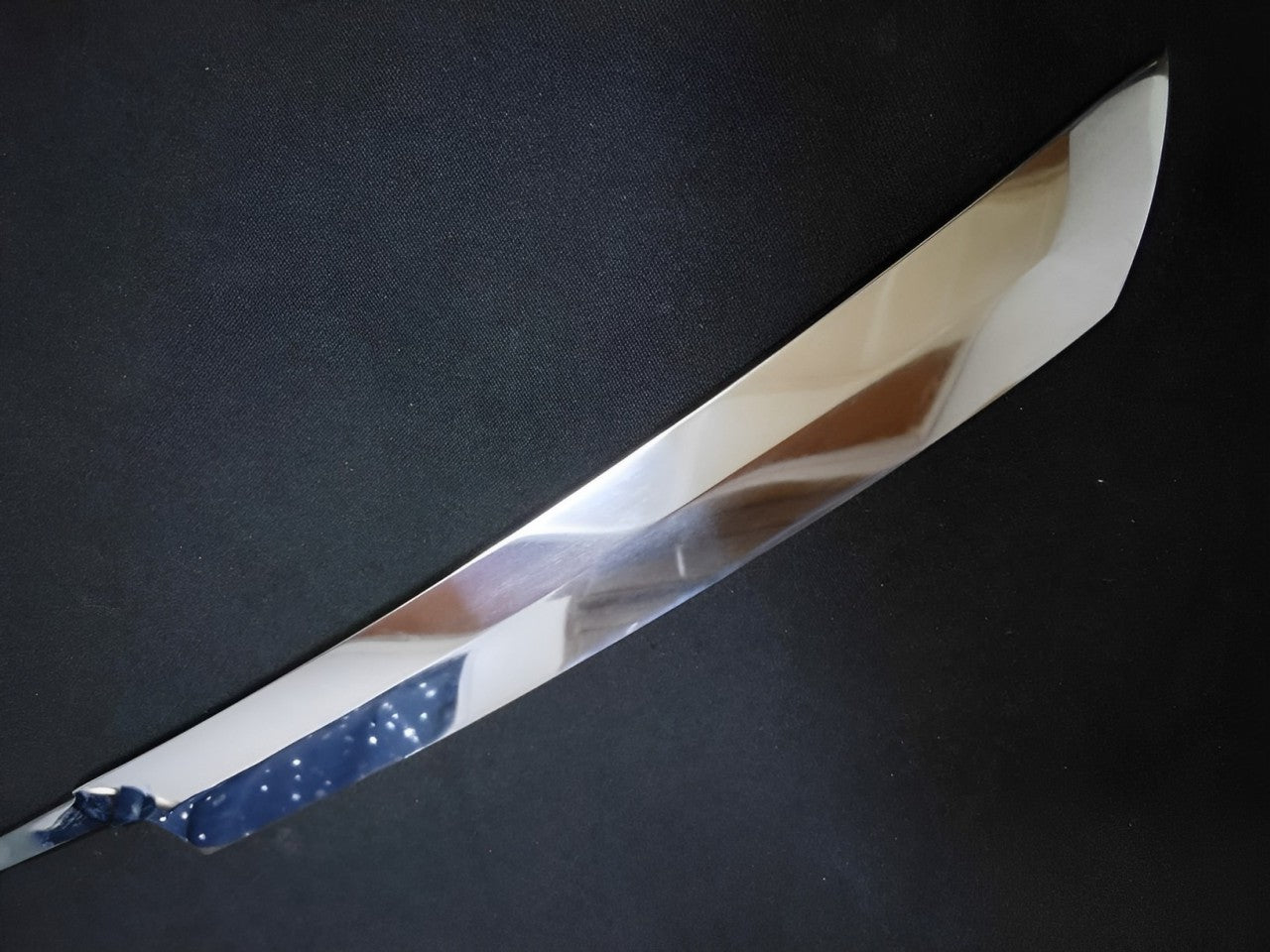
Yanagiba (Sakimaru)
A sashimi knife with a graceful curved tip, combining elegance and precision. Originating in Kansai, its katana-like profile is valued for both performance and presentation, enhancing the visual artistry of sashimi preparation.

Yanagiba (Kiritsuke)
A hybrid knife blending sashimi precision with Kiritsuke versatility. Its wider, thicker blade handles sashimi slicing and various kitchen tasks, appealing to chefs who want both elegance and multi-functionality in one blade.


