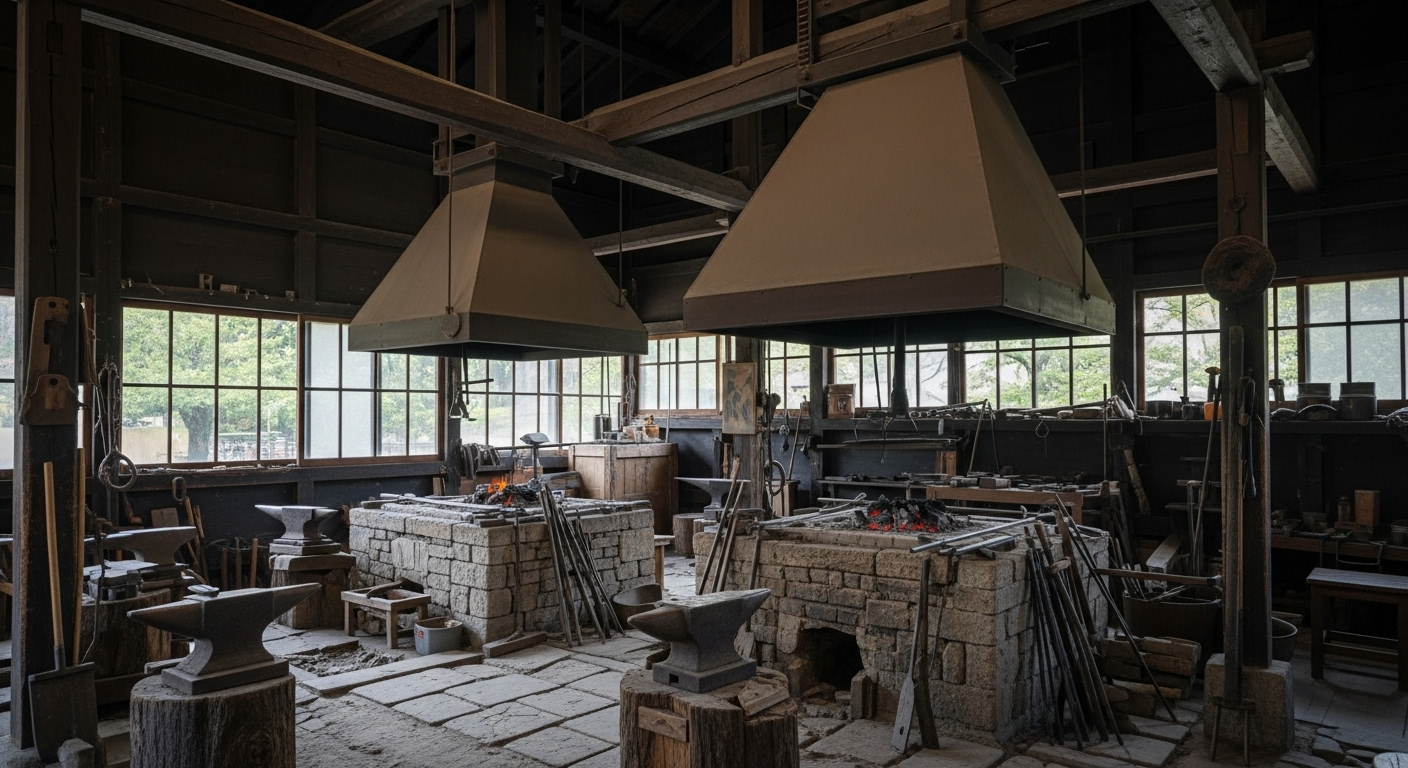
What Fire and Hammer Actually Do to Steel
-
July, 20 2026
-
There is a word in Japanese — kitaeru — that means both to forge metal and to train the body or mind through disciplined practice. The same word. The same idea.
This is not coincidence. The people who named the process understood something that is easy to miss when you look at a finished knife: that what happens to steel under the hammer is not simply shaping. It is transformation. The steel that emerges from forging is not the same steel that entered the fire. It has been changed at a level that no cutting or grinding or machining can replicate, because the change happened inside.
-
What the Hammer Actually Does
When a smith heats steel and strikes it, the visible result is a change of form — the metal flattens, spreads, takes on the shape the smith is working toward. This is what most people imagine when they think of forging.
But the more significant thing is happening where you cannot see it.
Steel, at a microscopic level, is not solid in the way it appears. It has structure — grain, crystalline organization, and within that structure, voids. Tiny gaps, invisible to the naked eye, distributed through the material. These voids are sites of potential weakness: places where, under stress, the steel can fail.
The hammer closes them. Each strike compresses the material, pushes the structure together, eliminates the spaces between. The Japanese smith's expression for this — hagane ga shimaru, the steel tightens — describes something real and precise. The density of the metal increases. The grain refines. What was distributed becomes concentrated. The steel that results is more resilient under impact, more consistent in its behavior, more capable of holding an edge through the repeated stress of daily use.
This is why forged tools have been chosen, across cultures and centuries, for work that demands toughness. The Japanese sword. The woodworker's chisel. The heavy deba for breaking down fish. The hammer closes what the raw material left open, and in doing so produces something that the raw material, however good, could not become on its own.
-
The Precision That Looks Like Power
From a distance, forging looks like force. A smith at a hammer, striking heated metal, shaping it by repeated blows. The impression is of power applied until the metal yields.
This impression misses what is actually happening.
A master smith forging a knife blade is working toward tolerances of less than a millimeter — not despite the violence of the process, but through it. Every strike is a calculation. The smith is reading the steel constantly: its color as it cools, which tells them the temperature and therefore what the metal will do; its resistance under the hammer, which tells them where the density is still uneven; the way it moves, which tells them whether what they are doing is working with the material or against it.
The goal of this precision is not aesthetics. It is physics. When the blade reaches the heat treatment stage — when it is heated to a critical temperature and then quenched, rapidly cooled to lock in its hardness — the steel must be as uniform as possible. Variations in thickness mean variations in how heat moves through the blade during quenching. Variations in how heat moves mean variations in the rate of transformation happening inside the steel. Variations in transformation rate mean differential stress — and differential stress means warping, the subtle distortion that ruins an edge geometry that can take a craftsperson hours to establish.
The smith who can forge a blade to near-perfect uniformity before it reaches the quench is not demonstrating skill for its own sake. They are laying the foundation for everything that follows — the heat treatment, the grinding, the sharpening — to work correctly. The precision of the forging is what makes the precision of the finished knife possible.
-
-
The Conversation With the Metal
There is a third dimension to forging that is harder to describe than density or precision, but that experienced smiths describe consistently, in their own words, when they talk about their work.
Steel remembers.
This is not mysticism. It is a practical observation about material behavior. Steel that has been stressed — worked against its nature, forced into a shape it resists — carries that stress. It may hold the form for years. But given time, given the repeated thermal cycles of daily cooking and the stress of repeated use, it may begin to return toward the state the force imposed. Subtle warping. A blade that was true when it left the workshop, no longer true years later.
The smith who understands this does not simply impose form on steel. They work with it — reading the material's response to each strike, sensing where it is moving easily and where it is resisting, adjusting the sequence and placement of blows to allow the steel to take the shape without being forced against itself.
This is what experienced smiths mean when they speak of a dialogue with the metal. Not metaphor. A practical description of a process in which the material's behavior at every moment carries information, and the smith who can read that information can produce a blade that is stable — not just at the moment it leaves the workshop, but across decades of use — because the form was arrived at with the steel, not imposed upon it.
-
-
What This Means for the Knife You Hold
Every knife made in Sakai through traditional hand-forging carries all three of these things: the increased density of steel that has been consolidated under the hammer, the geometric precision of a smith who worked to tolerances that determined how the heat treatment would behave, and the stability of steel that was shaped in dialogue with its own nature rather than forced against it.
These qualities are not visible in the finished knife. They cannot be seen or measured by the person who holds it. They make themselves known over time — in the way the edge holds, in the consistency of the knife's behavior across years of use, in the fact that a blade made this way at Shiroyama Knife Workshop will still be performing correctly three decades from now if it is maintained with the care it was made with.
This is the investment that forging represents — not in the cost of the knife, but in the time and knowledge that went into the steel before anyone touched a whetstone. The sharpener who brings the blade to its final edge is working with material that has already been prepared for that edge to be exceptional. The grinding, the polishing, the final sharpening — all of it rests on what the forge established.
When you cut with a forged knife from Sakai, you are cutting with steel that has been transformed — not just shaped, but fundamentally changed by the application of fire, force, and the accumulated judgment of someone who has spent their working life learning to read what metal requires.
That transformation is invisible. It is present in every cut.
The Making of Japanese Knives
For over six centuries, Sakai’s artisans have transformed raw steel into blades of extraordinary sharpness and beauty. From forging and heat treatment to sharpening and handle fitting, each step carries the spirit of tradition—revealing why Japanese knives are trusted by chefs around the world.
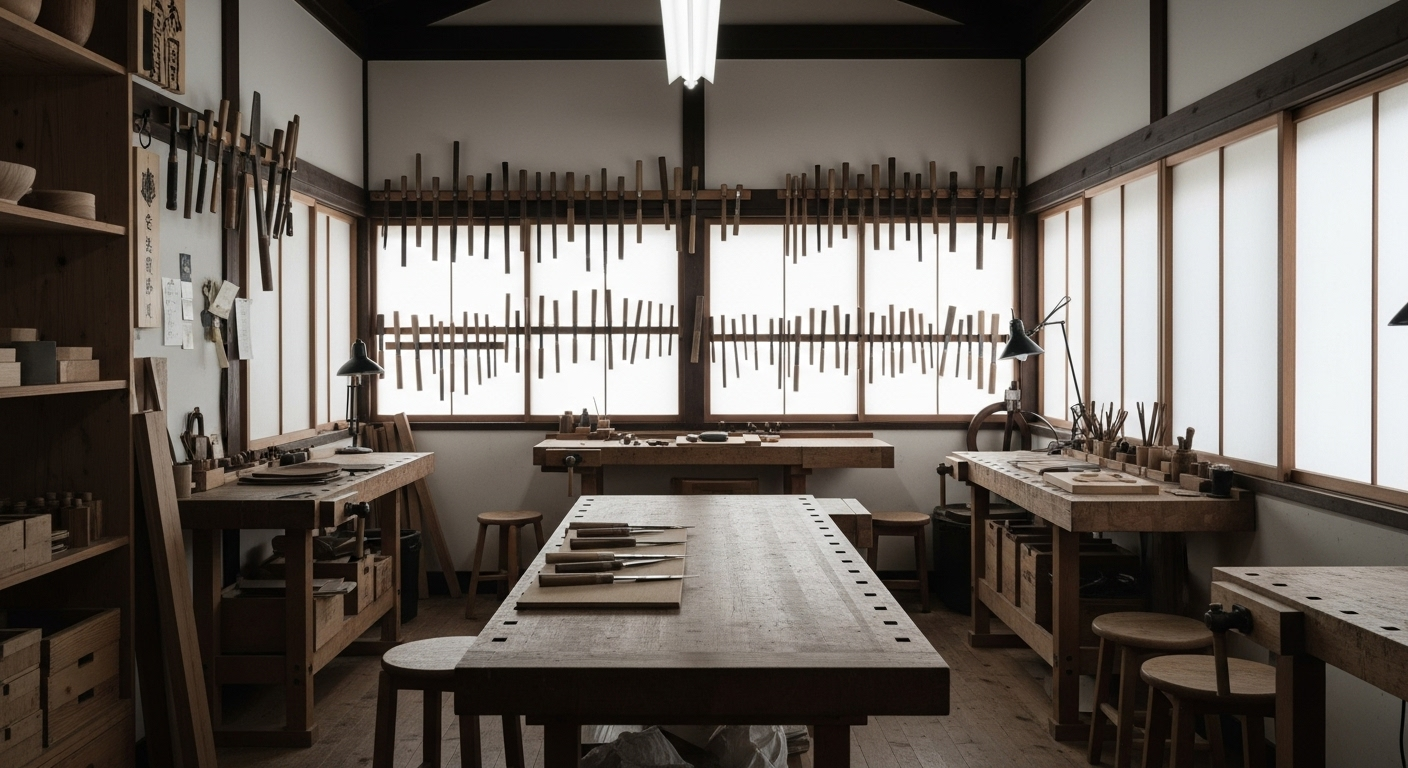
The Soul of Craftsmanship
-
The Moment the Wind Passes Through the Heart
Working as a traditional craftsman of Japanese knives is like gazing into a mirror that reflects the truest self. In the relentless pursuit of perfection, I once struggled to forgive my own shortcomings and failures. But over time, I realized something profound: accepting even the flawed parts of myself is essential to the journey.
-
The tiny scratches on a blade, the subtle irregularities in sharpening—facing them honestly, correcting when possible, and sometimes leaving them as they are—taught me an invaluable lesson. Within these imperfections, I began to feel a quiet wind passing through my heart.
-
Weaknesses and mistakes are not stains to be hidden. They are part of a craftsman’s character. Just as a knife does not need to be flawless to serve, a person does not need to be perfect to shine. It is individuality—the small imperfections—that allow a tool to fit seamlessly into someone’s hand, or resonate deeply in someone’s heart.
-
The day I finally told myself, “It’s okay to just be me,” the tension lifted, and a new sense of flow entered my work.
To all who read this, be gentle with yourselves. Let the wind pass through your heart, and you may discover something quietly beautiful—in both life and in craft.
Experience the sharpness trusted by professional chefs across Japan — handcrafted in Sakai City
Through our exclusive partnership with Shiroyama Knife Workshop, we deliver artisan-crafted Sakai knives worldwide. Each knife comes with free Honbazuke sharpening and a hand-crafted magnolia saya. Optional after-sales support is also available to help you care for your knife with lasting confidence.
KIREAJI's Three Promises to You
-
1. Forged in the Legacy of Sakai
From Sakai City—Japan’s renowned birthplace of professional kitchen knives—each blade is crafted by master artisans with over six centuries of tradition. Perfectly balanced, enduringly sharp, and exquisitely finished, every cut carries the soul of true craftsmanship.
-
2. Thoughtful Care for Everyday Use
Every knife includes a hand-fitted magnolia saya for safe storage. Upon request, we offer a complimentary Honbazuke final hand sharpening—giving you a precise, ready-to-use edge from day one.
-
3. A Partnership for a Lifetime
A KIREAJI knife is more than a tool—it is a lifelong companion. With our bespoke paid aftercare services, we preserve its edge and beauty, ensuring it remains as precise and dependable as the day it first met your hand.