How Long Should Your Yanagiba Be? The Answer Will Surprise You.
-
May 11, 2026
-
A Professional's Journey From 210mm to 270mm — and What Changed Along the Way
When a knife instructor with years of professional kitchen experience tells you that the length of your yanagiba is more important than the steel it is made from, or the sharpness it is honed to, it is worth stopping to understand why.
This is not a dramatic claim. It is a practical one — rooted in the physics of how a long pulling knife actually works, and in the specific failures that happen when the blade is too short for the task it is being asked to perform.
The recommended length, from professionals who have worked through this question in actual kitchen conditions: 270mm, or 9 sun in traditional Japanese measurement. Not as a rigid rule, but as the length at which the yanagiba begins to fully deliver what it was designed to deliver.
Here is how that conclusion was reached, and why it matters for anyone who uses — or is considering — a sashimi knife.
-
Starting at 210mm: What You Notice First
The starting point for many practitioners is a 210mm yanagiba. It is a manageable length, less intimidating than longer blades, and genuinely functional. A saku of tuna can be sliced on it. Fish can be broken down. The knife does what a yanagiba is supposed to do — in the most basic sense of the words.
But the kitchen tells you things that specifications do not. Over time, across many services, across many different cuts and different types of fish and different presentations, a picture develops. The 210mm blade works. But it does not always work in the way a yanagiba is supposed to work. And the difference, once noticed, is impossible to unsee.
-
The Single-Stroke Principle: Why Length Is Not About Reach
To understand why length matters so much, you need to understand what the yanagiba's pulling cut is actually trying to achieve — not just mechanically, but in terms of what it does to the ingredient.
The ideal cut in sashimi preparation is a single uninterrupted stroke. The blade enters the fish at the beginning of the stroke and exits at the end, without stopping, without reversing direction, without lifting and repositioning. One motion, beginning to end.
This matters because every interruption in a pulling stroke is a point of potential compression. When the blade stops mid-cut and reverses, or when a shorter blade runs out of length before the cut is complete and must be repositioned, the ingredient at that point experiences a change in the force being applied to it. The lateral motion that was separating cells cleanly is interrupted. Pressure that the pulling cut was designed to avoid is momentarily applied. The result is visible in the cut face: a slight step, a ridge, an irregularity that marks where the stroke was interrupted.
On a piece of fish that will be presented as sashimi — where the cut face is part of what is being eaten, where the visual clarity and textural integrity of each piece directly affects the experience at the table — this matters. Not catastrophically, not as a disaster, but as the difference between work that is correct and work that is excellent.
A 270mm blade, for most sashimi work with typical fish portions, allows the stroke to complete without interruption. The blade enters, travels the full length of the cut, and exits. One motion. The cell separation that the pulling cut is designed to produce happens consistently, across the full length of the cut face.
-
Force, Cells, and the Flavor Connection
There is a second dimension to the length question that goes beyond the mechanical: what happens when the blade is too short and the cook compensates with force.
A short blade that cannot complete its cut in a single stroke naturally prompts the cook to apply additional downward pressure — to drive the blade through the remaining material rather than drawing it through. This is not a technique failure. It is a physical response to a tool that is not the right size for the task.
But downward pressure is exactly what the pulling cut is designed to avoid. As explored elsewhere in this series, the pulling cut works by shifting the dominant force from vertical — which compresses cells before separating them — to horizontal — which separates cells by moving parallel to their structure. The moment significant downward force is added, the physics of the cut change. The cellular compression that produces drip, that releases bitter compounds, that damages the textural integrity of the flesh — the compression that the pulling cut was designed to prevent — begins to occur.
The connection between blade length and food flavor is real, and it works through this mechanism. A blade that is long enough to complete its stroke without additional downward force produces a cut face that is genuinely different from a blade that required force to finish. The difference is visible in the flesh. It is also detectable on the palate — in the texture of the fish, in the clarity of its flavor, in the absence of the metallic or watery quality that cellular damage introduces.
-
The Sogigiri Question: Why Diagonal Cuts Change Everything
There is a practical dimension of length that becomes apparent only in certain types of work: the diagonal cut, or sogigiri.
A straight cut across a saku of tuna — pulling the blade through a rectangular block of fish in a perpendicular direction — requires a stroke length roughly equal to the width of the fish. For a standard saku, 240mm can manage this reasonably well, though the margin is narrow.
A sogigiri — cutting at an angle to produce the broader, thinner slices used for certain sushi toppings and specific presentations — requires a considerably longer stroke for the same piece of fish. The blade is traveling diagonally across a longer path through the material. The effective length of cut is greater than the simple width of the fish.
For diagonal cuts on standard-sized fish portions, 270mm provides the margin that 240mm does not. The difference between having enough blade and needing to reposition mid-cut is the difference between a presentation that looks intentional and one that shows the limitation of the tool.
This is why the recommendation reaches beyond 240mm to 270mm: not because 240mm fails at the basic task, but because 270mm handles the full range of cuts that sashimi preparation actually involves, without the compromises that a shorter blade requires.
-
How to Measure Your Yanagiba Correctly
A practical note that prevents confusion when comparing blade lengths: the yanagiba is measured differently from most knives.
Most kitchen knives are measured from the heel — the rearmost point of the blade — to the tip. The yanagiba has a machi: a gap or step between the blade and the handle, where the blade transitions to the tang that fits into the handle. This machi is not part of the cutting surface.
The correct measurement for a yanagiba is from the machi to the tip — the actual usable blade length, not including the machi itself. A knife described as 270mm should have 270mm of usable blade from the machi forward. If you are comparing knives or assessing what you currently have, measure from the machi, not from the handle.
This matters when purchasing, because some descriptions and listings are not consistent about this point, and a knife described as a certain length may have a different usable blade length depending on how the measurement was taken.
-
The Concerns About Length: Real, But Manageable
The objections to longer blades are real and deserve an honest response.
In a home kitchen, a 270mm yanagiba is a substantial piece of equipment. The counter space required for the pulling motion — drawing the blade toward the body through a full stroke — is not trivial. In a compact kitchen, this can feel genuinely limiting.
The practical answer is that the pulling motion of a yanagiba, unlike the rocking motion of a Western chef's knife, is linear in a single direction. It requires clear space in one direction only. A 270mm blade in a kitchen that has 400mm of clear space in the drawing direction is entirely workable. The same blade in a kitchen where the stroke is limited to 200mm is not.
Skin removal — pulling the skin from a fish fillet — is sometimes cited as more challenging with a longer blade. This is accurate, particularly in the early stages of developing technique. The longer blade requires a degree of control that a shorter blade does not, and skin work involves a specific motion that takes time to develop. But this is a technique issue rather than a fundamental limitation. With practice, the longer blade's additional leverage and surface contact become advantages rather than obstacles.
The consistent recommendation from experienced practitioners: if you are going to invest in a yanagiba, invest in 270mm. The extra length will feel challenging in the first weeks. It will feel necessary within a few months. And in the cuts that reveal what a yanagiba can actually do — the long diagonal slices, the presentations that require a full stroke — it will show you things that a shorter blade cannot.
-
The Practical Path
Start with the length you will actually use. If your kitchen genuinely cannot accommodate a 270mm blade's pulling motion, or if you are cooking alone at home for two people and rarely prepare whole fish, 240mm is a reasonable starting point that still delivers the essential character of the yanagiba's cut.
But if you are approaching sashimi preparation seriously — if you want to understand what this knife actually does and why Japanese cuisine developed around it — 270mm is where that understanding begins. The knife that can complete its cut without compromise, in a single stroke, without additional force, at any angle the preparation requires, is the knife that shows you what the pulling cut is actually for.
The journey from 210mm to 270mm, for one practitioner, was the journey from a knife that works to a knife that reveals. The conclusion, reached through practical experience rather than specification: the length is not a detail. It is the point.
Yanagiba
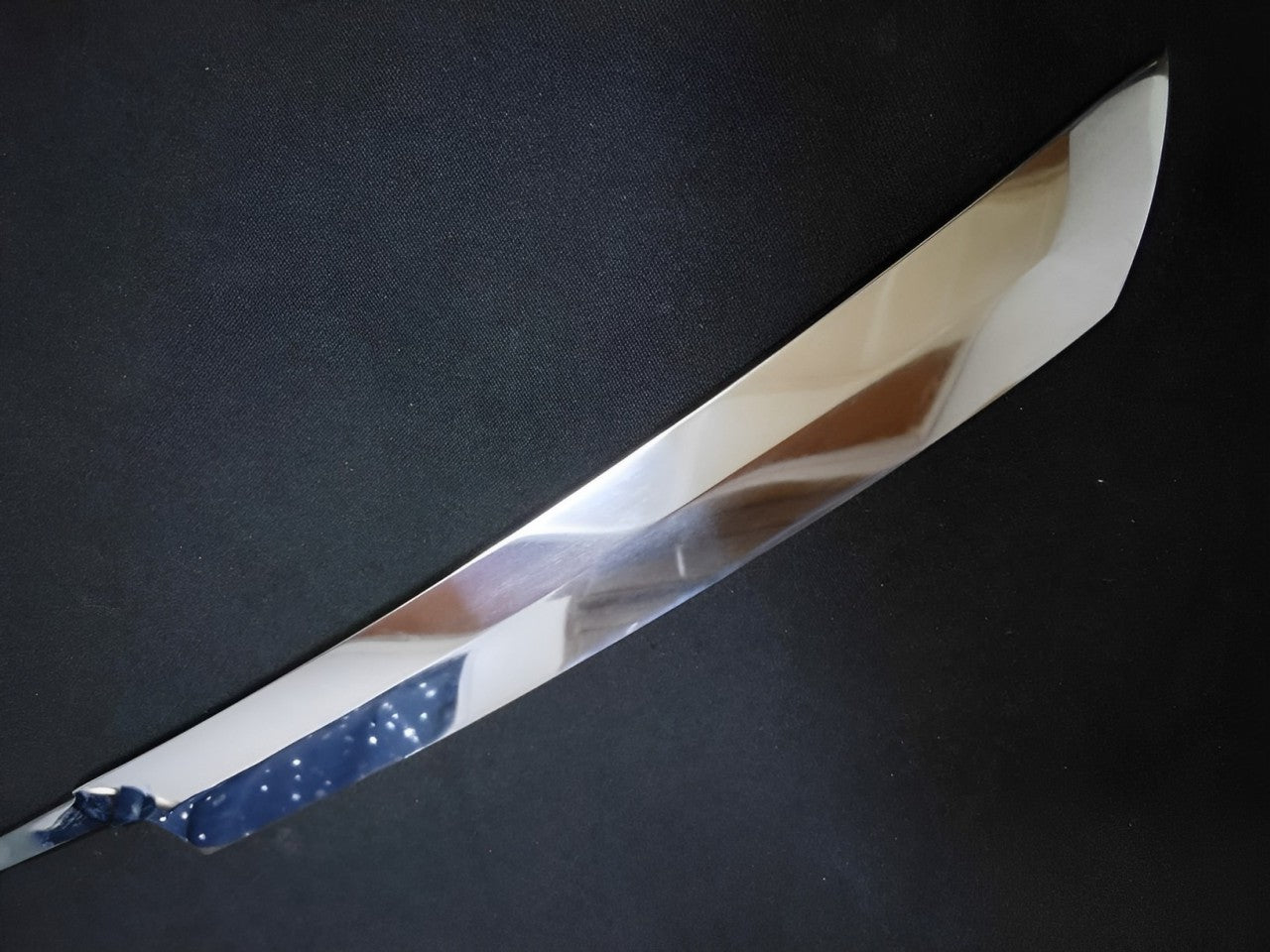
A traditional Japanese sashimi knife with a long, slender blade, designed for smooth single-stroke slicing. It preserves the delicate texture and natural flavor of raw fish, making it essential for authentic sashimi preparation.
Yanagiba (Sakimaru)
A sashimi knife with a graceful curved tip, combining elegance and precision. Originating in Kansai, its katana-like profile is valued for both performance and presentation, enhancing the visual artistry of sashimi preparation.
Yanagiba (Kiritsuke)
A hybrid knife blending sashimi precision with Kiritsuke versatility. Its wider, thicker blade handles sashimi slicing and various kitchen tasks, appealing to chefs who want both elegance and multi-functionality in one blade.
The Soul of Craftsmanship
-
Embracing Tradition and Growing Through Questions
The desire to know is always alive in the heart of a craftsman. As we hone our skills, create tools, and refine techniques, it is essential never to stop asking questions. Each time we wonder what to learn or how to move forward, that curiosity becomes the key to taking the next step.
In craftsmanship, the answers do not come from theory alone. They appear in tangible forms—shaped into the very tools we create. It is as if the experiences and wisdom we accumulate over time flow naturally into the steel, guiding us toward the future. -
The answers to our questions may not always arrive in clear words. Yet, in the things we see and feel each day, wisdom quietly reveals itself. This process nourishes our craft, deepens our understanding, and lights the path toward the next challenge, the next creation.
Experience the sharpness trusted by professional chefs across Japan — handcrafted in Sakai City
Through our exclusive partnership with Shiroyama Knife Workshop, we deliver artisan-crafted Sakai knives worldwide. Each knife comes with free Honbazuke sharpening and a hand-crafted magnolia saya. Optional after-sales support is also available to help you care for your knife with lasting confidence.
KIREAJI's Three Promises to You
-
1. Forged in the Legacy of Sakai
From Sakai City—Japan’s renowned birthplace of professional kitchen knives—each blade is crafted by master artisans with over six centuries of tradition. Perfectly balanced, enduringly sharp, and exquisitely finished, every cut carries the soul of true craftsmanship.
-
2. Thoughtful Care for Everyday Use
Every knife includes a hand-fitted magnolia saya for safe storage. Upon request, we offer a complimentary Honbazuke final hand sharpening—giving you a precise, ready-to-use edge from day one.
-
3. A Partnership for a Lifetime
A KIREAJI knife is more than a tool—it is a lifelong companion. With our bespoke paid aftercare services, we preserve its edge and beauty, ensuring it remains as precise and dependable as the day it first met your hand.